Italian M 1891 Knife Bayonet, Adapted for Enfield

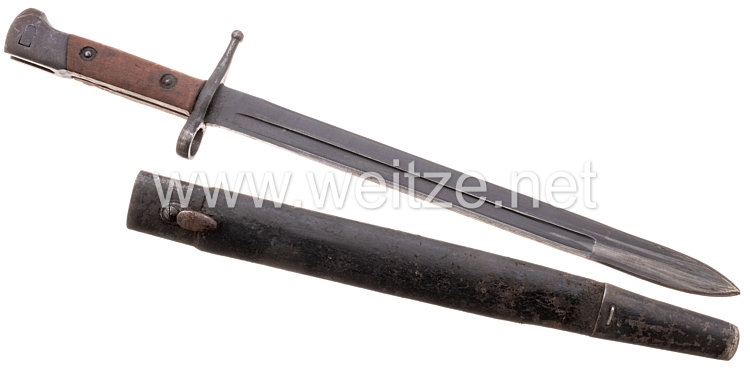
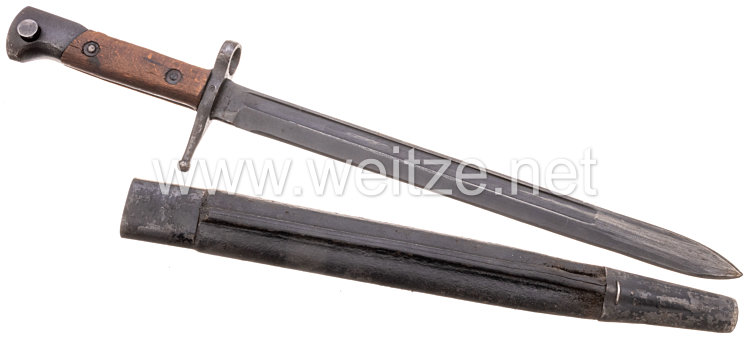
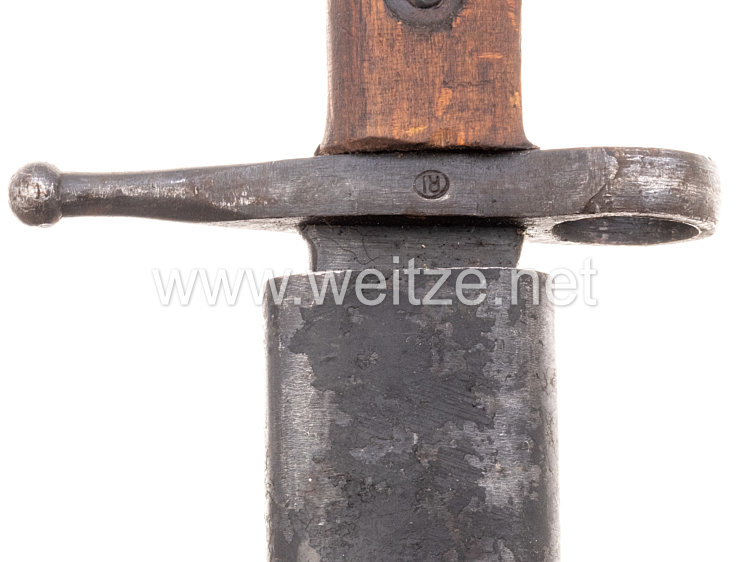
Blade with traces of bluing, without maker's mark, steel hilt with riveted wood grip scales, new pommel piece fitted, slightly shrunk black leather scabbard of P07 type, shortened and fitted with Italian steel muzzle ring, a rare variant in very good condition. Condition 2-
443614
450,00

Italian M 1891 Knife Bayonet, Adapted for Enfield

The Italian knife bayonet Model 1891 represents one of the most enduring and widely distributed side arms in modern military history. Originally developed for the Carcano rifle M1891, this bayonet was used by the Italian army for several decades and underwent numerous modifications and adaptations.

The development of the M1891 bayonet occurred as part of the comprehensive modernization of Italian armed forces toward the end of the 19th century. The Carcano system, named after weapons designer Salvatore Carcano, was intended to equip Italy with a modern repeating rifle that met contemporary European standards. The accompanying bayonet followed the contemporary trend toward slender, knife-bayonet-type blades that could serve both as weapons and tools.

The present specimen represents a particularly interesting historical anomaly: an adaptation to British Enfield rifles. Such conversions were not uncommon during and after the two World Wars, when military equipment was frequently improvised, retrofitted, or adapted to available weapons. The reasons for such modifications were diverse, ranging from captured weapons and military aid programs to post-war use in various conflicts.

The technical characteristics of the M1891 bayonet were typical of its era. The blade, originally provided with bluing, was meant to be protected against corrosion. The steel mounting with riveted wooden grip scales corresponded to the robust construction method of Italian military equipment. The typical blade length was approximately 300 mm, with the entire bayonet reaching a length of about 445 mm.

The adaptation present here shows several significant modifications. The newly attached pommel piece indicates a reworking that was necessary to adapt the bayonet, originally designed for the Carcano rifle, to the British Enfield system. Enfield rifles, particularly the widely distributed Lee-Enfield in its various variants, had a different attachment system than Italian Carcano rifles.

Particularly noteworthy is the scabbard, which represents a combination of different traditions. The shortened black leather scabbard of type P07 refers to German military material. The Model 1907 was the standard scabbard for various German side arms and was produced in large quantities. The combination with an Italian steel throat piece demonstrates the pragmatic approach to reusing military equipment.

Such hybrid pieces frequently originated in the post-war period or in areas with mixed military stocks. After World War I and especially after World War II, European armories were filled with material of the most diverse origins. In Italy itself, but also in former colonial territories, among partisan units, or in newly formed armed forces, available material was often creatively combined.

Italian military history of the 20th century offers numerous contexts in which such adaptations could have originated. During the Abyssinian War (1935-1936), in the Spanish Civil War (1936-1939), during World War II on various theaters of war from North Africa to the Balkans, or in the chaotic period between 1943 and 1945, when Italy was torn between German occupation, Allied liberation, and civil war situation.

After 1945, Italian weapons and bayonets were exported to various countries or delivered as military aid. At the same time, British Enfield rifles were distributed on a large scale to allied nations. The combination of both systems could therefore have originated in various geopolitical contexts of the Cold War.

From a collector's perspective, this piece represents a rare variant that documents the complex history of military equipment in the 20th century. While standard M1891 bayonets are relatively common, modified specimens show the practical military history beyond official regulations and production lists. They are testimonies of actual use, improvisation, and the often chaotic reality of military supply.

The preservation of such historical objects is of significant scientific value, as they offer authentic insights into the material culture of the military and document the often forgotten aspects of weapons history.