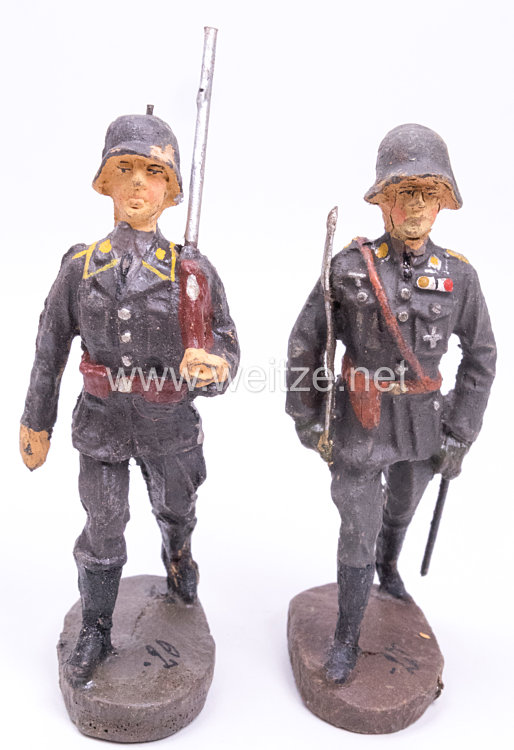
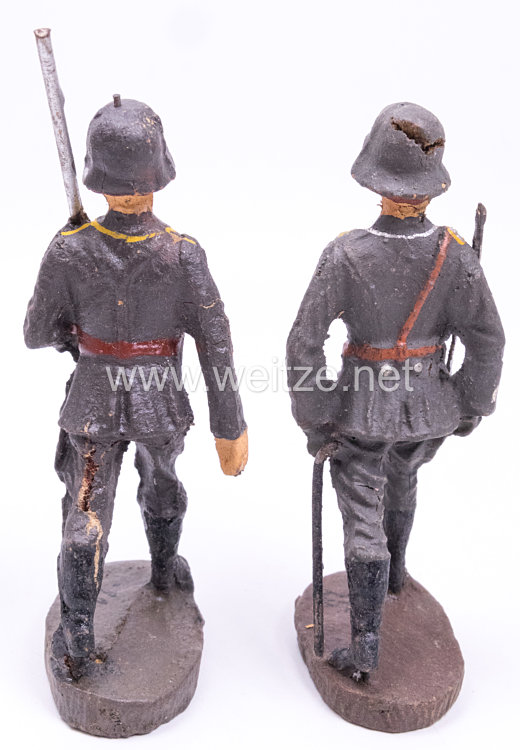
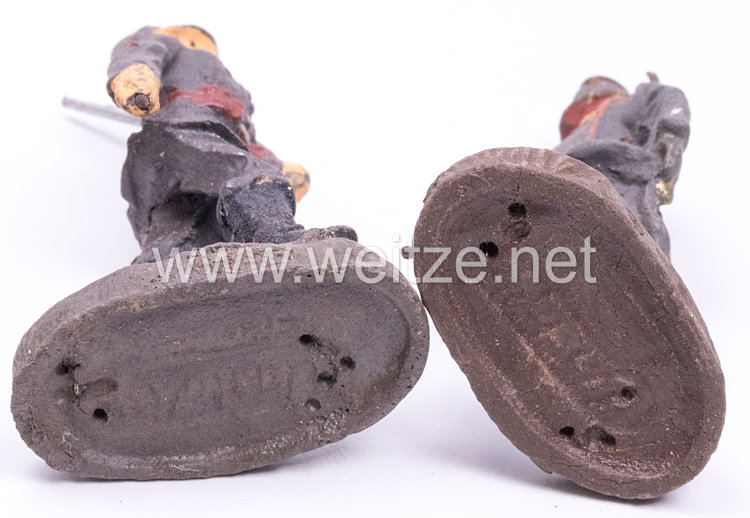
Elastolin - Luftwaffe Aviation Officer and Soldier Marching with Rifle and Steel Helmet

7.5 cm, still with original price of 20 Rpf, Condition 2.
324814
50,00

Elastolin - Luftwaffe Aviation Officer and Soldier Marching with Rifle and Steel Helmet

This Elastolin figure depicting an officer and soldier of the Luftwaffe Fliegertruppe represents a fascinating example of German toy manufacturing during the Third Reich era. Standing 7.5 cm tall with an original retail price of 20 Reichspfennig, this object documents not only military-historical aspects but also the everyday culture and propaganda efforts of the National Socialist period.

The Elastolin company was founded by the Hausser family in Ludwigsburg and developed into one of Germany's leading manufacturers of composition figures. The name “Elastolin” refers to the material used, an elastic compound of casein, chalk, glycerin, and other additives applied to wire armatures. This technique enabled the production of detailed yet durable toy figures that enjoyed great popularity.

The Luftwaffe was officially established on February 26, 1935, after the German Reich cast off the military restrictions of the Treaty of Versailles. Under the leadership of Hermann Göring, the Luftwaffe rapidly developed into the most modern air force of its time. The Fliegertruppe formed the core of this military branch and included fighter, bomber, and reconnaissance units.

The Luftwaffe's uniforms differed markedly from those of other Wehrmacht branches. The characteristic blue-gray color was unique and intended to underscore the technological modernity of this service branch. The Model 35 steel helmet mentioned in the figure description was standard headgear for ground personnel and anti-aircraft soldiers. Flying personnel wore special flight caps instead.

The price of 20 Reichspfennig places this figure in the category of affordable mass-produced goods. For comparison: an industrial worker earned an average of 30-35 Reichsmarks per week in the 1930s. Such toy figures were therefore affordable for broad segments of the population and were deliberately used as instruments for the militarization of youth.

The depiction of marching soldiers with rifles corresponded to the military ideal of the era. The Karabiner 98k, the Wehrmacht's standard weapon, was frequently reproduced in such miniatures. The marching posture symbolized discipline, order, and military strength – values that the Nazi regime intensively propagated.

Elastolin figures were produced in large series and encompassed the entire spectrum of the Wehrmacht as well as political and paramilitary organizations. Besides individual soldiers, vehicles, artillery pieces, and even complete dioramas were offered. The company supplied not only the civilian market but also received contracts for training purposes and propaganda exhibitions.

After World War II, production of military figures had to be discontinued. The Hausser company switched to civilian themes but could never again match its earlier success. Today, original Elastolin figures from the Nazi era are sought-after collectibles that are documented both from military-historical and cultural-historical perspectives.

Condition 2 in the object description corresponds in collector terminology to very good to good preservation with minimal signs of use. This is remarkable for objects made from a material susceptible to temperature fluctuations and moisture.

From today's scholarly perspective, such objects are important sources for researching Nazi propaganda and everyday culture in the Third Reich. They document how military values were imparted from childhood and how the toy industry was integrated into ideological education. Museums and research institutions preserve such objects as witnesses to a dark period of German history.

r