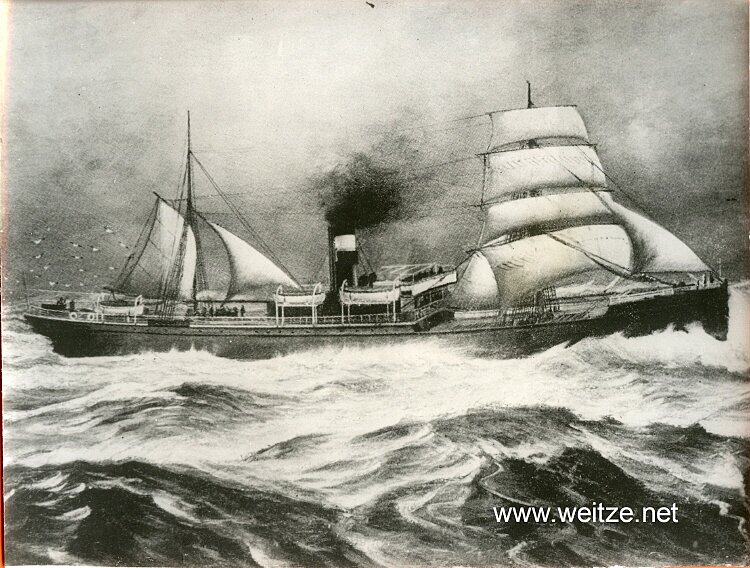
Press Photograph "50 Years of German-Australian Steamship Company"
Historical Context: Press Photographs of the German-Australian Steamship Company
The Deutsch-Australische Dampfschiffs-Gesellschaft (DADG), or German-Australian Steamship Company, was one of the most significant German shipping lines that maintained maritime traffic between Europe and Australia during the late 19th and early 20th centuries. This press photograph commemorating the company's 50th anniversary documents an important milestone in the history of this enterprise and reflects the maritime and economic significance of German shipping companies during the colonial era.
The DADG was founded in 1888 in Hamburg and rapidly developed into a leading force in Australian trade. The company operated regular routes between German ports and Australian cities such as Sydney, Melbourne, and Brisbane. During a time when steamships were increasingly replacing traditional sailing vessels, the DADG symbolized technological progress and the global reach of the German Empire.
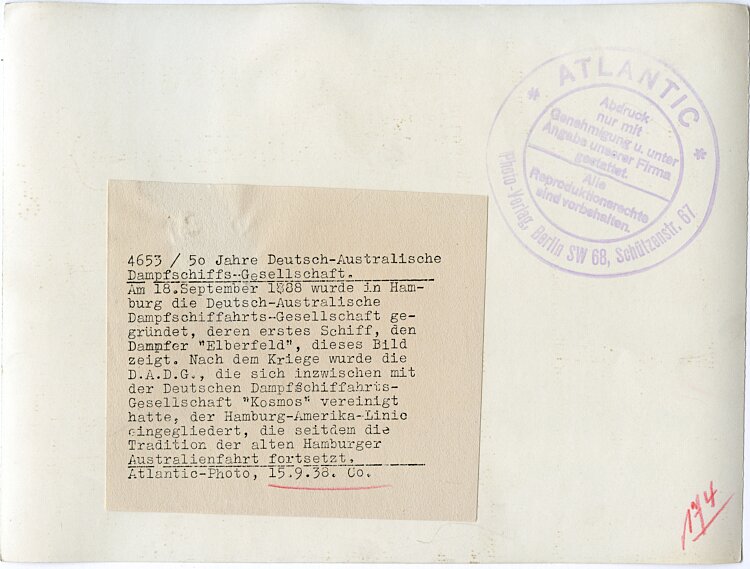
Press photographs like this example were important instruments of corporate communication and public relations in the early 20th century. Anniversary celebrations were carefully documented, and images were distributed to newspapers and trade publications. The text on the reverse side, as present in this specimen, was customary and typically contained information about the depicted event, the date, and sometimes instructions for publication.
The 50th anniversary of the DADG would therefore have been celebrated around 1938 – a time of great political and economic upheaval in Germany. The National Socialists had already seized power, and German merchant shipping was under increasing political pressure. Many shipping companies had to adapt or restrict their international operations.
The history of German steamship traffic to Australia is closely linked with German colonial policy in the Pacific. Germany maintained colonies in German New Guinea, Samoa, and other Pacific territories that required regular shipping connections. The DADG played a key role in supplying these territories and transporting people and goods.
The ships of the DADG were modern for their time and offered both passenger and freight services. They transported emigrants to Australia, brought wool and other Australian raw materials to Europe, and supplied the German colonies in the Pacific. The voyages lasted several weeks and often included stopovers in Africa or Asia.
With the outbreak of World War I in 1914, German merchant shipping suffered a severe setback. Many ships were confiscated, sunk, or had to be interned in neutral ports. The DADG lost a large portion of its fleet, and the German colonies in the Pacific were occupied by Allied troops.
After the war, German shipping attempted to reestablish itself, but the conditions of the Treaty of Versailles and the loss of the colonies made this considerably difficult. Nevertheless, new ships were built in the 1920s and routes were resumed, albeit on a reduced scale.
The use of press photographs during this era reflects the growing importance of visual mass communication. Photographs became an important medium for documenting corporate history and generating public interest. The professional quality of such images and their systematic distribution to media representatives expressed modern marketing strategies.
The format of 22 x 16.5 cm corresponds to the standard sizes for press photographs common at the time, optimized for reproduction in newspapers and magazines. The text on the reverse served not only for identification but also as captions for editors.
With the beginning of World War II in 1939, commercial shipping between Germany and Australia ended definitively. The remaining ships were requisitioned for military purposes or fell victim to the naval war. After 1945, German merchant shipping was reorganized under Allied control, but the old connections to Australia were never restored to the same extent.
Such historical press photographs are today valuable documents of economic and maritime history. They offer insights into corporate culture, maritime technology, and the international trade relations of their time, and are important sources for historians and collectors alike.