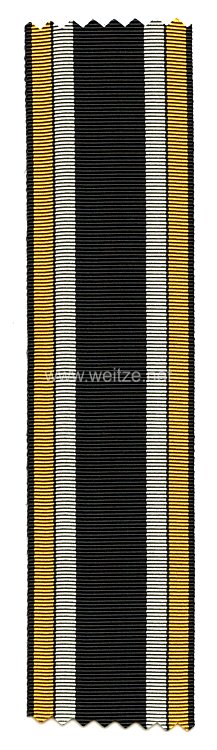
New Ribbon Prussia Commemorative Cross Königgrätz, Main-Armee, Den Treuen Kriegern, 1866
Shipping as letter 1€ postage possible.
International shipping at your own risk as a letter 2.50€ postage possible.
The Commemorative Cross for the Main Army 1866 represents a significant piece of military-historical evidence from the time of the German War, which fundamentally changed the political map of Central Europe. This decoration was instituted by the Kingdom of Prussia to honor the participants in the Battle of Königgrätz and the entire campaign against Austria.
The German War of 1866, also known as the Austro-Prussian War, was a decisive conflict for supremacy in the German territories. Prussia, under the leadership of Minister President Otto von Bismarck and King Wilhelm I, sought to reorganize the German Confederation under Prussian leadership, while Austria attempted to defend its traditional predominance. The war lasted only seven weeks and ended with Prussia's overwhelming victory.
The Battle of Königgrätz (also called the Battle of Sadowa) on July 3, 1866, was the decisive battle of this war. With approximately 440,000 soldiers involved, it was one of the largest battles of the 19th century. The Prussian army under Field Marshal Helmuth von Moltke decisively defeated the Austrian Northern Army under Feldzeugmeister Ludwig von Benedek. The victory was largely due to superior Prussian military organization, the use of the railway network for troop deployment, and equipment with the modern needle gun.
The commemorative cross bears the inscription “Den Treuen Kriegern” (To the Faithful Warriors), expressing recognition for the loyalty and bravery demonstrated during the campaign. The designation “Main Army” refers to one of the three Prussian armies deployed in the 1866 campaign. The Main Army, under the command of General Edwin von Manteuffel, operated against the South German allies of Austria, particularly against the Kingdom of Bavaria and other medium-sized states organized in the 8th Federal Corps.
The military operations of the Main Army took place primarily in Franconia, Thuringia, and Hesse. Significant engagements included the battles at Dermbach, Kissingen, Hammelburg, and Tauberbischofsheim. The Main Army fulfilled its strategic task of tying down South German troops and preventing their junction with the main Austrian army. After the victory at Königgrätz, the Main Army advanced into South Germany and contributed to the complete suppression of resistance.
The present ribbon for the commemorative cross was manufactured subsequently, as indicated by the designation “Neues Band” (new ribbon). The original ribbon of the commemorative cross for the Main Army featured the Prussian colors of black and white with additional stripes. The dimensions of 39 mm width and 150 mm length correspond to the typical measurements for medal ribbons of this era, which were worn on the uniform.
The institution of the commemorative crosses occurred through Supreme Cabinet Order of September 20, 1866. Different versions of the cross were created for the various armies: for the First and Second Armies that fought at Königgrätz, as well as for the Main Army. The crosses were awarded to all officers, non-commissioned officers, and enlisted men who had participated in the campaign, regardless of whether they had been involved in combat actions.
The commemorative cross itself was made of bronze and displayed on the obverse the inscription “KÖNIGGRÄTZ” or “MAIN-ARMEE” along with the date “1866”. On the reverse was typically the inscription “GOTT WAR MIT UNS IHM SEI DIE EHRE” (God was with us, to Him be the glory). The cross was designed after the model of the Iron Cross, but without the central royal cipher.
The historical significance of this decoration lies not only in its military dimension but also in its political consequences. The victory of 1866 led to the dissolution of the German Confederation, the founding of the North German Confederation under Prussian leadership, and the exclusion of Austria from German politics. This paved the way for the founding of the German Empire in 1871 after the Franco-Prussian War.
For collectors and historians, such commemorative crosses and their ribbons represent important material witnesses to an era that had a lasting impact on German and European history. They document not only military events but also the commemorative culture of the 19th century and the manner in which states honored the achievements of their soldiers and inscribed them into collective memory.