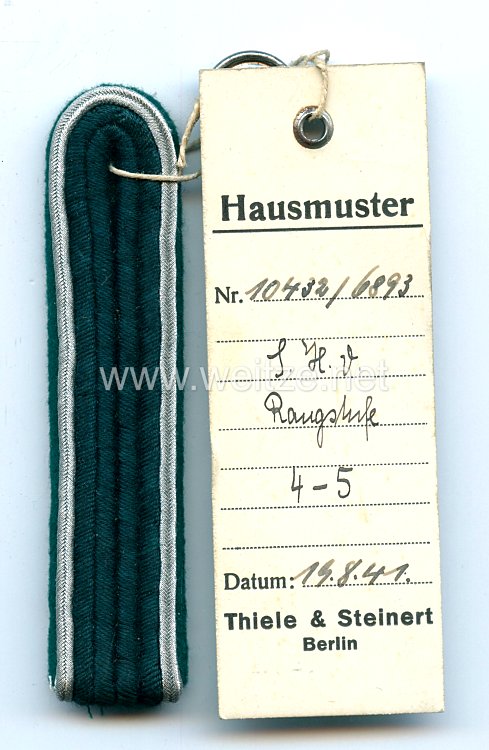
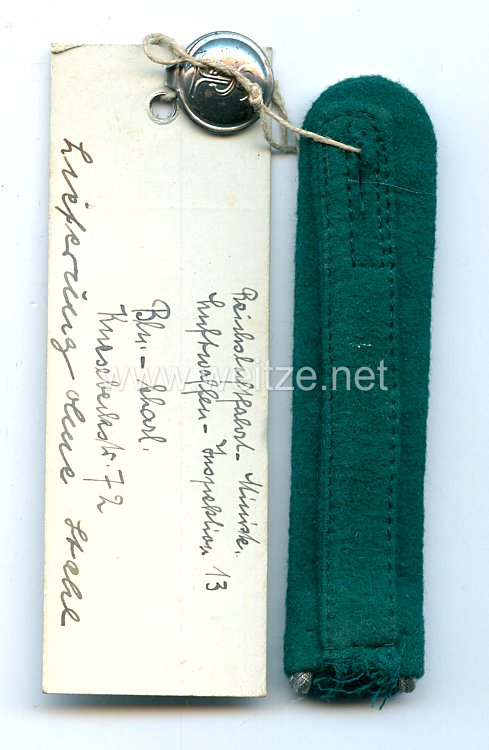
Luftwaffe Single Shoulder Board, Member of the Reich Air Ministry Aviation Inspection Rank Grade 4 - 5

Green cloth, with loop. Sample piece by the firm “Thiele & Steinert”, sealed as house pattern, inscribed and dated 19.8.1941. In mint condition.
356413
150,00

Luftwaffe Single Shoulder Board, Member of the Reich Air Ministry Aviation Inspection Rank Grade 4 - 5

This individual shoulder board represents a significant artifact documenting the complex uniform regulations and rank insignia systems of the German Luftwaffe during World War II. This particular specimen, manufactured by the renowned firm Thiele & Steinert, was sealed and documented as a pattern sample on August 19, 1941 – a date falling within a period of intense military expansion and organizational consolidation of the Luftwaffe.

The Reich Air Ministry (Reichsluftfahrtministerium or RLM) was established in 1933 under Hermann Göring and quickly developed into the central administrative and command authority of the German air forces. Within this extensive organization, the Luftwaffen-Inspektion (Air Force Inspectorate) played a crucial role in supervising, training, and standardizing the various branches and specialized services. The inspectorates reported directly to the Commander-in-Chief of the Luftwaffe and functioned as control and advisory bodies for their respective specialized areas.

The green cloth of the shoulder board is characteristic of personnel assigned to the Reich Air Ministry and distinguishes itself from the yellow branch colors of flying units or the various color codes of other Luftwaffe specialized services. This color coding enabled immediate visual identification of an officer's or official's organizational affiliation – an essential element in the highly structured German military hierarchy.

The designation rank levels 4-5 refers to middle-grade positions within the Luftwaffe hierarchy. This range typically encompassed Hauptmann and Major (rank levels 4 and 5 according to the system of the time), who performed important administrative and operational functions within the ministry. These officers were frequently entrusted with planning duties, coordination between various departments, and implementation of Reich Air Ministry directives.

Particularly noteworthy is this piece's provenance as a pattern sample from the firm Thiele & Steinert. This practice was widespread in the German military system: manufacturers of uniform components and equipment had to submit sample specimens for approval and maintain them for their own production records. The sealing and dating of August 19, 1941, documents the formal approval process and confirms that this piece conformed to exact military specifications. Such house patterns served as references for ongoing production and ensured that all manufactured pieces met established standards.

August 1941 marks a significant phase of World War II. The Wehrmacht was in the midst of Operation Barbarossa, the invasion of the Soviet Union that had begun on June 22, 1941. The Luftwaffe played a decisive role in this campaign, and the Reich Air Ministry was intensively engaged in coordinating supplies, personnel, and strategic planning. The standardization and proper identification of uniforms was of particular importance during this period of rapid armed forces expansion.

The firm Thiele & Steinert was among the established manufacturers of military insignia in the German Reich. Such companies were subject to strict quality controls and had to comply with the precise specifications of the Army Administration and the Reich Air Ministry. The designation as a “house pattern” with official sealing demonstrates the close cooperation between private manufacturers and military procurement offices.

The mint condition of this pattern sample is exceptional and explained by its function: as a reference specimen, it was not worn but preserved in the manufacturer's archive. This makes such pieces particularly valuable historical documents today, as they show the original condition and exact specifications without the wear of actual use.

Shoulder boards and rank insignia were integral components of the complex identification system in the Third Reich military. They conveyed not only information about rank and affiliation but were also expressions of the strongly hierarchical organizational culture. The precise execution and documentation of such details reflects the bureaucratic thoroughness with which the Nazi regime administered military standards.

Today, such pattern samples are important study objects for military historians and uniform researchers, as they provide authentic references for correct identification and dating of uniform components. They document not only military hierarchies and organizational structures but also industrial manufacturing and quality control within the war economy context of World War II. The preservation of such items enables modern researchers to understand the meticulous attention to detail that characterized German military administration, even as the regime pursued its devastating military campaigns across Europe.

r