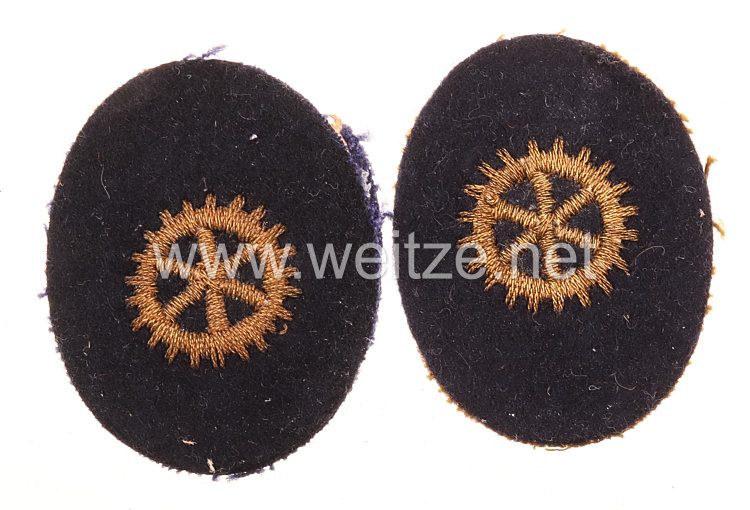
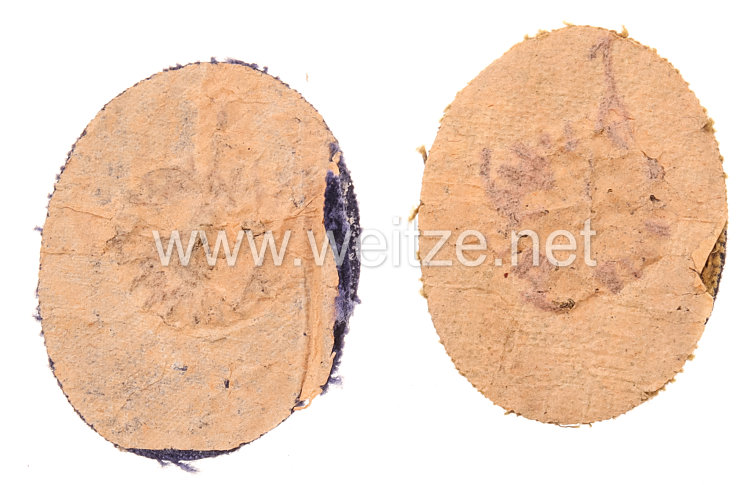
Kriegsmarine Pair of Sleeve Insignia for an Officer and Engineer
Condition may vary.
The Kriegsmarine sleeve insignia for officers and engineers represent an important element of German naval uniform studies during the period of the Third Reich from 1935 to 1945. These machine-embroidered rank badges with seawater-resistant threads served not only to identify military rank but also to distinguish between different service groups within the German Kriegsmarine.
Following the re-establishment of the German Navy in 1935, emerging from the restrictions of the Treaty of Versailles, the Kriegsmarine established a comprehensive system of rank and grade insignia. The sleeve insignia for officers were largely based on the traditions of the Imperial Navy, but adapted to the new organizational structures. The uniform regulations of the Kriegsmarine were detailed in the Anzugsordnung für die Kriegsmarine (M.Dv. Nr. 375).
The officer sleeve insignia consisted of gold braids and stars on a dark background fabric. The number and arrangement of braids indicated the respective rank from Leutnant zur See (Ensign) to Großadmiral (Grand Admiral). A special feature was the use of seawater-resistant threads, specially developed for maritime use. These threads were resistant to salt water, UV radiation, and the aggressive marine environment, ensuring the durability and legibility of rank insignia even under difficult conditions.
The engineer officers of the Kriegsmarine formed a separate service group within the naval structure. They were responsible for the technical aspects of ship operations, particularly propulsion systems, machinery, and electrical systems. Their sleeve insignia differed from those of line officers through characteristic features: while line officers wore gold braids on a dark background, engineer officers had additional identifiers such as purple or violet interlayers between the braids, marking them as technical officers.
The machine embroidery of these badges represented an important technological advancement over hand-embroidered variants. Machine-manufactured badges were more cost-effective to produce and exhibited more uniform quality. They were manufactured in specialized military effects factories that were subject to strict quality controls. Renowned manufacturers such as firms in Lübeck, Hamburg, and Berlin produced these badges according to exact military specifications.
A pair of sleeve insignia for an officer and an engineer documents the different career paths within the Kriegsmarine. While the training of line officers took place at the Marineschule Mürwik in Flensburg, engineer officers underwent specialized technical training. Both officer groups were equally important for the operation of the complex warships of that era.
The rank structure of the Kriegsmarine included the following grades for officers: Leutnant zur See, Oberleutnant zur See, Kapitänleutnant, Korvettenkapitän, Fregattenkapitän, Kapitän zur See, Kommodore, Konteradmiral, Vizeadmiral, Admiral, and Großadmiral. Each rank was characterized by a specific number and arrangement of braids. Engineer officers held the same ranks with the addition “Ing.”
The preservation of these uniform pieces is of great importance from a historical perspective. The stated Condition 2 corresponds in military-historical classification to a good to very good state of preservation with slight signs of use. The use of seawater-resistant threads has contributed to the better conservation of these objects, as the materials were more resistant to environmental influences than conventional embroidery threads.
Today, such sleeve insignia are important objects of study for military historians and uniform experts. They provide insights into the organizational structure, hierarchies, and technical standards of the Kriegsmarine. Museums such as the Deutsches Marinemuseum in Wilhelmshaven and the Militärhistorisches Museum in Dresden preserve extensive collections of these uniform pieces and make them accessible to scientific research.