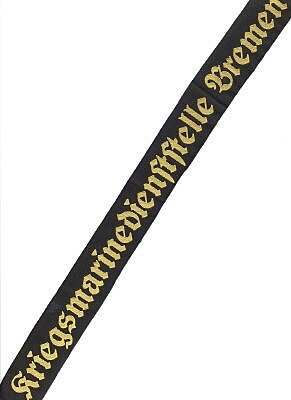
Kriegsmarine Cap Tally “Kriegsmarinedienststelle Bremen”
The Kriegsmarine cap tally bearing the inscription “Kriegsmarinedienststelle Bremen” represents a fascinating piece of maritime military history from the Second World War era. These woven cotton ribbons were an essential component of German naval personnel uniforms, serving both identification and traditional purposes.
The Kriegsmarine, as the official designation of the German Navy from 1935 to 1945, continued the tradition of cap tallies that had been established in the Imperial Navy. According to Kriegsmarine uniform regulations, enlisted personnel and non-commissioned officers without sword knots wore the characteristic peaked cap with a cap tally displaying the name of their respective ship or duty station.
Cap tallies were typically manufactured from black cotton and featured gold-yellow or white lettering. The weaving was usually done mechanically, with letters directly woven into the ribbon. The standard length measured approximately 120 to 140 centimeters, with ends featuring two parallel gold-yellow stripes. At the terminus were often two longer ribbons, the so-called “tails” or “ribbon ends,” which hung down at the back of the head.
Kriegsmarinedienststellen (Naval Service Stations) were shore-based naval facilities that fulfilled various administrative, logistical, and training-related functions. The Bremen station was one of many such establishments throughout the Reich territory. Bremen, as an important port city with a long maritime tradition, played a significant role in the organization of the Kriegsmarine. Various naval facilities were located here, including administrative offices, supply depots, and possibly training units.
The use of specific duty station designations on cap tallies was particularly common for naval personnel who did not serve aboard ships but worked in shore-based facilities. This differed from the practice for ship crews, who wore the name of their respective vessel. Examples of other duty station tallies included “Kriegsmarinedienststelle Hamburg,” “Marinestation der Ostsee” (Baltic Naval Station), or “Marinelazarett” (Naval Hospital).
The uniform regulations of the Kriegsmarine were strictly governed and documented in various service regulations. The “Dress Regulations for the Kriegsmarine” (M.Dv. Nr. 53) detailed precisely which uniform components were to be worn on which occasions. The cap tally was a mandatory component of working and walking-out uniforms for enlisted ranks.
During the war, a great variety of cap tallies developed, as the Kriegsmarine operated hundreds of ships, submarines, and duty stations. Collectors and historians have subsequently attempted to document this diversity, with cap tallies from famous ships such as “Bismarck,” “Tirpitz,” or “Admiral Graf Spee” being particularly sought after. Duty station tallies are generally less well-known but no less historically significant, as they document the extensive infrastructure of the Navy.
The manufacture of these cap tallies was carried out by specialized textile companies that also produced other uniform items and equipment for the Wehrmacht. Quality could vary depending on the time of manufacture and producer. Early war productions often showed higher quality in materials and workmanship, while later examples were sometimes made from simpler materials due to wartime constraints.
After the war's end, many of these cap tallies were taken by Allied soldiers as souvenirs or retained by their wearers. Today they are important historical documents preserved in military history collections, museums, and private collections. They serve research purposes and help better understand the organization and structure of the Kriegsmarine.
The condition assessment “Condition 2” corresponds in the usual classification of military collectibles to a good to very good state of preservation with possibly slight signs of use but without significant damage. Such well-preserved examples are particularly valuable for historical research as they provide authentic insights into the material culture of that era.