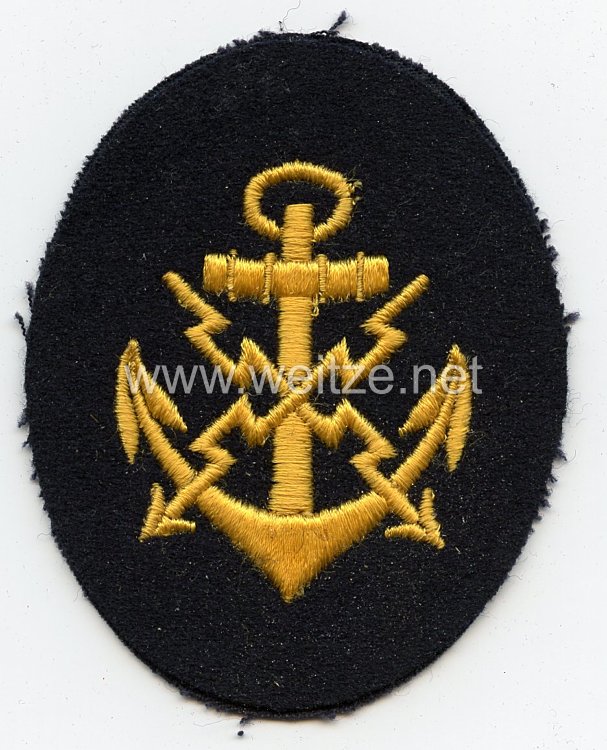
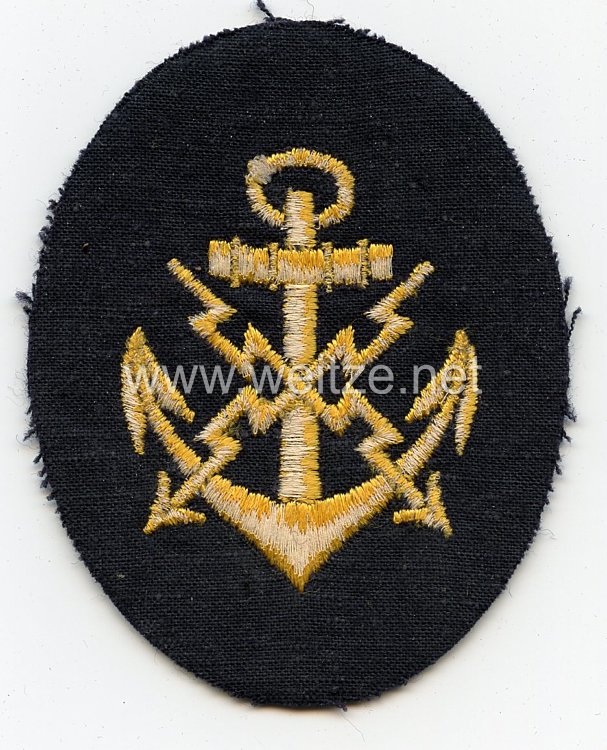
Kriegsmarine Sleeve Insignia Career Path Teletype Petty Officer

for the blue blouse, unworn, condition 2.
376613
15,00

Kriegsmarine Sleeve Insignia Career Path Teletype Petty Officer

The sleeve insignia for Kriegsmarine Teletype Operators (Fernschreibmaat) represents a fascinating testament to maritime communication technology and the organizational structure of the German Navy during World War II. These career insignia were essential components of uniform identification, enabling immediate recognition of a naval serviceman's professional specialization.

The Kriegsmarine, established in 1935 following Germany's official departure from the constraints of the Versailles Treaty, developed a complex system of rank insignia and career path identifiers. Career insignia, worn on the left upper arm of the blue service blouse, varied according to specialty and displayed specific symbols indicating the wearer's technical or administrative specialization.

The Fernschreibmaat (Teletype Petty Officer) belonged to the technical career path of communications, a field of critical importance to modern naval warfare. Teletypes (Teletype machines or Hellschreiber devices) enabled rapid and relatively secure transmission of encrypted messages between ships, submarines, and shore stations. Teletype technology represented a significant advancement over traditional Morse code telegraphy, as it allowed direct transmission of text characters without manual decoding.

The sleeve insignia for teletype operators typically displayed a stylized symbol representing teletype technology, often in the form of crossed lightning bolts or technical elements indicating electrical communication. These insignia were manufactured in various versions: for the blue service blouse (walking-out uniform), they were usually machine-embroidered on dark cloth backing, while corresponding variants existed for white summer uniforms.

The production of these insignia was carried out by various authorized manufacturers who had to maintain specific quality standards. The insignia were either machine-embroidered or woven, with the present example intended for the blue blouse. The blue service blouse was the standard walking-out uniform for enlisted personnel and petty officers of the Kriegsmarine, worn for official occasions and shore leave.

Training to become a Fernschreibmaat required specialized technical knowledge. After basic training, prospective teletype operators underwent specialized instruction at naval teletype schools, where they learned not only equipment operation but also fundamentals of encryption and message security. The rank of Maat corresponded to that of a petty officer and was awarded after appropriate service time and successful examination.

In operational deployment, teletype operators served aboard larger surface vessels as well as in shore stations and command centers. On submarines, space for teletype equipment was limited, which is why radio operators with Morse training were often preferred. However, in fleet formations and larger warships, teletype communications were indispensable for coordinating complex operations.

The importance of communications cannot be overstated. The naval war of World War II was to a considerable extent a battle for information superiority. The famous decryption of the Enigma codes by the Allies demonstrates how crucial secure communication was. Teletype operators played an important role in this communication chain, even though their work is less well-known than that of radio operators.

After the war's end, many of these insignia were kept by soldiers as souvenirs or entered Allied collections as war trophies. Unworn specimens, such as the present example, are relatively rare today, as most insignia were actually used. They were either stored at distribution points to troops or in warehouses, thus surviving the war unused.

For military historical collections, such career insignia are important documents of organizational history and technological development. They illustrate the increasing specialization of military functions in the 20th century and the growing importance of technical expertise in warfare. The teletype operator's sleeve insignia stands representative of the technological transformation in military communications, which progressed from signal flags through Morse telegraphy to teletype and finally to modern digital communication.

The condition and provenance of such items provide insights into the material culture of the Kriegsmarine. Unworn pieces like this one offer collectors and historians pristine examples of period manufacturing techniques and design standards, unmarred by the wear of actual service. They serve as reference pieces for authenticating other examples and understanding the production variations that existed among different manufacturers throughout the war years.