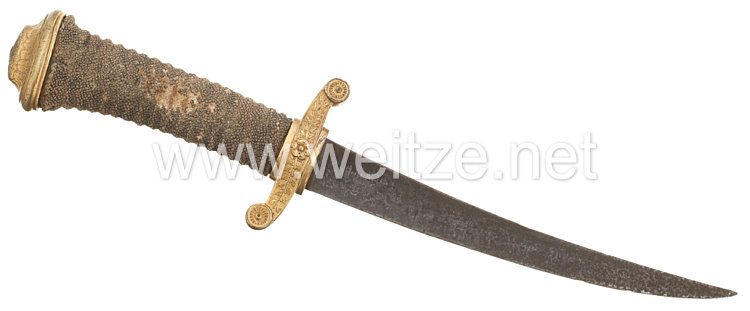
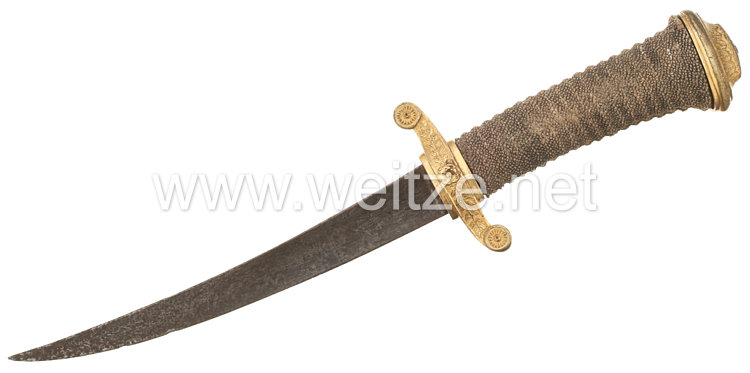
France Short Curved Dagger for Colonial Troop Officers

Curved wedge-shaped blade with fullered back, traces of etching faintly visible, finely pitted toward the point, pommel and crossguard of gilt brass, shagreen grip, without scabbard, more pronounced signs of age. Condition 2-3

Blade length approximately 160mm
Overall length approximately 270mm
370313
450,00

France Short Curved Dagger for Colonial Troop Officers

The French colonial dagger for officers represents a fascinating example of military edged weapon development in the late 19th and early 20th centuries. These distinctive weapons were specifically designed for officers of the Troupes coloniales, the French colonial troops who served in France's extensive overseas possessions.

The French Colonial Troops, originally known as Troupes de la Marine, evolved into an independent military formation from 1900 onwards. They operated in French colonial territories in Africa, Indochina, the Pacific, and the Caribbean. The special equipment of these troops, including their edged weapons, reflected both the traditions of the French Army and the particular requirements of colonial service.

This specimen displays the typical characteristics of a Colonial Troops officer's dagger. The curved wedge-shaped blade with a length of approximately 160 mm features a grooved back, a constructive peculiarity that both increased the blade's strength and reduced its weight. The curvature of the blade followed Oriental models and was particularly suited for cutting and slashing movements required in close combat.

The etchings still faintly visible on the blade are characteristic of French military edged weapons of this era. Such decorations typically included military emblems, trophy motifs, the French coat of arms, or regimental insignia. The etching technique allowed for the application of elaborate decorations that emphasized the bearer's status as an officer while simultaneously indicating affiliation with a particular branch of service.

The pommel and crossguard made of gilt brass correspond to the usual specifications for officers' weapons. The gilding served not only decorative purposes but also indicated the bearer's rank. While enlisted men and non-commissioned officers typically carried weapons with simpler metal fittings, officers' daggers were characterized by higher-quality materials and more elaborate workmanship.

The shagreen grip (French: galuchat) is a particularly characteristic feature of French military edged weapons of the 19th and early 20th centuries. The use of shagreen as grip material had both practical and aesthetic reasons: the natural grain of the skin provided a secure, non-slip grip, even under difficult climatic conditions or with wet hands. At the same time, shagreen was an exotic, precious material that emphasized the status of an officer's weapon. In colonial territories, where many of these weapons were deployed, this material proved particularly resistant to moisture and extreme temperatures.

The overall length of approximately 270 mm clearly classifies this weapon as a dagger or poignard in French terminology. This compact size made the weapon a practical sidearm that could be worn on the belt without restricting the officer's freedom of movement. Unlike longer sabers or swords, the dagger was designed particularly for close combat and as a status weapon.

French colonial officers carried such daggers as part of their dress uniform as well as for field use. During the late 19th century and the beginning of the 20th century, edged weapons were still an integral part of officers' equipment, even though their practical military significance was already declining. They increasingly served as rank insignia and symbols of military authority.

The French colonial wars in which these weapons were used encompassed numerous campaigns: the conquest and pacification of territories in North Africa, Sub-Saharan Africa, Indochina, and Madagascar. Officers of the colonial troops were often engaged in irregular combat against local resistance movements, where close-combat weapons could still have practical significance.

The historical context of these weapons is intimately connected with France's colonial expansion during the Third Republic. Between 1870 and 1914, France established the world's second-largest colonial empire. The colonial troops played a crucial role in this expansion and in maintaining French control over these territories. Officers serving in these units often came from military academies like Saint-Cyr and were specially trained for colonial service.

The regulations governing officers' equipment in the colonial troops were set forth in various military ordinances. While specific patterns were prescribed for certain weapons, there was also room for individual variation, particularly in officers' sidearms like daggers. This allowed for a degree of personalization while maintaining the overall military aesthetic and functionality.

The wear marks and preserved condition of this specimen testify to its authentic history. The absence of the sheath is not uncommon in historical militaria, as sheaths made from organic materials like leather often did not have the same lifespan as the metal blades themselves.

Today, such French colonial daggers represent important testimonies of military history and are highly valued by collectors of French militaria. They represent a specific era of French colonial history and the development of military edged weapons in the transition to modern warfare.

r