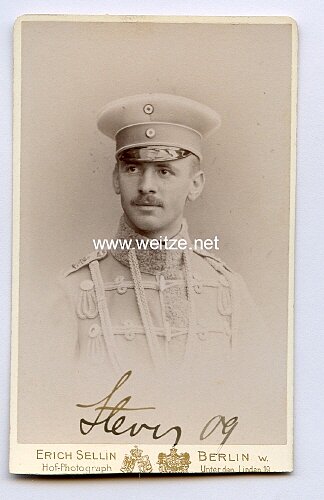
World War I Photograph, Member of a Hussar Regiment of the German Empire
Historical Context: Photograph of a Member of a Hussar Regiment of the German Empire from World War I
This photograph depicts a soldier from a Hussar Regiment of the German Empire during the era of World War I (1914-1918). Such images represent important historical documents that provide insight into military culture, uniforms, and the self-perception of the Imperial German Army.
Hussar Regiments in the German Empire
The Hussars formed a traditional branch of light cavalry with origins dating back to the 15th century. In the German Empire, there were a total of 21 Hussar Regiments at the outbreak of war in 1914, distributed among the various contingents of the federal states. Prussia maintained 14 regiments, Saxony three, Bavaria two, and Baden and Hesse one each. Each regiment wore a distinctive uniform with specific colors and features based on historical traditions.
Hussars were distinguished by their characteristic uniform, which differed markedly from other cavalry units. Typical features included the Attila (a tight-fitting, braided jacket), the fur cap (Kolpak or Busby), and for parade dress, the dolman with fur trimming. Different regiments wore different colors: for example, the Silesian Hussar regiments wore yellow or white uniforms, while other regiments wore blue, green, or red Attilas.
Military Photography in World War I
Photographs of soldiers held enormous significance during World War I for the soldiers themselves and their families. In an era without modern communication means, these images served as an important connection between the front and home. Many soldiers had themselves photographed at field photo studios or local photographers to send pictures of themselves in uniform to their relatives.
The size of approximately 6.5 x 10 cm corresponds to the then-common postcard format or the slightly smaller cabinet card format typical for private photographs. Such photographs were frequently mounted on firm cardboard and often bore the photo studio's stamp on the reverse, along with handwritten dedications or dates.
The Employment of Cavalry in World War I
At the outbreak of war in 1914, cavalry, including the Hussar regiments, still played an important role in military planning. Their traditional tasks were emphasized: reconnaissance, pursuit of defeated enemies, and rapid flanking attacks. The first months of the war, especially during the wars of movement from August to November 1914, still saw classical cavalry deployments.
With the development of trench warfare from late 1914 onward, however, cavalry increasingly lost relevance. Machine guns, barbed wire, and modern artillery made mounted attacks nearly impossible. Many cavalrymen were subsequently dismounted and employed as infantry or took over guard and security duties behind the front. Some Hussar regiments were later even converted into bicycle battalions or motorized units.
Social and Cultural Significance
Belonging to a Hussar regiment carried high social prestige in the German Empire. Officer positions were often reserved for the nobility or upper bourgeoisie. The colorful uniform and military tradition made the Hussars an elite unit that took center stage at parades and social occasions.
For the depicted soldier, the photograph was likely an expression of pride in his membership in this prestigious branch of service. At the same time, it served as a memento for his family and as a personal document of his military service.
Collector Value and Historical Importance
Today, such photographs are important military-historical sources. They document not only uniforms and equipment but also provide insight into the soldiers' world. For collectors and historians, they are particularly valuable when notations on the reverse provide information about regiment, names, dates, or deployment locations. The indicated condition 2 suggests a well-preserved photograph with only minor signs of use, which is remarkable for a document over a century old.
This photograph represents millions of similar images created during World War I, serving today as silent witnesses to a vanished era – the final years of the German monarchy and the demise of traditional cavalry as a military branch.