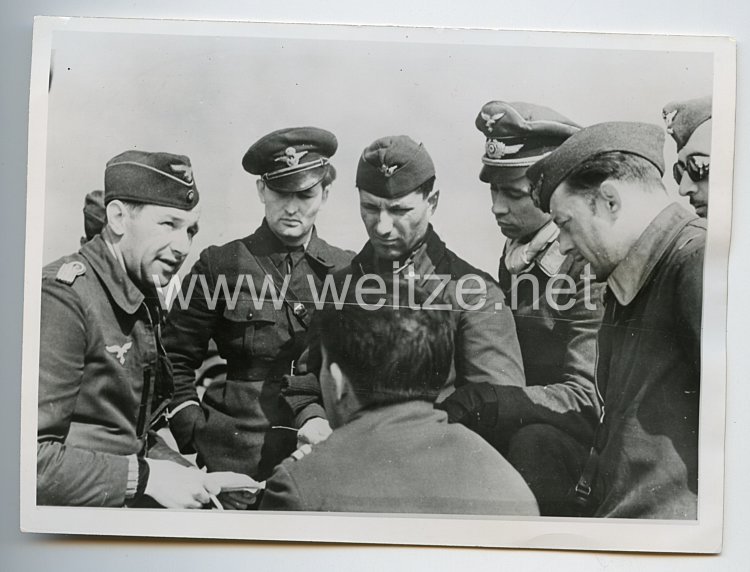
Luftwaffe Press Photo: German-Romanian Aviation Comradeship in the East 26.5.1943
German-Romanian Air Comradeship in the East: Luftwaffe Press Photography of World War II
This Luftwaffe press photograph dated May 26, 1943, documents a significant aspect of military cooperation between Nazi Germany and Romania during World War II. Produced as official propaganda material, it illustrates the German-Romanian brotherhood-in-arms on the Eastern Front during a critical phase of the war.
Historical Context of the German-Romanian Military Alliance
Romania joined the Tripartite Pact in November 1940 and became one of Nazi Germany's most important allies in World War II. Under the leadership of Marshal Ion Antonescu, Romania participated in Operation Barbarossa, the German invasion of the Soviet Union, beginning in June 1941. Romanian participation was motivated both politically and strategically: the country hoped to regain Bessarabia and Northern Bukovina, which had been annexed by the Soviet Union in 1940.
The Royal Romanian Air Force (Forțele Aeriene Regale ale României) played an active role on the Eastern Front. Romanian air units operated both independently and in close coordination with the German Luftwaffe. This cooperation included joint operations, training measures, and the exchange of technical expertise.
The Significance of Press Photographs in War Propaganda
This photograph originated from the extensive system of Nazi visual propaganda. The Wehrmacht's Propaganda Companies (Propagandakompanien or PK) systematically produced photographic material for the domestic and foreign press. These images were intended to serve multiple purposes: documenting military operations, strengthening morale on the home front, and demonstrating international support for the German war effort.
Photographs showing cooperation with allied nations were particularly valuable for propaganda purposes. They suggested a common European struggle against Bolshevism while concealing the actual power structures and dependencies within the Axis powers.
The Situation in May 1943
The timing of this photograph, May 1943, is of particular historical significance. A few months earlier, the German 6th Army had capitulated at Stalingrad, marking a turning point in the war. The defeat had also severely affected Romanian troops, who suffered substantial losses in the battle. In May 1943, the Eastern Front was in a phase of consolidation as both sides prepared for the summer offensive that would lead to the Battle of Kursk in July.
At this time, sentiment in Romania was already beginning to shift. Heavy losses and the deteriorating strategic situation raised doubts about German leadership. Nevertheless, propaganda continued to rely on images of comradeship and shared determination to achieve victory.
Technical Aspects of Luftwaffe Press Photography
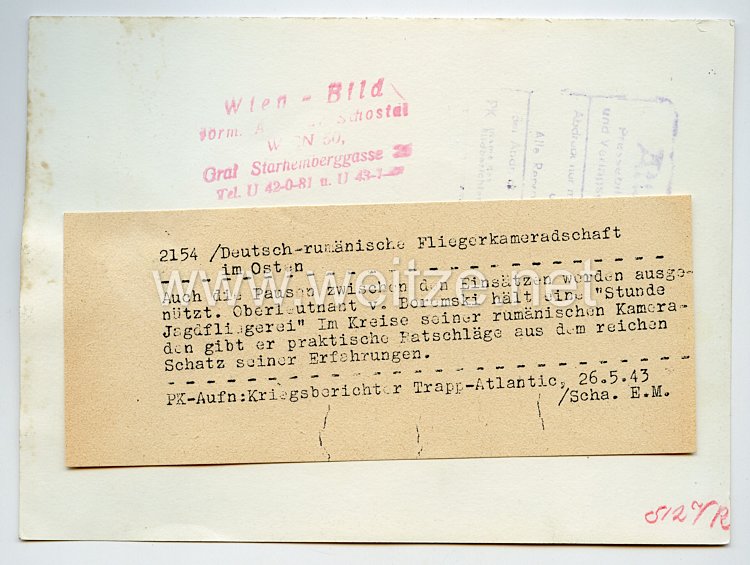
Luftwaffe press photographs like this one followed standardized production and distribution procedures. The images were taken by specially trained war correspondents, developed, and provided with captions. The reverse inscription typically contained information about the location, date, units or persons depicted, and an image number for archival purposes.
The format of approximately 18 x 13 cm corresponds to the standard dimensions for press photographs of that era. These images were distributed to newspapers, magazines, and propaganda offices at home and abroad. They also served as source material for articles in publications such as Signal Magazine or the Deutsche Wochenschau (German Weekly Newsreel).
The Romanian Air Force in World War II
The Romanian Air Force initially operated with its own aircraft types, including British and French models. As the war progressed, it increasingly received German aircraft such as the Messerschmitt Bf 109 and the Junkers Ju 87 Stuka. Romanian pilots were partially trained in Germany and participated in all major operations on the Eastern Front, from the Crimea to the Caucasus.
Cooperation between the German and Romanian air forces was not without tensions. Differences in equipment, training levels, and tactical doctrine occasionally led to conflicts. Nevertheless, many units developed genuine camaraderie that went beyond propagandistic portrayal.
Collector Value and Historical Significance
Original Luftwaffe press photographs are important historical documents today and sought-after collectibles. They provide insights into the visual propaganda of the Third Reich and document military alliances and operations. The indicated condition grade of 2 suggests a well-preserved example with only minor signs of use.
For historians, such photographs are valuable sources that must be critically analyzed. They do not show the reality of war but rather the desired portrayal of that reality. Nevertheless, when examined in the context of other sources, they can provide important information about propaganda strategies, military relationships, and the visual culture of World War II.