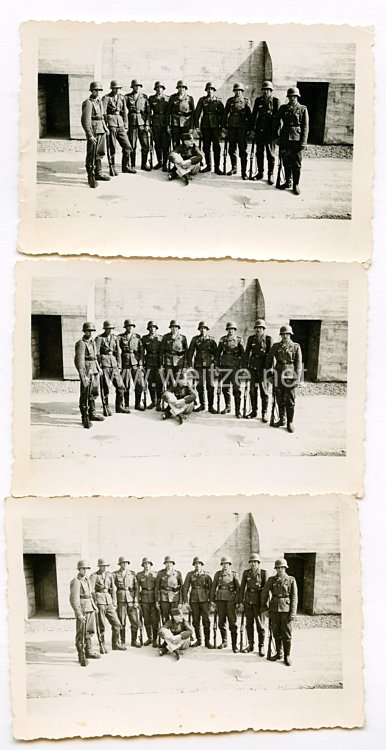
Luftwaffe Photographs, Soldiers in front of a Bunker

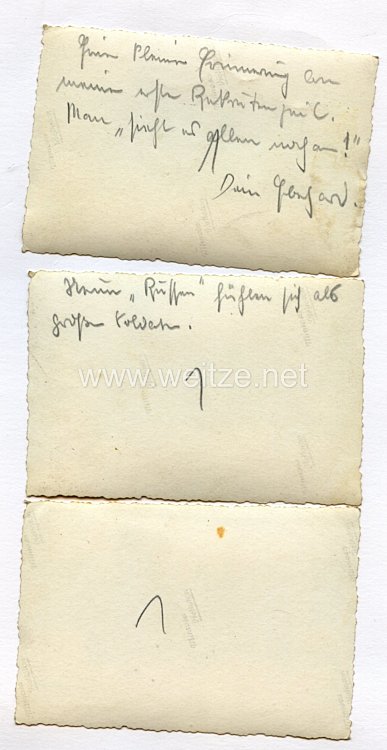
3 identical prints, approx. 6 x 9 cm, condition 2.
400012
15,00

Luftwaffe Photographs, Soldiers in front of a Bunker

These photographs of Luftwaffe soldiers in front of a bunker represent an important aspect of military documentation during World War II. The three identical prints, measuring approximately 6 x 9 cm, were typical of photography from that era and reflect the ubiquitous practice of documenting military installations and personnel.

The Luftwaffe, officially founded on February 26, 1935, developed into the most modern air force of its time. Under the leadership of Hermann Göring as Commander-in-Chief, this branch of service expanded rapidly and played a central role in German warfare from 1939 to 1945. Photographic documentation was an integral part of both official propaganda work and the soldiers' private culture of remembrance.

The bunker system was essential for the Luftwaffe. During the war, thousands of fortified installations of various sizes were constructed, from small splinter-protection bunkers to massive flak towers and command centers. These structures served to protect personnel, store equipment and ammunition, and function as operational centers for anti-aircraft defense and airspace surveillance. The most famous examples are the monumental flak towers in Berlin, Hamburg, and Vienna, but also the numerous bunker facilities at airfields and in strategically important areas.

Military photography served several functions: it was used for official reporting by the Propaganda Companies (PK), for military reconnaissance and documentation, and as personal memories for soldiers. The format of approximately 6 x 9 cm corresponds to the medium format cameras or small-format prints common at the time. The existence of three identical prints suggests that these images were probably taken privately, possibly to share with comrades or send to family members.

The Luftwaffe uniforms were characteristically blue-gray in color, distinguishing them clearly from the field-gray uniforms of the Army and the black or later field-gray uniforms of the Waffen-SS. Various rank insignia, sleeve stripes, and decorations enabled identification of the rank and function of the soldiers depicted. The Luftwaffe comprised not only flying personnel but also anti-aircraft units (Flak), signal troops, ground personnel, and paratroopers.

In the context of historical research, such photographs are of considerable value. They document soldiers' daily lives, the condition of military installations, and the reality of military service beyond official propaganda. While official photographs by propaganda companies were often staged, private photographs frequently show more authentic moments of soldier life.

The Wehrmacht's bunker constructions followed standardized construction plans by the Organisation Todt, which was responsible for large parts of military construction projects. Depending on strategic importance and timing of construction, building methods varied considerably. Early installations were often elaborately designed, while later constructions suffered from increasing material and time shortages. Wall thicknesses could range from a few decimeters for simple splinter-protection bunkers to several meters for bomb-proof command centers.

For collectors and historians, such photographs offer important insights into military infrastructure and soldiers' lives. The state of preservation is of great importance, as the quality of papers and chemicals from the 1940s often led to discoloration and damage. Triple copies also enable interesting comparisons regarding different aging processes.

The legal and ethical aspects of collecting such militaria must always be observed. While historical photographs are legal per se, German law prohibits the use of unconstitutional symbols. Serious collectors and institutions treat these objects as historical documents that serve education and research, not glorification.