Luftwaffe Message Drop Bag

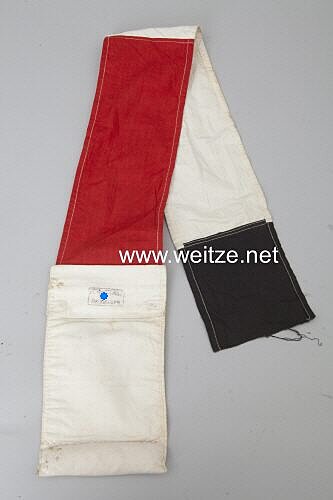
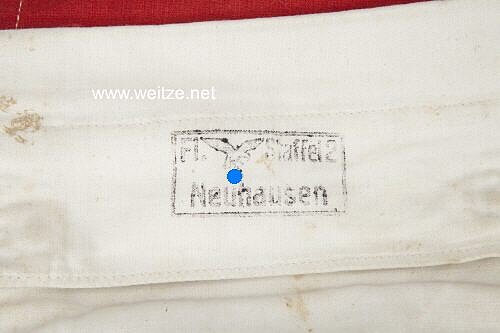
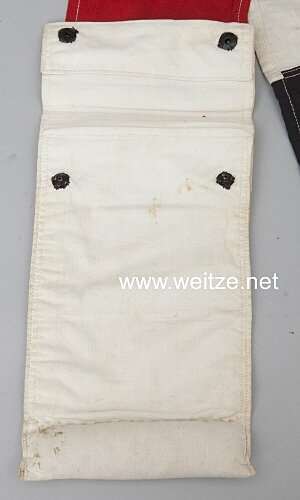
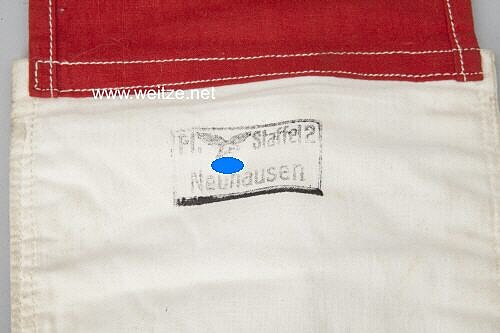
circa 1937, black/red/white message drop bag, both sides marked with unit stamp "Fl. Staffel 2 Neuhausen", end of bag is filled with sand for dropping purposes, the black end shows wear, condition 2-
203012
390,00

Luftwaffe Message Drop Bag

The Luftwaffe message drop bag, also known as Nachrichtenabwurftasche or Meldungsabwurftasche, represents a fascinating artifact of military communication technology from the 1930s and 1940s. This specialized piece of German Air Force equipment served to transmit messages and reports from aircraft to ground troops or stations when radio communications were unavailable, disrupted, or undesirable for security reasons.

Technical Construction and Function

The drop bag was specifically designed for deployment from aircraft. The characteristic three-color design in black, red, and white was by no means randomly chosen but served an important practical purpose: the high-contrast colors enabled quick location of the dropped bag on the ground, regardless of terrain conditions. Whether on snow, grassland, or dark soil – at least one of the colors would always provide clear contrast with the environment.

The lower end of the bag was filled with sand, which represented a crucial design feature. This weighting served multiple purposes: first, it ensured targeted, stable flight during deployment, similar to an arrow principle. Second, the weight prevented the bag from being carried away by wind or drifting over a large area. Third, the sand filling ensured that the bag landed in the correct orientation upon impact and remained clearly visible.

Historical Context and Usage

The bag described here bears the unit stamp “Fl. Staffel 2 Neuhausen” and dates to around 1937, a period of massive rearmament and reorganization of the Luftwaffe. Following the official establishment of the Luftwaffe in 1935, which represented a clear breach of the Treaty of Versailles provisions, new units were rapidly established and equipped. The designation “Fl. Staffel” stands for Fliegerstaffel (flying squadron), the basic tactical unit of the Luftwaffe, typically consisting of 9 to 12 aircraft.

The necessity for such drop bags arose from the technical limitations of radio technology at the time. Although radio equipment was already deployed in military aircraft during the 1930s, it was often unreliable, heavy, susceptible to interference, and not available in all aircraft types. Particularly during reconnaissance flights, liaison missions, or situations requiring radio silence, message drop bags were indispensable.

Operational Scenarios

Drop bags found use in various operational situations. During reconnaissance missions, important observations and situation maps could be quickly transmitted to ground command posts. As part of army cooperation, the collaboration between Luftwaffe and ground forces, they enabled direct communication with advancing or encircled units. They also served as an important backup system for liaison flights between different command posts.

During the early war years, especially during the Polish Campaign of 1939 and the Western Campaign of 1940, when rapid warfare often overtaxed communication lines, these simple but reliable communication tools proved valuable. Even later in the war, as radio technology advanced, drop bags remained part of standard equipment for many Luftwaffe units.

Material Properties and Preservation

The bags were typically manufactured from robust canvas or similar durable textiles. The worn black end of the bag described here suggests actual operational use – the sand filling and repeated impact during deployment left natural signs of wear. The good overall condition with still-legible unit stamp makes such pieces valuable historical documents.

Collector Value and Historical Significance

Today, original Luftwaffe drop bags are relatively rare militaria objects. Many were consumed during the war, lost, or disposed of after the war's end. Examples with clear unit stamps are particularly interesting as they offer the possibility of tracing the history of specific units. They represent an era when analog communication methods were still indispensable and document the pragmatic solutions that military organizations developed for everyday operational challenges.

These artifacts provide tangible evidence of the realities of aerial warfare before modern digital communications, reminding us of the ingenuity required to solve tactical problems with the technology available at the time. For historians and collectors alike, such items offer unique insights into the daily operational procedures of the Luftwaffe and the practical challenges faced by military aviators during this pivotal period in history.