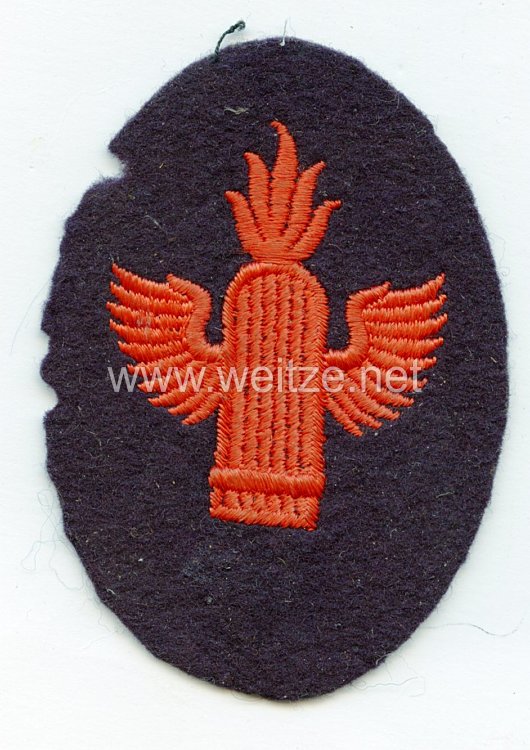
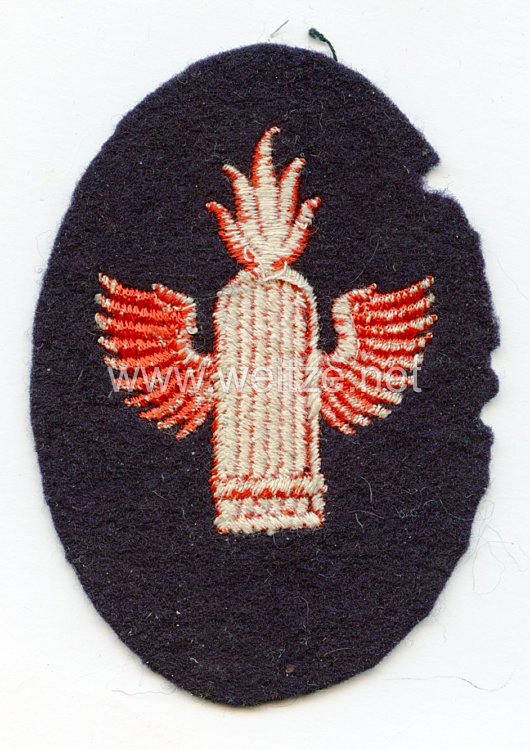
Kriegsmarine Sleeve Insignia Special Training Gunner or Observer of Light Flak Artillery
The Kriegsmarine sleeve badge for special training as gunner or observer of light anti-aircraft artillery represents a fascinating piece of German naval uniform history from World War II. This machine-embroidered specialist badge for the blue uniform documents the increasing importance of air defense in maritime warfare during the 1940s.
The Kriegsmarine developed a complex system of sleeve badges throughout World War II to identify specialized training and skills of crew members. These badges were worn on the left upper arm of the uniform jacket and served not only to identify specialists aboard ship, but also as markers of particular qualifications and training achievements.
Light anti-aircraft artillery played a crucial role in defending German warships against Allied air attacks. With the increasing threat from enemy aircraft, particularly from 1942 onwards, training qualified anti-aircraft gunners and observers became a priority for the Kriegsmarine. Crews needed to be able to respond quickly to air attacks and execute coordinated defensive measures.
The badge for gunners and observers of light anti-aircraft artillery was typically awarded after completion of specialized training. This training encompassed theoretical and practical components, including ballistics, target acquisition, gun handling, and coordination with other defensive measures. The distinction between gunners and observers was operationally significant: while gunners directly operated the weapons, observers were responsible for target acquisition and fire direction.
The machine embroidery of these badges was standard for mass production during the war. Unlike hand-embroidered variants, which were often made for officers or in the pre-war period, machine production enabled faster and more cost-effective manufacturing. The badges were embroidered on dark blue fabric, matching the blue uniform (service dress) of the Kriegsmarine.
The blue uniform of the Kriegsmarine, also known as the Bordjacke (deck jacket), was the standard working uniform for enlisted men and petty officers aboard ships. It consisted of dark blue cloth and was worn during daily service. Various sleeve badges were attached to this uniform, indicating the wearer's rank, career path, and special qualifications.
The introduction of specialized badges for anti-aircraft crews reflects the technological development of naval warfare. At the beginning of the war, German warships had relatively modest air defense capabilities. As the conflict progressed and Allied air superiority increased, anti-aircraft armament was continuously strengthened. Light anti-aircraft guns typically included 2-cm and 3.7-cm weapons, deployed against low-flying attackers and for close-range defense.
The organization of anti-aircraft crews aboard ship followed clear hierarchies and responsibilities. Each gun had an assigned crew consisting of gunners, ammunition handlers, and observers. Coordination between different anti-aircraft positions was managed through central fire control stations that distributed target information and coordinated fire.
From a historical perspective, such sleeve badges are today important collectibles and research objects. They provide insights into the organizational structure, personnel management, and training systems of the Kriegsmarine. The indicated condition 4 suggests a well-preserved piece with normal signs of use, typical for textile militaria from this period.
Research into such badges contributes to understanding military daily life and technical development. They document not only material culture but also the human dimension of war – the training, specialization, and organization of the crews who wore these badges. These artifacts serve as tangible connections to the experiences of naval personnel and the evolution of maritime air defense systems during a pivotal period in naval history.