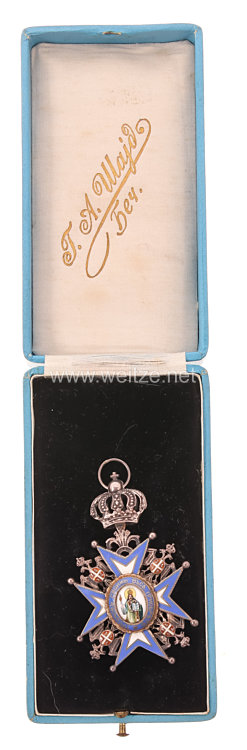
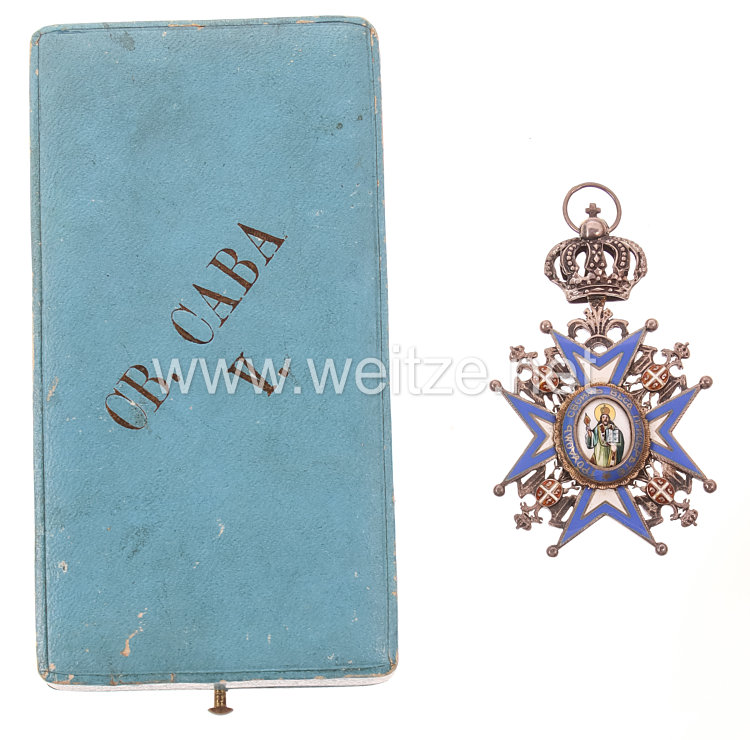
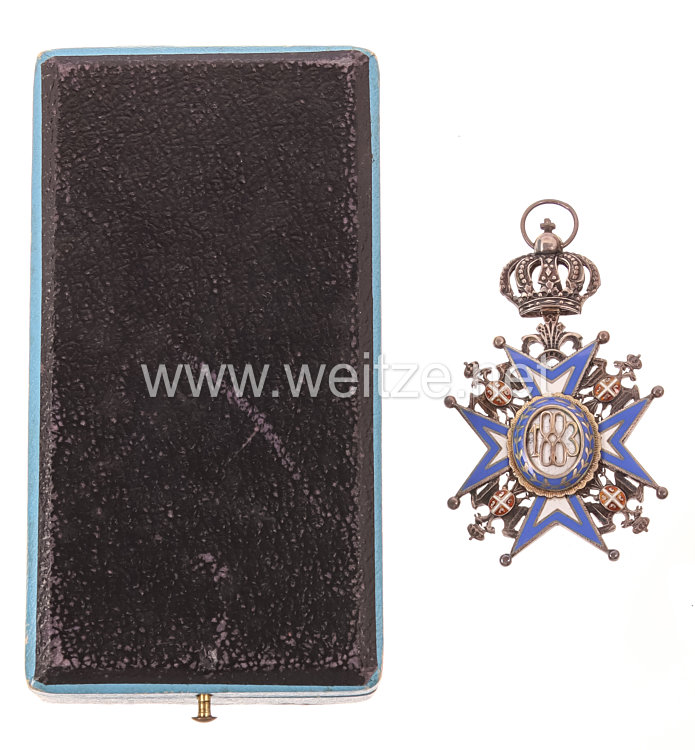
Kingdom of Serbia Order of St. Sava 2nd Model 1883, 5th Class Cross
The Order of St. Sava (Serbian: Orden Svetog Save) ranks among the most significant state decorations of the Kingdom of Serbia and later of the Kingdom of Serbs, Croats and Slovenes (Yugoslavia from 1929). This decoration represents the second model of 1883 in the 5th Class, the lowest grade of this prestigious order's hierarchy.
The order was originally established on January 23, 1883 by King Milan I. Obrenović and was named after Saint Sava, the first archbishop of the Serbian Orthodox Church in the 13th century and patron saint of Serbia and Serbian education. The order's statutes were revised several times, with the second model introduced in the founding year of 1883, distinguished by refined technical and aesthetic characteristics.
The 5th Class cross was manufactured from silver and featured fine enameling on both sides. The characteristic form of the cross displays typical features of Serbian order craftsmanship of this era: an equal-armed cross with broadened ends, usually enameled in red. The center typically bore the image or monogram of Saint Sava on the obverse, while the reverse frequently displayed the Serbian coat of arms or an appropriate inscription. The enamel work was executed in the traditional cloisonné technique, requiring the highest level of craftsmanship precision.
The Order of St. Sava was awarded in five classes: 1st Class as Grand Cross, 2nd Class as Grand Officer, 3rd Class as Commander, 4th Class as Officer, and 5th Class as Knight. The 5th Class was worn on a ribbon without rosette and represented the entry-level class into the order's community. Despite its position in the hierarchy, this decoration was highly esteemed as it represented recognition of significant merit.
The award criteria for the Order of St. Sava were broadly defined. The order was primarily awarded for merit in the fields of education, science, art, and culture. Unlike purely military decorations, it particularly honored achievements in the civilian sphere, making it an important instrument of the Serbian Kingdom's cultural policy. Recipients could be both Serbian citizens and foreign personalities who had rendered service to Serbian culture and science.
The manufacture of such orders was carried out by specialized court suppliers and order workshops, frequently in Belgrade or by renowned European manufactories. The craftsmanship quality was an essential feature of the decoration's authenticity and value. Each piece was carefully crafted, with the enameling requiring particular expertise, as it needed to be both aesthetically pleasing and durable.
The presentation case in which this decoration is presented is an integral component of the order's bestowal. These cases were specially manufactured to safely store and dignifiedly present the order. They were typically lined with velvet or silk and frequently bore embossing or inscriptions indicating the order.
After World War I and the founding of the Kingdom of Serbs, Croats and Slovenes in 1918, the Order of St. Sava continued to be awarded, now as a decoration of the new state. The order's statutes remained largely intact, with minor adjustments made to accommodate the changed state structure. The order retained its significance as the most important civilian decoration for cultural and scientific merit.
For collectors and historians, Orders of St. Sava of the second model from 1883 are particularly interesting as they represent an important phase of Serbian history. King Milan's reign was characterized by modernization efforts and the strengthening of state institutions. The establishment and awarding of orders was part of this policy and served the creation of modern state symbolism.
The preservation of such historical decorations is of great importance for cultural heritage. The enameling is particularly delicate and can be damaged by improper storage or mechanical impact. Examples in good condition with complete enameling and original case are therefore particularly valuable for museum collections and private collections.
The Order of St. Sava remains an important symbol of Serbian cultural history and represents the nation's commitment to honoring intellectual and artistic achievement. Its continued recognition among collectors and historians worldwide testifies to its enduring significance as a symbol of Serbian statehood and cultural identity during a pivotal period of European history.