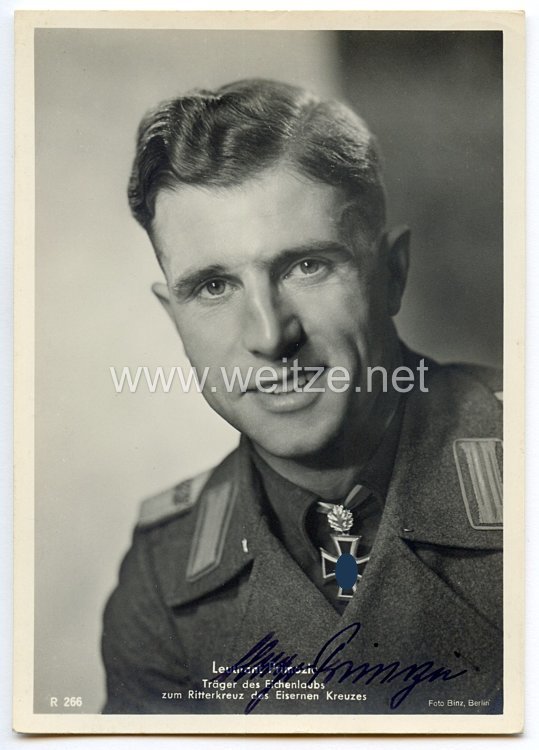
Army - Original Signature of Knight's Cross Recipient Lieutenant Hugo Primozic

on his film photo postcard, with very fine ink signature "Hugo Primozic", unmailed, condition 2.
303812
180,00

Army - Original Signature of Knight's Cross Recipient Lieutenant Hugo Primozic

This signed film-photo postcard of Lieutenant Hugo Primozic represents a significant historical document from World War II and the German Wehrmacht. As a Knight's Cross recipient, Primozic belonged to those soldiers who received Germany's highest decoration for bravery during the war.

The Knight's Cross of the Iron Cross was instituted on September 1, 1939, by Adolf Hitler as a reinstatement of the decoration awarded during World War I. It represented a grade between the Iron Cross 1st Class and higher grades such as the Knight's Cross with Oak Leaves. Throughout the entire war, this decoration was awarded approximately 7,300 times, underlining its exclusivity.

Film-photo postcards of Knight's Cross recipients were an important element of military propaganda and troop welfare during the war. The Wehrmacht and the Nazi regime systematically used the popularity of successful soldiers to boost morale on the home front and among the troops. These postcards were produced in large editions and served various purposes: they were collectibles, propaganda tools, and personal mementos simultaneously.

The production of such postcards was often carried out by specialized publishers such as Hoffmann, Franke, or the Wehrmacht's Propaganda Companies. The photographs usually showed soldiers in their best uniforms, often with visibly worn decorations. The designation “film-photo” suggests that the image possibly originated from footage of the Deutsche Wochenschau (German Weekly Newsreel) or other propagandistic film productions.

The ink signature on this postcard represents particular value. Original signatures of Knight's Cross recipients were and remain sought-after collector's items. During the war, many decorated soldiers signed such cards for comrades, admirers, or at the request of collectors. Some signatures were given in military hospitals, during troop visits, or during home leave. The authenticity of such signatures can today be verified through comparison with documented signatures in military personnel files or other contemporary documents.

The condition grade 2 of the postcard according to the collector's scale (which typically ranges from 1 for perfect to 5 for heavily damaged) indicates that the object is in very good condition, possibly with only minor signs of wear. This is remarkable for a paper document over 80 years old and significantly increases its historical and material value.

The fact that the card is unmailed means it was never sent through the postal system. This was frequently the case with cards given as personal dedications directly or kept as collectibles. Mailed cards with field post stamps have their own historical value through postal markings, but unmailed examples are often in better condition.

Such signed postcards are today important sources for military-historical research and uniform studies. They document not only the iconography of Wehrmacht propaganda but also the everyday culture of war and the way Nazi leadership staged military glory and exploited it for their purposes. Research in recent decades has increasingly recognized these “small” objects as sources that provide insights into mentalities, propaganda strategies, and the veneration of military role models.

In the modern evaluation of such historical objects, it is important to distinguish between their significance as primary historical sources and uncritical glorification. Museums and academic collections preserve such documents as testimonies of a dark epoch in German history, whereby historical context and critical classification must always be paramount.