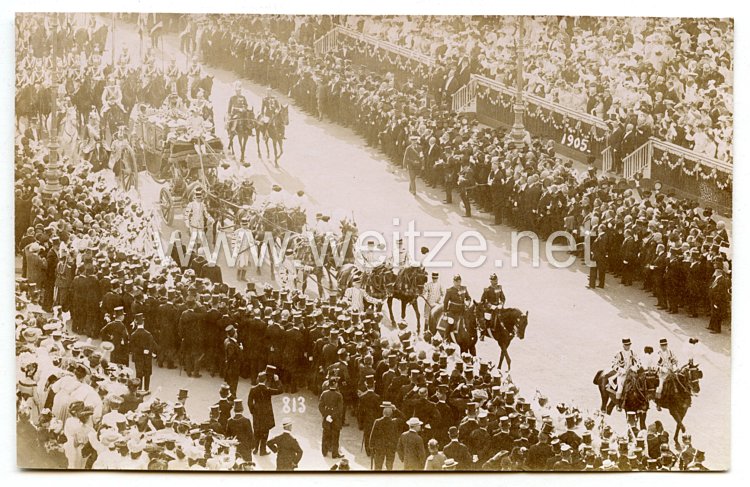
German Empire 1871-1918 Postcard Parade 1905
This postcard from 1905 documents a military parade during the era of the German Empire (1871-1918), a period characterized by intense military tradition and representative state ceremonial displays. Such postcards were a popular medium in the early 20th century for disseminating patriotic motifs and documenting military events.
The German Empire under Kaiser Wilhelm II, who reigned from 1888 to 1918, was distinguished by a particular emphasis on military splendor and ceremonial. Military parades were not merely demonstrations of military strength but also important social events that symbolized the connection between monarchy, army, and population. The year 1905 fell within a period of relative stability before the major crises of the 20th century, when the Empire sought to consolidate its power and prestige on the international stage.
Military parades during this time took place on various occasions: imperial birthdays, regimental anniversaries, state visits, or on Sedan Day, which commemorated the victory over France in 1870. These events were staged with great effort and regularly attracted thousands of spectators. The troops presented themselves in their characteristic uniforms, which varied according to branch: infantry in dark blue tunics, cavalry in splendid cuirassier or hussar uniforms, and artillery with their guns.
The postcard culture experienced its golden age around 1900. Postcards were the social medium of their time, enabling rapid communication. Particularly popular were picture cards with patriotic, military, or royal themes. Publishers produced these in large print runs, often as photographic cards or lithographic prints. Military postcards were collected not only by veterans and soldiers but also by the general population as an expression of national identity.
The photographic or artistic representation of parades on postcards followed certain conventions: they typically showed marching troops, assembled formations, cavalry squadrons, or the Kaiser inspecting troops. The images were intended to convey order, discipline, and military strength. Architecture and cityscapes were frequently incorporated, such as the Brandenburg Gate in Berlin or the grand parade streets like Unter den Linden.
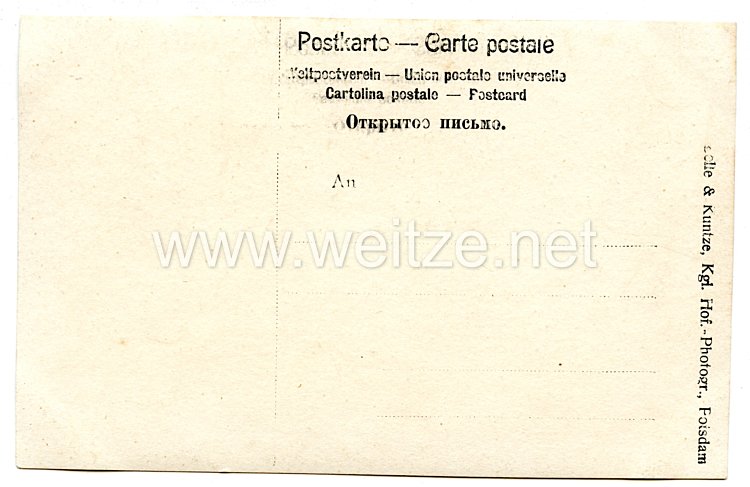
The condition rating of 2 indicates a well-preserved, only lightly used postcard. According to standard collector grading, this means the card may show minimal signs of use but is overall in very good condition. The dimensions of 13.7 x 8.7 cm correspond to the standard format for postcards of that era.
In historical context, such postcards document not only military events but also the social mentality of the Wilhelmine era. They reflect the militarization of society, in which military values such as obedience, duty, and patriotism were highly esteemed. At the same time, they demonstrate the technical development of mass media and photography, which made it possible to make events accessible to a broad audience.
For today's collectors and historians, such postcards are valuable sources. They offer insights into uniforms, military organization, urban development, and the visual propaganda of the time. The iconography of these images shaped the collective memory of a generation and influenced the perception of the military in society until the outbreak of World War I in 1914.
The preservation of such ephemeral objects as postcards is historically significant, as they were mass-produced items often not kept for posterity and are therefore rarer today than one might assume. They complement official military documents and offer a more popular perspective on military history.