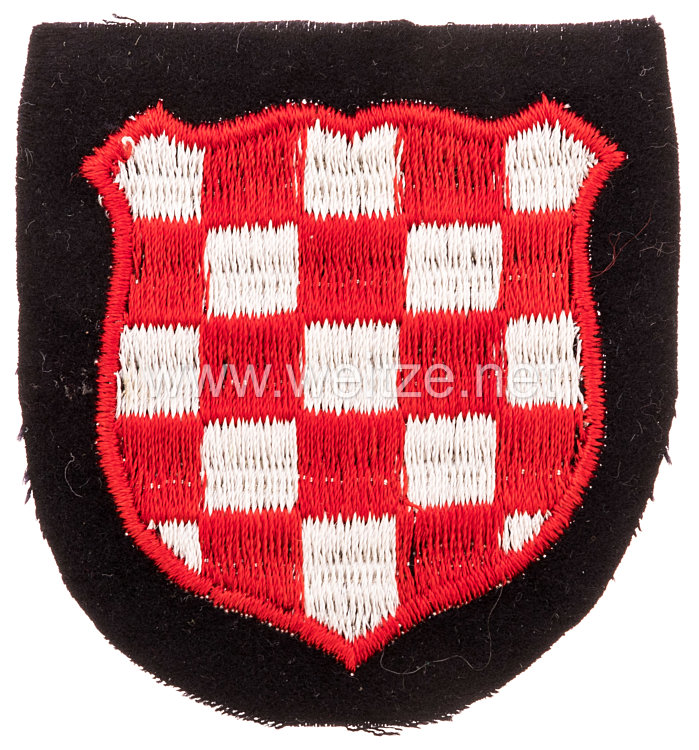
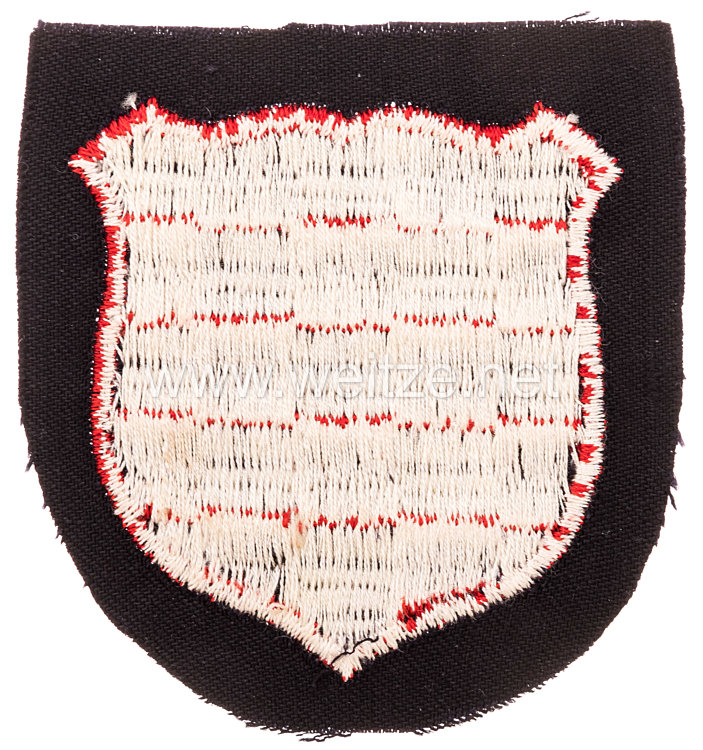
Sleeve Shield of the Croatian Volunteers of the Waffen-SS Division Handschar
The sleeve shield of the 13th Waffen Mountain Division of the SS “Handschar” (Croatian No. 1) represents a significant document of the complex history of the Waffen-SS during World War II. This unit, composed primarily of Bosnian Muslim volunteers, was established in 1943 as part of German war efforts in the Balkans.
The division was founded in February 1943 on the orders of Heinrich Himmler and was one of the first non-Germanic SS divisions. The name “Handschar” refers to a traditional Croatian scimitar and symbolized the cultural identity of the recruits. The formation occurred in the context of the partisan war in Yugoslavia, where the German Wehrmacht faced considerable resistance.
The sleeve shield typically displays the division's characteristic emblem: an arm pointing right with a drawn scimitar (Handschar) above a swastika. The design was intended to represent the connection between the Islamic tradition of the region and SS ideology. The RZM-embroidered execution described here refers to the Reichszeugmeisterei, the central procurement office of the NSDAP, responsible for quality control and standardization of uniform parts and insignia.
Recruitment for the division began in spring 1943, primarily in the Independent State of Croatia (Nezavisna Država Hrvatska), a satellite state of the Third Reich. Approximately 21,000 men, predominantly Bosnian Muslims, volunteered or were recruited. The motivation of volunteers was diverse: protection from Serbian Chetniks, economic hardship, anti-communism, and in some cases genuine sympathy for the Axis powers.
Training of the division initially took place in France, at the Le Puy training ground and later in Neuhammer in Silesia. During this period, however, significant problems arose, including a mutiny in September 1943, when some recruits deserted. The division was not declared operational until March 1944.
The division's deployment was primarily limited to anti-partisan operations in Bosnia, Herzegovina, and northeastern Croatia. The unit was involved in numerous war crimes against the civilian population, particularly against Serbian and Jewish communities. This dark history makes objects from this division controversial historical artifacts.
The technical execution of the sleeve shield followed strict SS clothing regulations. RZM-embroidered badges were machine-made on a fabric backing and were characterized by precise workmanship. The unworn example demonstrates the high quality of German military production even in the later war years.
With the advance of the Red Army in autumn 1944, the division was transferred to Hungary, where it fought against Soviet troops. However, the unit's combat effectiveness was limited, and desertions were frequent. In spring 1945, the division retreated to Austria, where it surrendered to British forces in May 1945.
After the war, many members of the division were handed over to Yugoslavia, where they were tried for war crimes. The history of the Handschar Division remains a painful chapter in Balkan history and illustrates the complexity of ethnic and religious conflicts during World War II.
From a collector's perspective, sleeve shields of this division are relatively rare, as the unit existed for only about two years and production was limited. Unworn examples in good condition are particularly scarce, as many were destroyed after the war. Such objects today serve as important historical witnesses to a tragic period and should be viewed in the context of education and historical research.