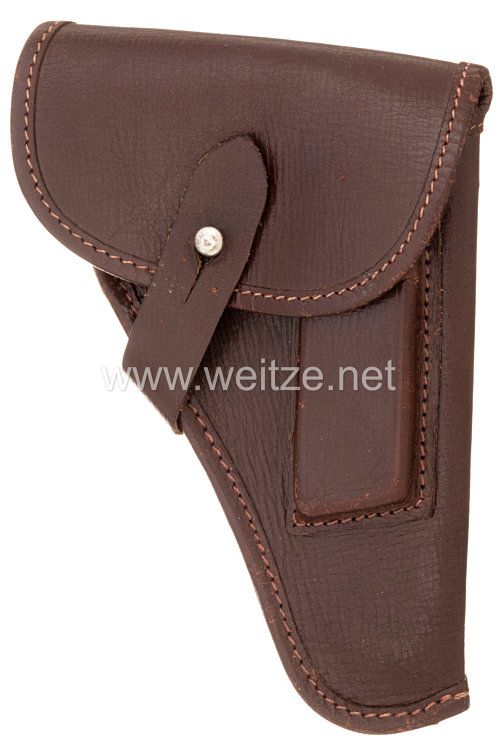
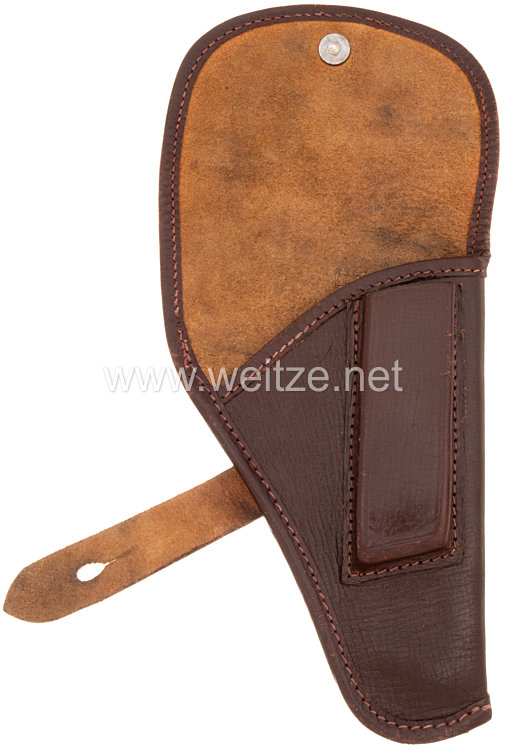
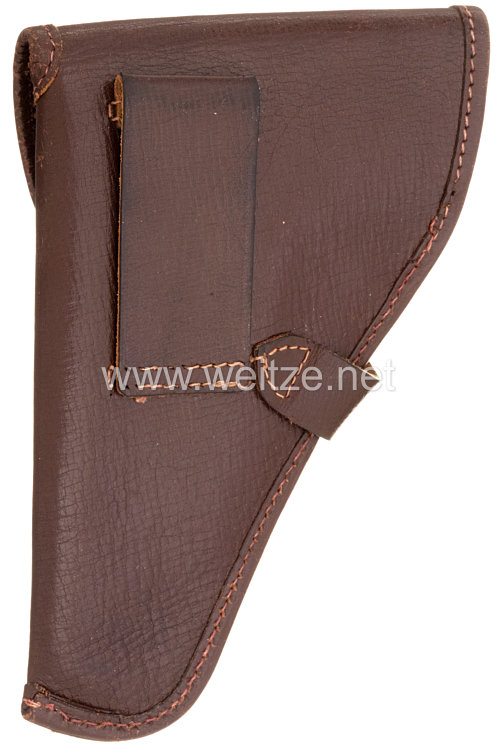
Pistol Holster for a 7.65mm

Brown leather. Worn, condition 2-
376411
70,00

Pistol Holster for a 7.65mm

Pistol Holster for 7.65mm Pistols - Military Equipment of the Early 20th Century

The pistol holster for 7.65mm caliber pistols represents a characteristic element of European military and police equipment during the first half of the 20th century. The 7.65mm caliber, also known as .32 ACP (Automatic Colt Pistol) or 7.65×17mm Browning, was developed by John Moses Browning in 1899 and quickly established itself as a standard caliber for semi-automatic pistols.

The use of brown leather as a material for military equipment followed a long tradition. Leather offered excellent protective properties, was resistant to weather conditions, and was relatively easy to work with. Brown leather was particularly favored by German, Austrian, and other Central European armed forces, while black leather was more commonly used by Western European armies.

Between 1900 and 1945, various pistol models in 7.65mm caliber were in military use. These included the Walther PP (Polizeipistole, introduced 1929), the Mauser HSc, the Sauer 38H, and various FN Browning models. These weapons were used not only by the Wehrmacht but also by police units, security services, and officers as service weapons.

The pistol holster served to protect the weapon from weather, dirt, and damage. At the same time, it enabled safe carrying on the belt or equipment harness. The construction of such holsters typically followed military regulations and service instructions that precisely specified materials, workmanship, and wearing method. The holsters were usually closable with metal buckles, snap fasteners, or leather straps and featured loops for attachment to the belt.

During World War I (1914-1918) and the interwar period, the importance of semi-automatic pistols steadily increased. Officers, signal personnel, drivers, and other specialized troops were equipped with these more compact weapons. The 7.65mm caliber was considered sufficient for military use at short distances and offered the advantage of lower recoil and higher magazine capacity compared to the larger 9mm Parabellum for the same weapon size.

In World War II (1939-1945), 7.65mm pistols were produced and deployed in large numbers. The Wehrmacht used these weapons primarily for rear-echelon services, Luftwaffe personnel, and as secondary weapons. Pistols of this caliber were also widespread among police units of the Third Reich. The corresponding leather holsters were manufactured by various producers and often bore manufacturer stamps, acceptance marks, and year dates.

The quality of workmanship of such equipment items varied depending on the time of manufacture and war situation. Early examples from the 1920s and 1930s are characterized by careful handwork and high-quality materials. As the war progressed, production had to be rationalized, which resulted in simplified constructions and sometimes inferior leather quality.

After 1945, many of these pistol holsters continued to be used. In the early Bundeswehr and police units, stocks from the pre-war period were still partially used. In other European countries, 7.65mm pistols remained in service for decades, particularly with police forces and in civilian use.

For collectors of military equipment, such pistol holsters represent important historical documents. They document the material culture of armed forces, manufacturing techniques, and military logistics. The state of preservation varies greatly, as leather is an organic material that ages through use, storage, and environmental influences. Worn pieces show the authentic patina of decades of history.