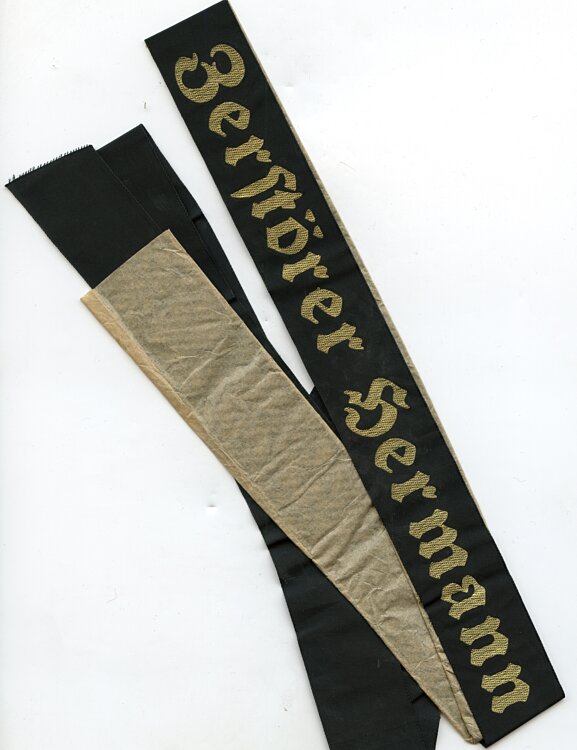
Cap Tally “Zerstörer Hermann Schoemann”
The cap tally of the destroyer Hermann Schoemann represents a significant maritime artifact from the Second World War era. Cap tallies of the Kriegsmarine were not merely functional components of naval uniforms, but also important identification markers that designated membership to a particular ship or unit.
The Hermann Schoemann was a destroyer of the Zerstörer 1934A class, also known as Type 1936A. The ship was built at the Germaniawerft in Kiel and commissioned on 9 March 1939. The destroyer was named after Korvettenkapitän (Lieutenant Commander) Hermann Schoemann (1892-1918), a German naval officer of the First World War who fell as commander of torpedo boat S 33 during an engagement in the German Bight on 23 March 1918.
With a displacement of approximately 2,400 tons and a length of 119 meters, the Hermann Schoemann was armed with five 12.7 cm guns, several anti-aircraft weapons, and eight torpedo tubes. The crew comprised approximately 320 men. The ship participated in various operations during the Second World War, including Operation Weserübung, the invasion of Norway in April 1940.
According to Kriegsmarine regulations, all enlisted ranks wore cap tallies bearing the inscription of their respective ship or unit. These ribbons were typically black with golden-yellow lettering displaying the ship's name in Latin characters. The standard length was approximately 150 centimeters, which corresponds exactly to the length described here. The ribbons were worn around the peaked cap (Tellermütze) and ended in two hanging loops at the back of the head.
The fate of the Hermann Schoemann was typical of many German warships of this era. On 2 May 1942, the destroyer participated in a convoy attack in the Arctic Ocean, known as Operation Rösselsprung. During combat with convoy QP 11, the Hermann Schoemann engaged in battle with British ships and was severely damaged. After the ship became unmaneuverability and could not be saved, it was scuttled by its own crew. Eight crew members lost their lives, while the majority of the crew was rescued by German escort vessels.
The fact that this cap tally is preserved in mint condition and in its original paper packaging makes it an exceptional collector's item. This suggests that the ribbon was possibly never issued or worn, but remained as reserve stock in a depot or warehouse. Such unworn specimens are significantly rarer than used cap tallies.
The production of these cap tallies was carried out in specialized textile manufactories according to precise Kriegsmarine specifications. The quality of the weaving technique and the durability of materials were of great importance, as the ribbons had to withstand harsh conditions at sea. The golden-yellow lettering was incorporated directly into the black ribbon through special weaving processes.
For collectors of maritime militaria and naval history, cap tallies from warships represent important historical documents. They enable the tracing of the history of individual ships and their crews. Cap tallies from ships lost in the war are particularly sought after, as they often represent the only surviving artifacts from these vessels.
The historical context of these objects must always be viewed with awareness of the tragic events of the Second World War. Today they serve as material witnesses to a dark period of German history and commemorate the sailors who lost their lives on both sides of the conflict.
Cap tallies like this Hermann Schoemann example are now protected historical artifacts in many countries. Their collection and study contributes to preserving naval history and understanding the human cost of war. Museums and maritime collections worldwide preserve such items not as glorification of war, but as educational tools to ensure future generations understand the realities of naval warfare and its consequences.