Luftwaffe - Original Signatures of Knight's Cross Recipient Generaloberst Erhard Milch

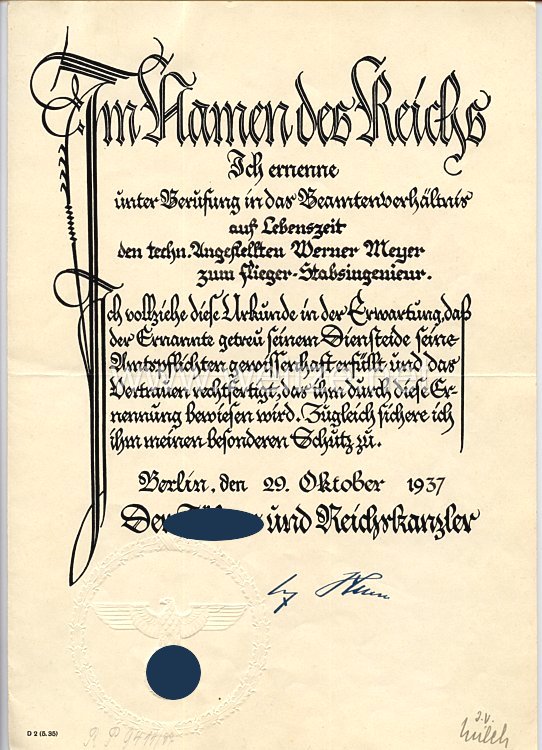
on an appointment certificate for a technical employee to Flieger-Stabsingenieur (Aviation Staff Engineer), issued in Berlin on October 29, 1937 with a very fine ink signature “Milch” i.V. (by proxy) as countersignatory. The double sheet is folded and shows signs of wear.
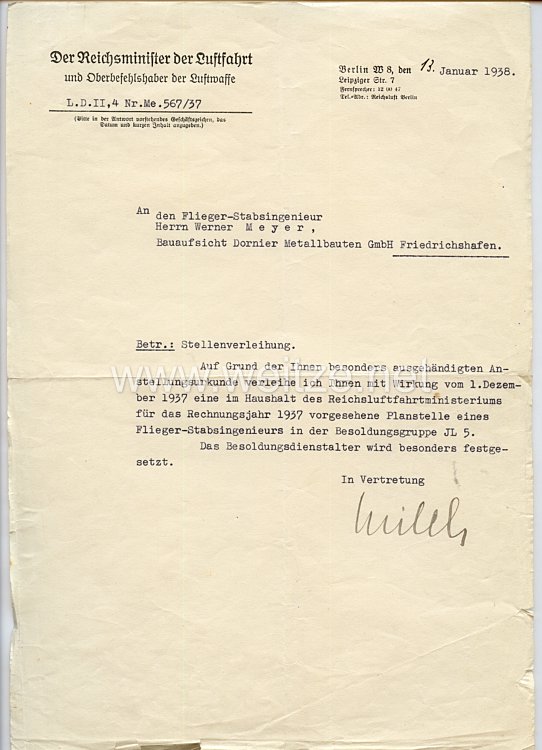
Included is the cover letter transmitting the certificate to the Flieger-Stabsingenieur at the Bauaufsicht Dornier Metallbauten GmbH Friedrichshafen dated January 13, 1938 with a very fine ink signature “Milch”; folded multiple times and showing signs of wear.
351411
250,00

Luftwaffe - Original Signatures of Knight's Cross Recipient Generaloberst Erhard Milch

These documents from 1937/38 represent significant testimony from the early developmental phase of the German Luftwaffe and bear the signature of one of its most central leadership figures: Generaloberst Erhard Milch.

Erhard Milch (1892-1972) was, after Hermann Göring, the second most important figure in the construction and development of the Luftwaffe in the Third Reich. Following a successful career at Lufthansa, where he served as director and contributed significantly to the modernization of German civil aviation, Milch was appointed by Göring in 1933 as State Secretary in the newly created Reich Aviation Ministry. In this position, he was primarily responsible for the secret construction of the Luftwaffe, which was officially revealed only in 1935.

The appointment certificate dated October 29, 1937 documents the promotion of a technical employee to Flieger-Stabsingenieur (Air Force Staff Engineer). This rank was part of the complex system of technical officials and employees that the Luftwaffe required for its development and maintenance tasks. Technical expertise was crucial for the rapid expansion of the air force. Milch recognized early that military air power depended not only on pilots and aircraft but also on a highly qualified technical infrastructure.

The signature “Milch i.V.” (in Vertretung - acting on behalf) shows that he was acting in his capacity as State Secretary on behalf of the Reich Aviation Ministry. Such signatures were by no means routine matters for lower-ranking positions - the fact that Milch himself signed these documents underscores the importance attached to technical training and qualification during this construction phase.

The accompanying transmittal letter dated January 13, 1938 is addressed to a Flieger-Stabsingenieur at the Construction Supervision of Dornier Metallbauten GmbH in Friedrichshafen. This is particularly significant as Dornier was one of the most important aircraft manufacturers in the German Reich. The company produced various bomber and reconnaissance aircraft that would later be deployed in World War II. The presence of Luftwaffe engineers at private armaments firms was part of the close-knit control system that Milch established to ensure quality and production targets.

Promotion to Flieger-Stabsingenieur was an important career step in the technical branch of the Luftwaffe. This position required comprehensive knowledge in aviation engineering, materials science, and production processes. Staff engineers were often responsible for supervising complex construction projects, quality assurance in aircraft production, or the development of new technical standards.

In 1937, the Luftwaffe was in a phase of intensive expansion. After the official announcement of its existence in 1935 and successful testing in the Spanish Civil War (1936-1939) through the Legion Condor, production capacities were massively expanded. Milch played a key role in this: he was responsible for aircraft production, training infrastructure, and technical development. His organizational skills, which he had developed at Lufthansa, served him well in this regard.

In 1940, Milch was promoted to Generalfeldmarschall (Field Marshal) and received the Knight's Cross of the Iron Cross in 1941, as mentioned in the object's title. These decorations underscore his central importance to German warfare. After the war, Milch was convicted of war crimes in the Milch Trial (1947) before the US Military Tribunal in Nuremberg, particularly for the use of forced laborers in the armaments industry, and sentenced to life imprisonment. However, he was released early in 1954.

These documents are historically valuable not only because of the signatures but also as testimony to the bureaucratic and organizational structures of the Nazi state. They demonstrate the close interconnection between military agencies and private armaments industry, as well as the importance attached to technical qualification and formal hierarchy. The visible signs of use and folding give the documents additional authenticity and remind us that these were not purely representative pieces but actually used administrative documents from one of the most consequential epochs in German history.

r