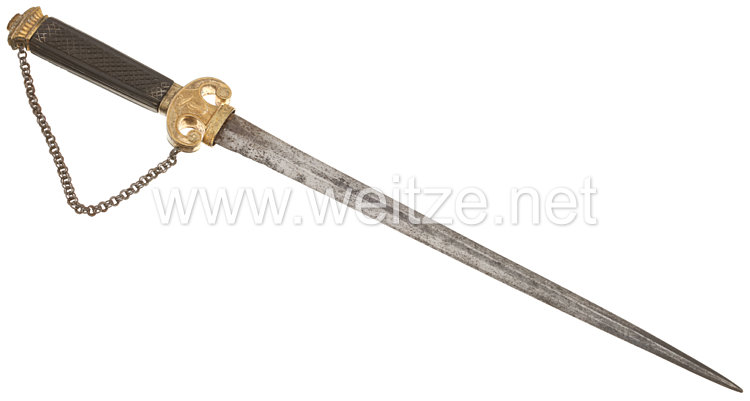
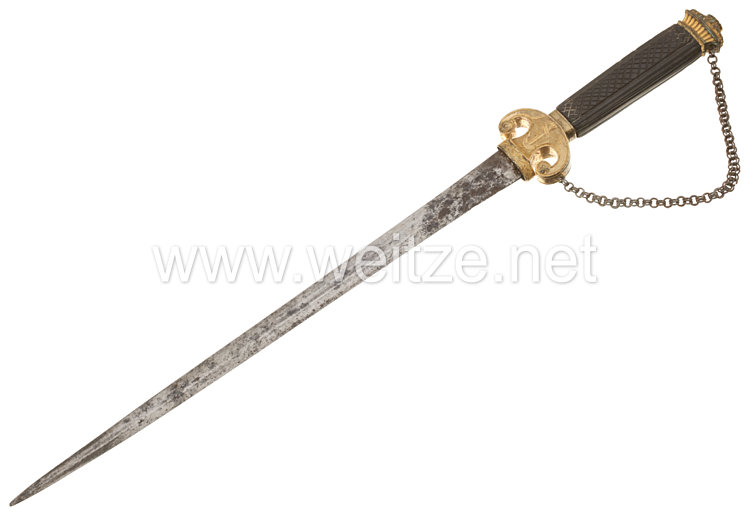
France Naval Officer's Dirk, circa 1830

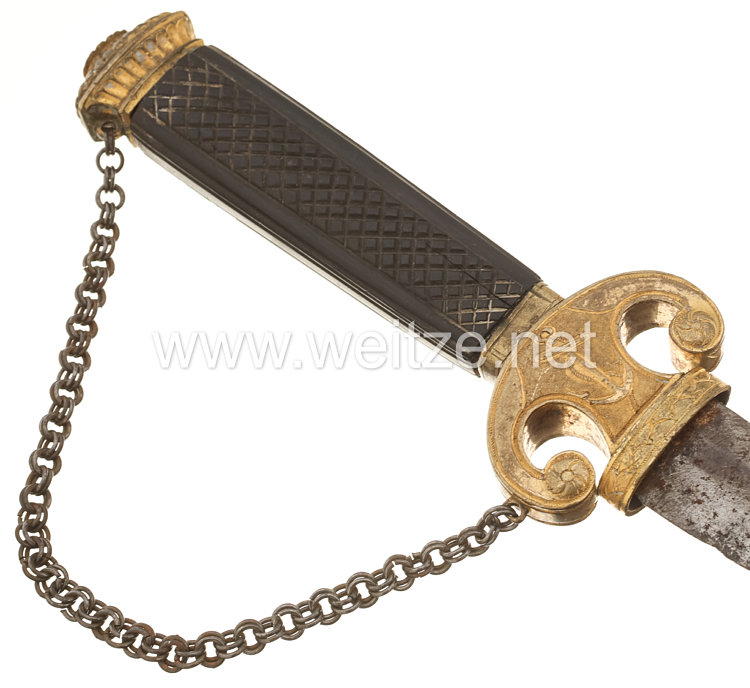
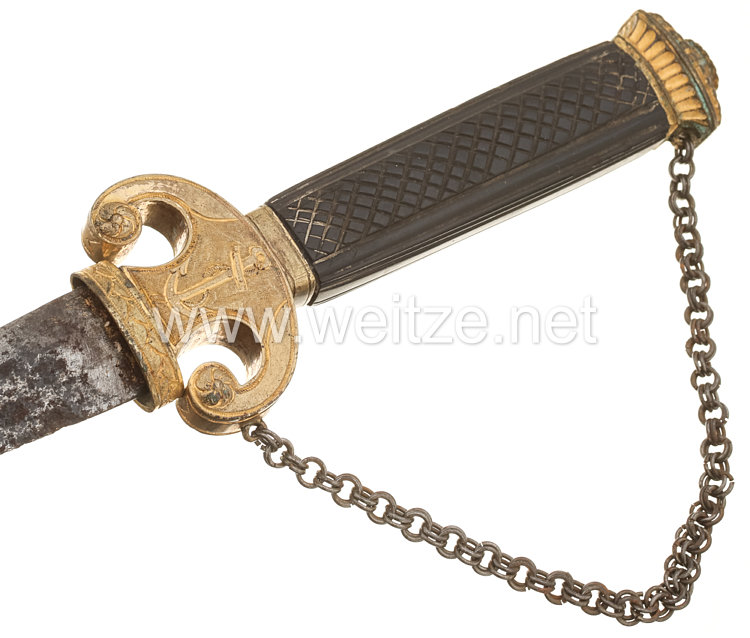
Slender rhomboid blade, unfortunately heavily corroded, traces of decorative engraving, pommel and crossguard of brass, gilt, black ebony grip, chain between pommel and crossguard, without scabbard, pronounced signs of age. Condition 2-3

Blade length approximately 370mm
Overall length approximately 530mm
370311
850,00

France Naval Officer's Dirk, circa 1830

The French naval dirk from around 1830 represents a fascinating period in the history of the Marine française and its uniform traditions. This era marks the years following the Napoleonic Wars and the beginning of the Restoration period under the Bourbons, followed by the July Monarchy under Louis-Philippe I.

The French Navy underwent a phase of reorganization and modernization during the 1820s and 1830s. After the Congress of Vienna in 1815 and Napoleon's defeat, France had to rebuild its naval forces. The Ordonnance royale of 1824 and subsequent regulations precisely defined the uniforms and armament of naval officers, including the wearing of edged weapons.

The naval officer's dirk was an important status symbol and simultaneously a functional weapon. The slender rhombic blade described here, with a length of approximately 370mm, corresponds to the typical dimensions of this era. The rhombic blade form was particularly popular for thrusting weapons, as it offered excellent penetration capability while ensuring structural stability. The remains of decorative engravings on the blade indicate the elaborate craftsmanship that characterized such officer dirks.

The use of gilt brass for the pommel and guard was characteristic of French naval dirks of this period. Gold symbolized the elevated rank of officers and emphasized their position in the military hierarchy. The black ebony grip was not only aesthetically pleasing but also practical: ebony provided a firm grip even in wet conditions at sea and was resistant to saltwater.

A distinctive feature of this type of dirk is the chain between the pommel and guard. This decorative and functional addition served multiple purposes: it acted as additional security, prevented loss of the weapon in heavy seas, and emphasized the ceremonial character of the dirk. Such chains were often artfully crafted and followed specific prescriptions of naval regulations.

In the French Navy of the 1830s, officers were required to wear appropriate edged weapons with their uniforms. The grande tenue (full dress uniform) demanded the wearing of a sword or dirk at official occasions, while the petite tenue (service uniform) had more flexible regulations. The dirk was particularly popular among junior officers and on smaller vessels, where a long sword could be impractical.

The period around 1830 was also marked by the French conquest of Algeria, which began in 1830. The Navy played a crucial role in transporting troops and in coastal operations. Officers carrying such dirks were often involved in these colonial enterprises, which considerably expanded the French colonial empire in the 19th century.

The craftsmanship of such dirks was performed in renowned weapon manufactories in Paris, Versailles, and other French cities. Well-known manufacturers such as Boutet, the former imperial gunsmith, or the Klingenthal manufactory produced high-quality edged weapons for the French armed forces. The quality of the engravings and gilding were signs of the mastery of French weaponsmiths.

The condition of the described object, with significant corrosion and clear signs of aging, is typical for weapons that were actually used in service and exposed to the elements over nearly two centuries. This distinguishes service weapons from purely ceremonial pieces, which often remained in better condition.

In summary, this naval dirk represents an authentic testimony to French naval history from a transformative era, when France was redefining its position as a significant maritime power after the Napoleonic upheavals.