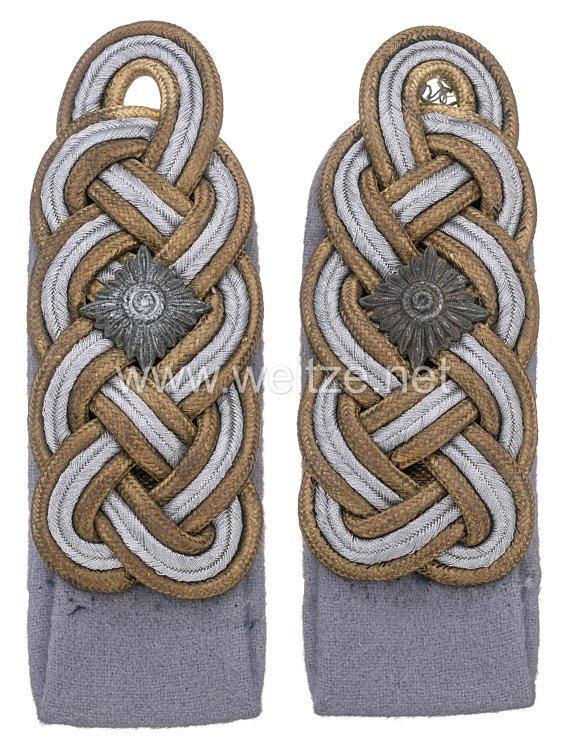
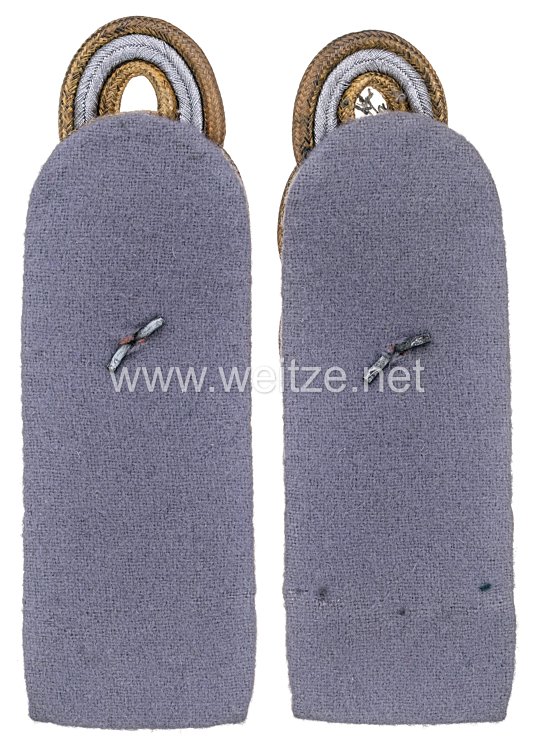
Waffen-SS Pair of Shoulder Boards for an SS-Gruppenführer
The described shoulder boards for an SS-Gruppenführer of the Waffen-SS represent a significant rank insignia from the Second World War era. These matte versions were specifically designed for the field tunic and were sewn in, as opposed to the removable versions used for parade uniforms.
The rank of SS-Gruppenführer corresponded to a Lieutenant General (Generalleutnant) in the Wehrmacht's military hierarchy and was introduced in 1932. Within the Waffen-SS, which functioned as the military arm of the Schutzstaffel, officers of this rank held important command positions, frequently serving as divisional commanders or in staff and administrative functions. The SS rank structure was based on traditional military ranks but used its own nomenclature, which formed part of National Socialist ideology and symbolism.
The shoulder boards (Schulterstücke) served as the primary means of rank identification on the uniform. For an SS-Gruppenführer, they typically consisted of silver-colored aluminum braid on a black or field-grey background, with three silver stars (pips) to denote the rank. The “matte finish” described here was characteristic of field uniforms, as shiny metal fittings were undesirable in combat situations – they could create light reflections and reveal the wearer's position.
The distinction between parade and field versions was firmly established in German military tradition. While parade uniforms featured shiny, often silvered or gilded rank insignia, field uniforms employed subdued, matte materials. These field tunic shoulder boards were sewn directly onto the uniform, ensuring their permanent attachment and meeting the practical requirements of field service.
The Waffen-SS developed from armed SS units into a full-fledged military formation operating parallel to the Wehrmacht from 1939 onwards. By the end of the war, it comprised 38 divisions with approximately 950,000 men. Officers holding the rank of SS-Gruppenführer bore considerable responsibility for military operations and were frequently involved in war crimes, which led to the later condemnation of the entire SS organization as criminal by the Nuremberg Tribunal.
SS uniform regulations were meticulously detailed in various service regulations. The SS-Dienstanzugvorschrift (SS Service Dress Regulations) precisely specified how rank insignia were to be worn, which materials were to be used, and how they were to be attached. These regulations changed several times during the war, particularly as material shortages led to simplifications and substitutions.
The condition described as “clearly worn” and “removed from the uniform” is typical of preserved uniform items from this period. After the war's end, many uniforms were destroyed, buried, or stripped of their insignia, as wearing SS symbols in occupied Germany was prohibited under penalty of law. Surviving pieces were often taken as war trophies by Allied soldiers or removed and hidden by German soldiers themselves.
From a historical perspective, such objects are important material witnesses to a dark epoch in German history. They document the military organization, hierarchy, and symbolism of the Nazi regime. Their preservation and scientific documentation serves historical research and education, while the crimes committed by wearers of such uniforms must never be forgotten.
The collection and exhibition of such objects is subject to strict legal regulations in Germany and other countries. The handling of Nazi memorabilia is regulated by the Criminal Code, particularly §86a (Use of Symbols of Unconstitutional Organizations). Historical research, education, and documentary purposes are expressly exempted from the prohibition.
These shoulder boards thus represent not merely a military-historical object, but also a memorial to the dangers of totalitarian ideologies and the importance of critical historical examination.