WHW - Gau 29: Schleswig-Holstein - 4th WHW 1936/37 - 23.01.1937

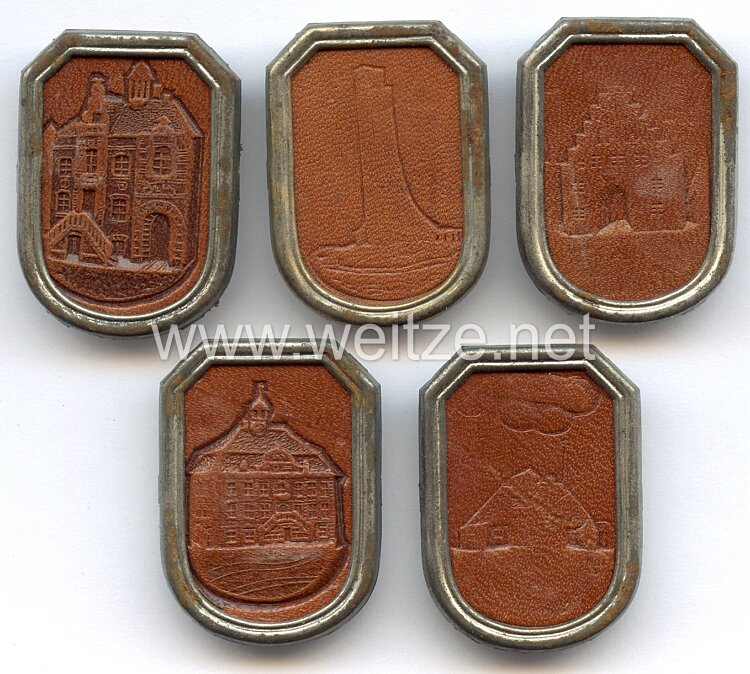
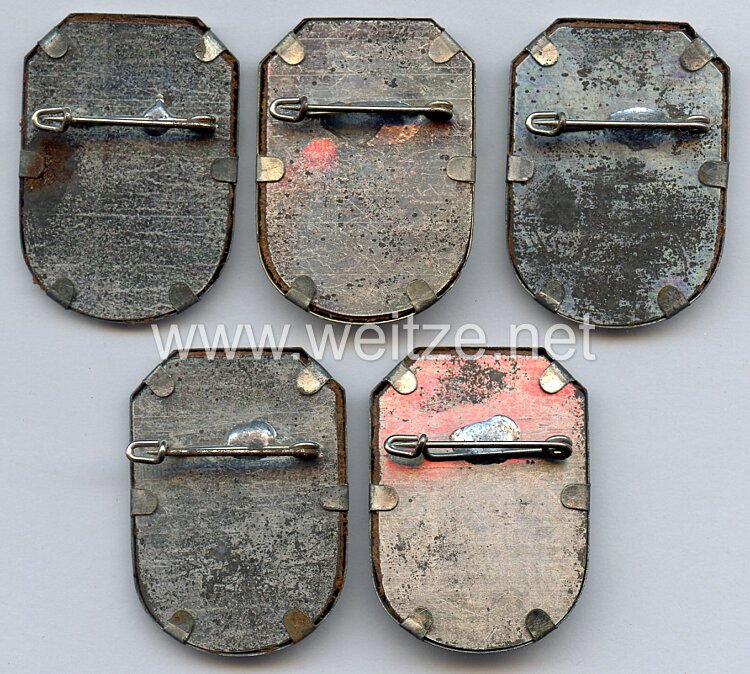
“Buildings”, complete series of 5 leather badges in metal frames, on pin; condition 2.
263010
35,00

WHW - Gau 29: Schleswig-Holstein - 4th WHW 1936/37 - 23.01.1937

The present object ensemble originates from the Winterhilfswerk (WHW) or Winter Relief Organization of National Socialist Germany and represents a complete series of five leather badges from Gau Schleswig-Holstein (Gau 29) of the fourth WHW campaign 1936/37, issued on January 23, 1937. These badges belong to the thematic series “Bauten” (Buildings) and are each set in metal frames and equipped with a pin for attachment to clothing.

The Winterhilfswerk was founded in September 1933 as a social welfare organization and rapidly developed into one of the largest Nazi mass organizations. Under the leadership of Erich Hilgenfeldt, who headed the Main Office for Public Welfare, the WHW organized annual collection campaigns during the winter months from October to March. The official purpose was to help needy German families through the cold season with food, coal, clothing, and cash.

The WHW badges played a central role in the donation system. In exchange for a donation, citizens received small pins, plaques, or, as in the present case, leather badges, which they wore visibly on their clothing. This served multiple purposes: on one hand, the badges functioned as donation receipts; on the other hand, they created social pressure, as the absence of such a badge publicly revealed who had not donated. The system was effectively a disguised tax, as hardly anyone could escape the social pressure.

The fourth WHW campaign of 1936/37 was particularly elaborately organized. Each campaign comprised several collection days and weeks during which different thematic series of badges were issued. The themes varied greatly: from regional motifs to traditional costumes, animals, fairy tale figures, to architectural representations as in the present “Buildings” series.

Gau Schleswig-Holstein (Gau 29) was one of the 43 administrative districts (Gaue) of the German Reich after the Nazi territorial reform. Each Gau issued its own regionally specific WHW badges that often depicted local peculiarities, buildings, traditional costumes, or other cultural features of the respective region. This made the badges sought-after collector's items, which was intended to increase willingness to donate.

The choice of leather in metal frames was relatively unusual for WHW badges and made this series particularly special. Most WHW badges were made of metal, wood, cardboard, glass, or ceramic. Leather badges were more elaborate to produce and were therefore manufactured less frequently. The combination with metal frames gave the badges additional stability and a more high-quality character.

The issue date of January 23, 1937 falls in the middle of the winter campaign 1936/37. On such collection days, members of NS organizations, particularly the NS-Volkswohlfahrt (NSV) or Nazi People's Welfare, the Hitler Youth (HJ), and the League of German Girls (BDM), were out on the streets collecting donations and distributing the badges.

The complete series of five badges described here is particularly valuable from a collector's perspective, as complete series are much rarer than individual pieces. Many badges were lost, damaged, or separated over the decades. The indicated condition 2 suggests good to very good preservation, with possibly slight signs of use but without significant damage.

The WHW collected enormous sums during its existence from 1933 to 1945. In the 1936/37 campaign alone, over 400 million Reichsmarks were supposedly collected. While a portion was actually used for social purposes, considerable funds flowed into armament and other state projects. The WHW was thus not only a welfare instrument but also an important propaganda and financing tool of the Nazi regime.

From today's perspective, WHW badges are important contemporary historical documents that provide insight into everyday culture, propaganda mechanisms, and social control of the Nazi state. They document how the regime combined social welfare with ideological penetration and incorporated every citizen into the system. For collectors and historians, regionally specific series such as the present one from Schleswig-Holstein are of particular interest, as they illustrate the decentralized organization of the WHW and the local design of Nazi propaganda.