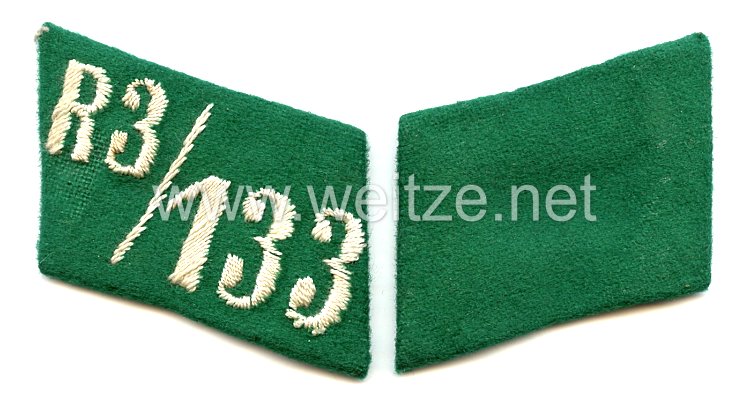
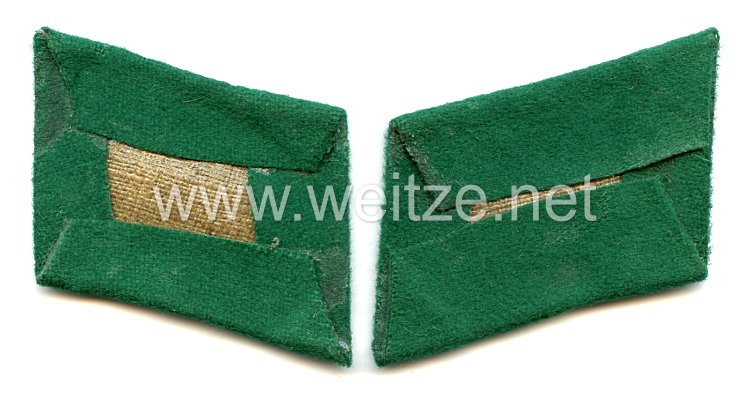
SA Pair of Collar Tabs SA-Gruppe Sachsen Reservesturm 3 of Standarte 133

Location Zwickau, circa 1933. Green wool with white embroidery "R3/133", unworn, condition 2.
424110
90,00

SA Pair of Collar Tabs SA-Gruppe Sachsen Reservesturm 3 of Standarte 133

These SA collar tabs represent a significant testament to the Nazi paramilitary organization during the early phase of their seizure of power. These rank insignia belonged to SA-Gruppe Sachsen (SA Group Saxony) and identified a member of Reservesturm 3 of Standarte 133 (Reserve Storm 3 of Regiment 133), stationed in Zwickau, dating to approximately 1933.

The Sturmabteilung (SA), or Storm Troopers, was founded in 1920/21 as the paramilitary combat organization of the NSDAP. Its members, known as the Brownshirts, played a central role in the rise of the Nazis to power. The SA was organized territorially into Groups, Subgroups, Standarten (regiments), Sturmbanne (battalions), and Stürme (companies). SA-Gruppe Sachsen was one of the regional main divisions and encompassed the territory of the Free State of Saxony.

The year 1933 marks a turning point in the history of the SA. After Hitler's seizure of power on January 30, 1933, the organization experienced massive membership growth. Within a few months, its strength swelled from approximately 500,000 to over 2 million members. This rapid expansion made the establishment of Reserve Stürme necessary to organizationally capture and structure the new members.

Standarte 133 was one of numerous local SA units in Saxony. Zwickau, as an industrial city in the Saxon Vogtland, had an active SA presence. The Standarte was divided into several Stürme and Reserve Stürme, with the latter often consisting of members who joined later or were less active.

The collar tabs described here are made of green cloth, which was characteristic of SA-Gruppe Sachsen. The various SA Groups used different base colors for their collar tabs to indicate regional affiliation. The white embroidery with the designation “R3/133” clearly identifies the wearer as a member of Reserve Storm 3 of Standarte 133. The “R” stands for “Reserve,” the number 3 for the third storm of this category, and 133 for the superior Standarte.

The unworn condition of these collar tabs is remarkable and raises interesting questions. They may have been manufactured for a wearer who never entered service, or they remained unused for other reasons. This could be related to the turbulent events of 1933, when the SA was in a phase of rapid expansion and reorganization.

The uniforming and rank designation of the SA followed detailed regulations. The collar tabs were worn in pairs on the collar ends of the brown SA uniform and served for quick identification of unit affiliation. They were part of a complex system of insignia that also included sleeve stripes, shoulder pieces, and various rank badges.

After the seizure of power in 1933, the SA increasingly developed into an uncontrollable force. Its leader, Ernst Röhm, sought greater influence and demanded a “second revolution.” This led to conflict with the Reichswehr and other power holders. The tensions erupted in the Night of the Long Knives on June 30, 1934, when Hitler had the SA leadership eliminated. After this event, the SA lost its political significance but continued to exist until 1945.

From today's perspective, such objects are important historical sources for researching National Socialist organizational structures and the everyday history of that time. They document territorial organization, symbolism, and the material culture of the SA. At the same time, they remind us of the dark side of German history, when paramilitary organizations were used to intimidate political opponents and enforce National Socialist tyranny.

The collection and scientific documentation of such objects today occurs exclusively for historical and educational purposes. They serve to educate about the mechanisms of totalitarian rule and warn of vigilance against extremist tendencies.