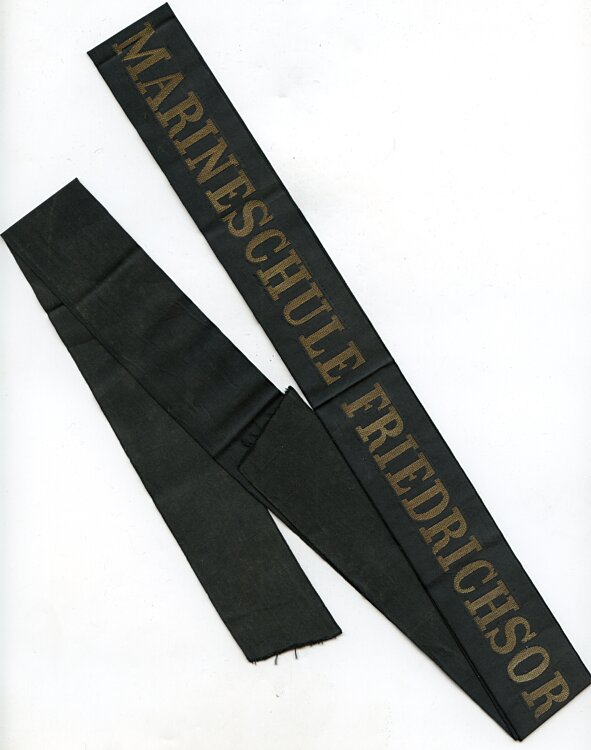
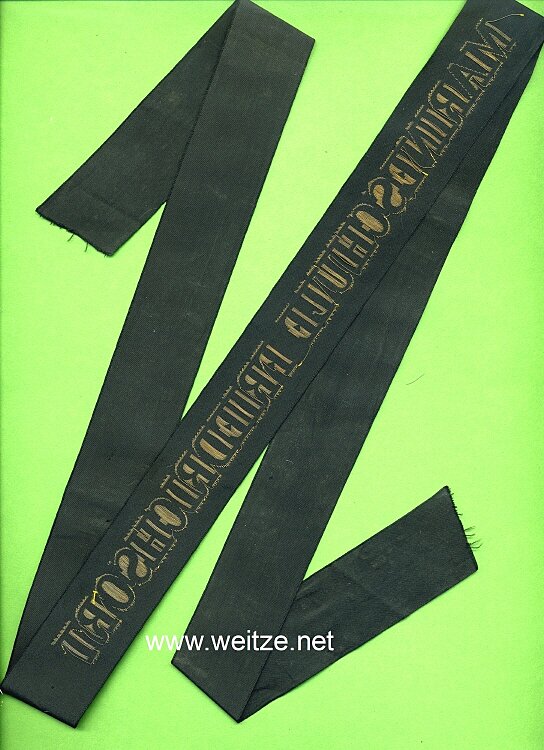
Reichsmarine Cap Tally "Marineschule Friedrichsort"

Metal thread woven, worn condition, 120 cm long. Condition 2
164310
30,00

Reichsmarine Cap Tally "Marineschule Friedrichsort"

The cap tally of the Naval School Friedrichsort represents a fascinating testimony to German naval history during the Weimar Republic. These ribbons, woven with metal thread, were worn by naval personnel on their service caps and served to identify their respective unit or ship.

The Marineschule Friedrichsort was located on the peninsula of the same name in the Kiel Fjord and was one of the most important training facilities of the Reichsmarine. The school had its roots in the Imperial Navy, but was reorganized after World War I under the restrictions imposed by the Treaty of Versailles of 1919. The treaty limited the German Navy to 15,000 men and prohibited the possession of modern warships, submarines, and naval aviation.

Friedrichsort primarily served for the training of petty officers and enlisted personnel. The naval school was known for its thorough and disciplined training, which was maintained despite the limited resources of the Weimar Republic. The curriculum included basic seamanship, weapons training, navigation, and military discipline. Many of the sailors trained here formed the backbone of the Reichsmarine in the 1920s and early 1930s.

The tradition of cap tallies in the German Navy dates back to the 19th century. Originally, they served practical purposes – keeping the cap secure in wind and weather. Over time, however, they evolved into important identification markers. Each ship, shore establishment, and naval school had its own characteristic cap tally with specific lettering.

The technical execution of these ribbons was remarkable. The higher-quality specimens, like the one described here, were woven using metal thread technique. Real metal threads – typically made of gold-plated or silver-plated wires – were incorporated into the textile structure. This not only gave the ribbons a prestigious sheen but also exceptional durability. The standard length of approximately 120 cm complied with regulations and allowed the ribbon to wrap twice around the cap with ends hanging down at the back of the neck.

The lettering was usually executed in gold or silver script on a black or dark blue background. The text “Marineschule Friedrichsort” was rendered in characteristic Fraktur script or in Latin letters. The ends of the ribbon were often fitted with small metal edgings to prevent fraying.

The historical context of the Reichsmarine (1919-1935) is essential for understanding these objects. After the defeat in World War I and the Revolution of 1918/19, the Navy had to be completely rebuilt. The Provisional Reich Navy was founded in 1919 and officially renamed Reichsmarine in 1921. Despite the drastic restrictions imposed by the Treaty of Versailles, the leadership endeavored to maintain a professional and well-trained navy.

The political situation of the Weimar Republic was also reflected in the Navy. The naval mutinies of 1918 in Kiel, which had triggered the revolution, were still fresh in memory. The Reichsmarine was therefore particularly concerned with discipline and political reliability. At the same time, it struggled with chronic lack of funds and outdated equipment.

Cap tallies like the present one were worn exclusively by enlisted ranks and petty officers. Officers instead wore caps with cockades and golden oak leaves. This clear distinction was part of the Navy's strictly hierarchical system.

The Marineschule Friedrichsort remained active well into the Nazi period. With the renaming of the Reichsmarine to Kriegsmarine in 1935 and the massive rearmament under Hitler, the cap tallies also changed. The inscriptions were adapted, and production methods became increasingly standardized.

Today, original Reichsmarine cap tallies are sought-after collector's items and important maritime relics. They document not only uniform history but also the organizational structure of the Navy between the world wars. Worn specimens, like the one described, are particularly valuable because they show authentic traces of use and were actually worn by naval personnel in service. They connect us directly with the young men who received their training at Friedrichsort and were part of a difficult transitional period in German history.

r