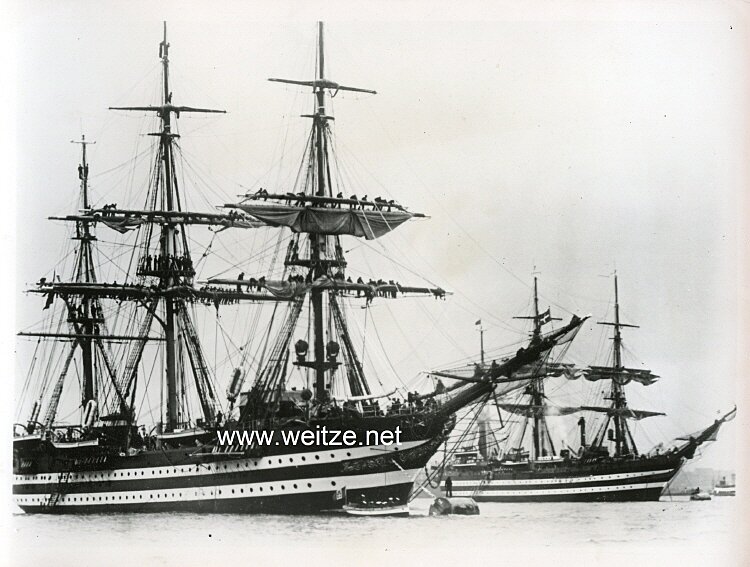
Press Photograph "Italian Training Ships in Kiel"
Press Photography of Italian Training Ships in Kiel: German-Italian Naval Relations in the Interwar Period
This press photograph documents the visit of Italian training ships to the German naval base at Kiel, a significant event reflecting the maritime and diplomatic relations between Germany and Italy. Such photographs served not only journalistic purposes in the first half of the 20th century but were also important instruments of public diplomacy and naval propaganda.
Kiel as a Naval Base
Kiel developed into one of Germany's most important naval ports since the 19th century. After the founding of the German Empire in 1871 and the expansion of the Imperial Navy, Kiel became the main base of the German fleet in the Baltic Sea. The Kiel Canal (Nord-Ostsee-Kanal), opened in 1895, significantly enhanced the strategic importance of the location. Even after World War I and the drastic restrictions imposed by the Treaty of Versailles in 1919, Kiel remained an important naval location for the Reichsmarine and later the Kriegsmarine.
Training Ships and Naval Education
Training ships played a central role in the education of naval officers and cadets. The Regia Marina, the Italian Royal Navy, maintained a proud tradition of sailing training ships that were essential for the practical training of young officers. The most famous Italian sailing training ship was the Amerigo Vespucci, launched in 1931 and still in service today. Other vessels such as the Cristoforo Colombo (1928) also served training purposes.
Such training ships regularly undertook extensive training voyages that served not only maritime education but also fulfilled diplomatic functions. Visits to foreign ports provided opportunities for cultural exchange and demonstration of maritime tradition and capability.
German-Italian Relations
Relations between Germany and Italy developed intensively throughout the 1920s and 1930s. While Italy had been under fascist rule under Benito Mussolini since 1922, the National Socialist regime came to power in Germany in 1933. Ideological proximity led to increased cooperation, which also manifested in the maritime sphere.
Naval visits were important components of these relations. They served the exchange of experience, mutual inspection, and not least the demonstration of alliance loyalty. The Rome-Berlin Axis, which formed from 1936 onward, further intensified these contacts. The Pact of Steel of 1939 finally sealed the German-Italian military alliance.
Press Photography as Historical Source
Press photographs like this one are valuable historical documents. During the interwar period and World War II, press photography became increasingly subject to state control. In Germany, the Reich Ministry of Public Enlightenment and Propaganda under Joseph Goebbels coordinated image reporting. In Italy, the fascist regime also strictly controlled the media.
Such photographs were typically taken by official naval photographers or accredited press photographers and distributed through press agencies. The caption on the reverse side, present on this specimen, usually contained information about the depicted event, the date, sometimes also usage instructions and censorship notes.
Format and Technical Aspects
The format of approximately 22 x 16.5 cm corresponds to common press photo formats of the time. Photographs were usually printed on baryta paper, a photographic paper coated with barium sulfate known for its excellent image quality. Captions on the reverse were often applied with stamps or typewritten texts, sometimes also handwritten.
Historical Significance
Such photographs document not only military-historical events but also the staging of international relations by the authoritarian regimes of the 1930s. They show how the military and navy were used as instruments of foreign policy and propaganda. Training ship visits combined the traditional courtesy of maritime customs with the new political reality of the emerging Axis powers.
For collectors and historians, such press photographs are important primary sources that provide insight into the visual culture and propaganda practices of the time. They complement written sources and help paint a more complete picture of military and diplomatic history.