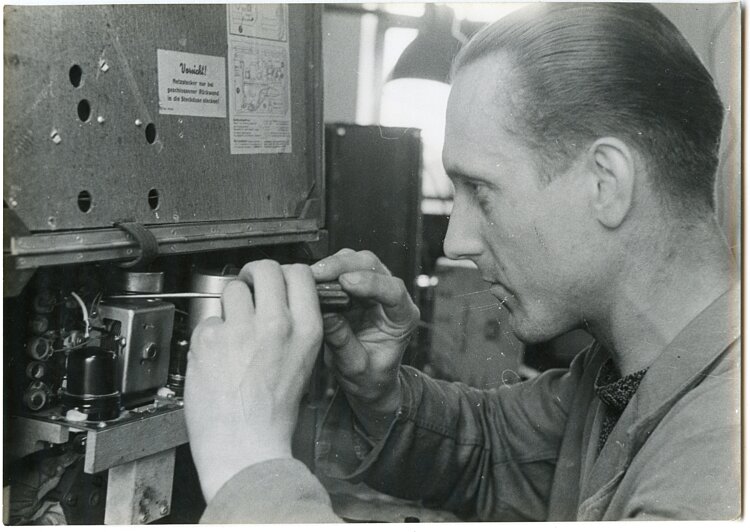
Press Photograph, Luftwaffe Electrician Repairing a Radio Receiver

, approx. 12 x 17 cm, repair workshop, condition 2.
208610
15,00

Press Photograph, Luftwaffe Electrician Repairing a Radio Receiver

Historical Context: Press Photograph of Luftwaffe Electricians Repairing a Receiver

This press photograph from the Second World War era documents an important but often overlooked aspect of the German Luftwaffe: the technical maintenance of radio receivers by specialized electricians. With dimensions of approximately 12 x 17 cm, it corresponds to the typical format of press photographs produced by the Wehrmacht's Propaganda Company (PK - Propagandakompanie) for publication in newspapers and magazines.

The Luftwaffe Signal Corps played a crucial role in the operational structure of the German air force. Without functioning radio equipment, coordinated air warfare was impossible. Electricians and radio technicians were among the highly qualified specialists whose training took several months to years to complete. They were responsible for the maintenance, repair, and restoration of complex electronic devices that were subjected to extreme stress under combat conditions.

The radio receivers of the Luftwaffe were technically sophisticated devices for their time. Among the most common models were the EZ 6, E 10, and various versions of FuG equipment (Funkgerät - radio device). These receivers required regular calibration, frequency accuracy checks, and repair when damaged. Repair workshops were located both at airfields and in rear areas, equipped with special testing devices, oscilloscopes, and measurement equipment.

The importance of such repair workshops cannot be overstated. During the course of the war, especially from 1943 onward, as material shortages increased and the production of new equipment was hampered by Allied bombing, the restoration of existing equipment became increasingly important. Workshops had to improvise and salvage parts from damaged equipment, a process known as “cannibalization.”

Press photographs like this one served multiple functions. On one hand, they were meant to demonstrate the technical superiority and organization of the German Wehrmacht; on the other, they honored the important work of ground personnel who often remained in the shadow of celebrated pilots. The Propaganda Companies produced hundreds of such images daily, only a fraction of which were published. The images underwent strict censorship procedures to ensure that no militarily sensitive information was disclosed.

The technical training of Luftwaffe electricians took place in specialized Luftnachrichtenschulen (Air Signal Schools), such as those in Halle, Kaufbeuren, or Köthen. Training included theoretical foundations of electrical engineering, high-frequency technology, and practical exercises on original equipment. Particularly talented technicians could be assigned to advanced courses where they participated in the development of new equipment or repair procedures.

The format of approximately 12 x 17 cm corresponds to the postcard or contact print format that was standard in the 1940s. Such photographs were developed on baryta paper and often marked on the reverse with censorship stamps, image numbers, and brief descriptions. Condition 2 indicates well-preserved material with minor signs of use, which is remarkable for historical photographs from this period.

The depiction of workshop activities in war photography was part of a comprehensive propaganda strategy that sought to present the war as an organized, technically professional enterprise. Unlike dramatic combat scenes, such images show the “invisible” side of war – the logistical and technical support without which no military operation would have been possible.

Today, such press photographs are important historical documents that provide insights into military daily life, technical equipment, and the working conditions of ground personnel. They complement the often one-sided picture dominated by combat operations and serve as reminders of the thousands of technicians, mechanics, and specialists whose work was crucial to the course of the war.

r