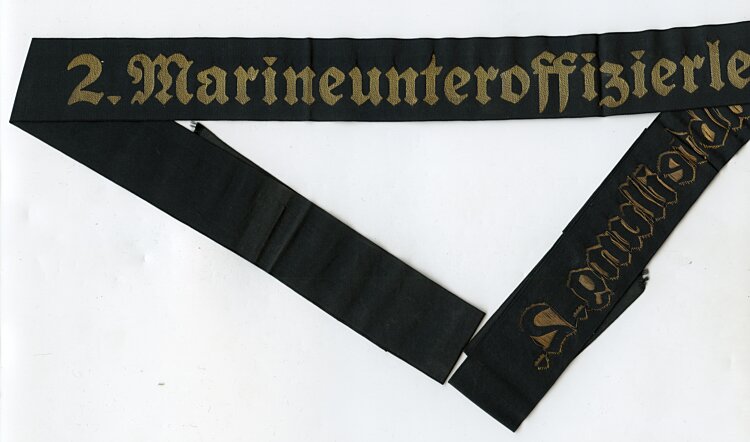
This cap tally from the 2nd Naval NCO Training Division 2 of the Kriegsmarine represents an authentic artifact of German naval training during World War II. These cap tallies were part of the standard uniform of German naval personnel and served both for identification purposes and to foster esprit de corps within the various units.
The Kriegsmarine was officially established in 1935 following the Nazi seizure of power, replacing the Reichsmarine of the Weimar Republic. With rearmament and the repudiation of the Treaty of Versailles, the German Navy expanded considerably, creating an enormous demand for qualified personnel. The Naval NCO Training Divisions played a central role in the systematic training of non-commissioned officers who formed the backbone of the naval forces.
The cap tally was woven with metal thread, a technique characteristic of high-quality cap tallies. The metal thread, typically made of gold or silver-plated copper wire, was interwoven with black cotton yarn to create the golden letters on a black background. This manufacturing method was labor-intensive and required specialized weavers, often based in traditional textile centers such as Wuppertal or other German industrial cities.
The Naval NCO Training Divisions were specialized training facilities established following the expansion of the Kriegsmarine. The numbering indicates several parallel institutions designed to meet the growing training requirements. Training encompassed both theoretical and practical components, including navigation, seamanship, weapons technology, naval discipline, and military leadership. The training duration varied depending on specialization but typically lasted several months.
According to the Kriegsmarine uniform regulations, enlisted men and non-commissioned officers wore the traditional sailor's cap with its characteristic cap tally. The tally was wrapped around the cap and fastened at the back with a bow. The inscription identified affiliation with a particular unit, ship, or, as in this case, a training facility. This enabled quick identification of unit affiliation and fostered cohesion within the unit.
The condition of this specimen is described as “lightly worn” with a rating of 1-2, indicating minimal signs of use. This suggests that the tally was actually worn but has remained well-preserved. Such authentic signs of wear give historical objects special value as they document actual use by a naval serviceman.
The training facilities of the Kriegsmarine were located at various sites along the German coasts. Important naval bases and training centers included Kiel, Wilhelmshaven, Flensburg-Mürwik, and Stralsund. The precise location of the 2nd Naval NCO Training Division 2 would require further archival research, as facilities could also be relocated or restructured during the course of the war.
Cap tallies like this are today important military historical collectibles that provide insight into the organizational structure and daily life of the Kriegsmarine. They document not only the formal hierarchy but also the importance of training in an increasingly technically complex form of naval warfare. The Kriegsmarine relied on state-of-the-art technology, from submarines to heavy cruisers, which required correspondingly qualified personnel.
From today's perspective, such objects are important sources for researching the military history of the Third Reich. They help historians reconstruct the structures, training pathways, and everyday life of naval personnel. At the same time, they serve as reminders for critical engagement with this dark chapter of German history.
The metal thread weaving technique used in these tallies represented a traditional craft that combined functionality with aesthetic appeal. The gold-colored lettering stood out clearly against the black background, ensuring visibility while maintaining the formal elegance expected of naval uniforms. The durability of this weaving method meant that tallies could withstand the harsh maritime environment and regular wear.