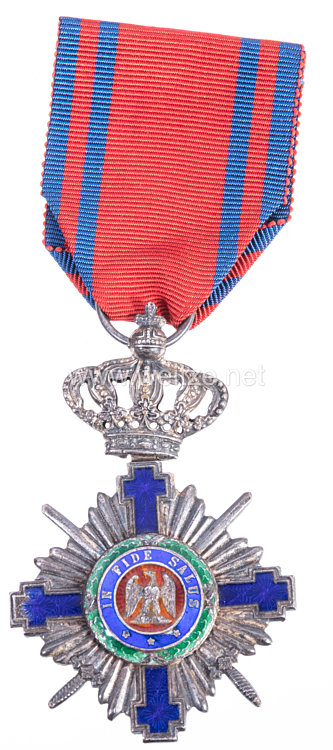
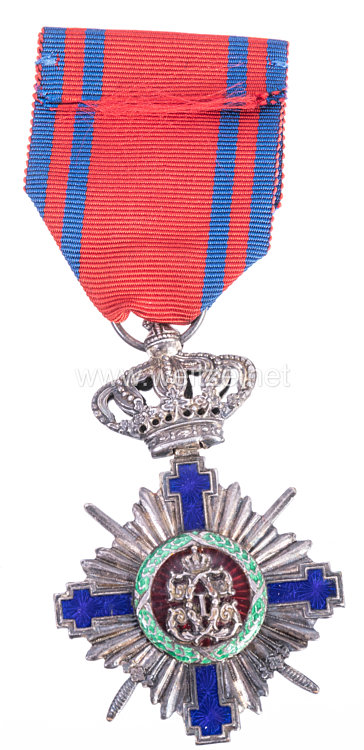
Kingdom of Romania: Order of the Star of Romania 1st Model 1877-1932, Knight's Cross with Swords
The Order of the Star of Romania (Romanian: Ordinul Steaua României) ranks among the most significant decorations of the Kingdom of Romania and represents an important epoch in Romanian history. The Knight's Cross with Swords of the first model (1877-1932) described here documents military recognition during a formative period of Romanian statehood.
The Order was established on May 10, 1877 by Prince Carol I, immediately before Romania's entry into the Russo-Turkish War. This historical context is of crucial importance: the decoration was created to honor exceptional merit in both civilian and military spheres, while Romania was fighting for its independence from the Ottoman Empire. The successful participation in the war led to the international recognition of Romanian independence at the Congress of Berlin in 1878.
The first model of the Order, awarded from 1877 to 1932, is distinguished by specific design characteristics. The Knight's Cross is made of silver-plated metal and characteristically enameled on both sides. The cross form typically displays the Romanian coat of arms in the center, surrounded by a blue medallion bearing the inscription “IN FIDE SALUS” (In Faith Lies Salvation). The arms of the cross are decorated with enamel work that speaks to the high craftsmanship quality of Romanian order manufactures during this period.
The swords on this specimen are of particular historical significance. They were added exclusively for awards recognizing military merit, thus clearly identifying this as a decoration for wartime service. The crossed swords between the arms of the cross distinguish this military variant from the civil version without swords. This makes such pieces important witnesses to Romanian military history between the War of Independence in 1877/78 and the end of the monarchy.
The Order was structured in five classes: Grand Cross, Grand Officer, Commander, Officer, and Knight. The Knight's Cross represented the fifth and most frequently awarded class, though this does not mean the decoration was commonplace. The criteria for award were strict, and each decoration had to be justified by concrete merits. Both Romanian nationals and foreign military personnel and diplomats could be honored with the Order, giving it an international character.
The original ribbon on which the cross was worn is preserved with this specimen—an important authentic detail. The ribbon of the Star of Romania was traditionally rendered in the Romanian national colors of blue and red, with the exact arrangement and width of the stripes varying according to class. For the Knight's Cross, the ribbon was typically fashioned in a narrower format and worn at the buttonhole or on the uniform.
The historical period from 1877 to 1932, during which this model was awarded, encompasses several defining events in Romanian history: the War of Independence, Carol I's elevation to King in 1881, the Balkan Wars, World War I (in which Romania fought on the side of the Entente from 1916 to 1918), and the interwar period with the creation of Greater Romania. Bearers of this Order were thus participants in significant military campaigns that shaped the modern Romanian nation.
The fact that the described specimen is “lightly worn” and shows “minor enamel damage on the left arm of the cross” underscores its authenticity. These signs of use are typical of orders that were actually worn by their recipients at official occasions and military ceremonies, as opposed to modern reproductions or unworn archival pieces.
In 1932, a new model of the Star of Romania was introduced, differing in some design details from the first model. This makes all specimens of the first model witnesses to a specific historical epoch. The Order remained one of Romania's most important decorations until the abdication of King Michael I in 1947 and the establishment of the People's Republic.
Today, such orders are important collectibles and historical documents that provide insight into the honors system of European monarchies and the military history of Southeastern Europe. They recall a time when Romania was consolidating its national identity and establishing its place among European nations.