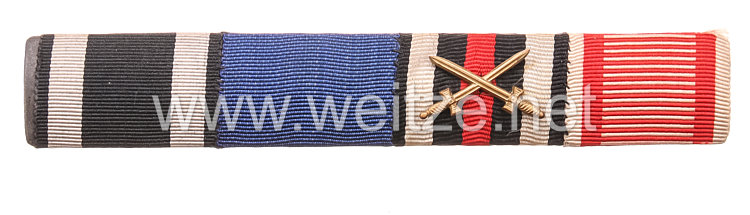
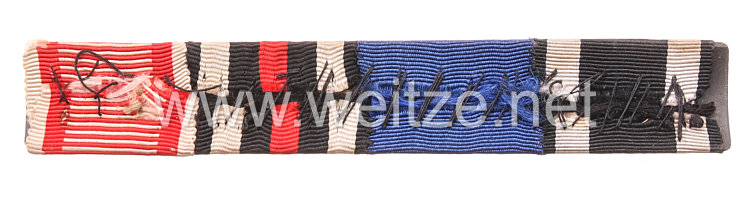
Field Clasp of a World War I Veteran

Iron Cross 1914 2nd Class. Honor Cross for Combatants 1914-18. Service Time Medal. Austria Bravery Medal. Width 11.5 cm.
413610
30,00

Field Clasp of a World War I Veteran

This medal bar belonging to a veteran of the First World War represents the military biography of a soldier who served in the armed forces of the German Empire between 1914 and 1918, and possibly also had contact with Austro-Hungarian units. The combination of four decorations on a ribbon bar offers a fascinating insight into the German honors system of the Imperial era and the Weimar Republic.

The Iron Cross 2nd Class of 1914 was the most common yet significant bravery decoration of the German Empire during World War I. Kaiser Wilhelm II renewed this award, originally instituted in 1813 by King Frederick William III, on August 5, 1914, just one day after the war began. The Iron Cross was awarded in two classes, with the 2nd Class representing the basic level. During the war, approximately 5.2 million soldiers received this decoration. The characteristic black and white ribbon with silver borders was worn on the uniform, while the actual medal was only worn on special occasions.

The Honor Cross for Combatants 1914-18, also known as the Hindenburg Cross, was not instituted until after the war by Reich President Paul von Hindenburg on July 13, 1934. This retrospective decoration was intended to honor all German war participants and was issued in three variants: for front-line fighters (with swords), for war participants (without swords), and for bereaved families (in black). The version for war participants present here suggests that the bearer served in the war zone but may not have fought directly on the front lines. By 1945, approximately 6.2 million of these crosses had been awarded.

The Long Service Medal was an award for many years of faithful military service in the German Army or Navy. There were different versions depending on length of service, typically for 9, 12, 15, or 25 years. These medals had been awarded in various German states since the mid-19th century and continued after the founding of the Empire in 1871. They document that the bearer was not only active during the war but had previously served as a professional soldier or long-serving non-commissioned officer.

The Austrian Bravery Medal represents a remarkable addition and testifies to the close military cooperation between the German Empire and Austria-Hungary as allies in World War I. The Imperial and Royal Bravery Medal was awarded in bronze and silver and could also be given to members of allied armies. German soldiers who participated in joint operations or supported Austro-Hungarian troops could receive this decoration. Such joint deployments occurred particularly on the Italian Front, in the Balkans, or on the Eastern Front.

The 11.5 cm width of the medal bar corresponds to the standardized dimensions for ribbon bars of that era. Such ribbon bars were manufactured by specialized military effects companies and produced according to the exact regulations of the respective army administration. The order of decorations on the bar followed strict hierarchical rules, with higher decorations and older foundations generally taking precedence.

This medal bar documents not only the personal bravery and service of an individual soldier but also the complex military history of the years 1914 to 1934. It connects the horrors of World War I with the culture of remembrance of the interwar period. For military historical collections, such medal bars are of particular value as they represent authentic testimonies of that era and make the military career of a veteran traceable.

The preservation and documentation of such military historical objects is of great importance to historical scholarship, as they constitute material sources for researching World War I and its social aftermath.