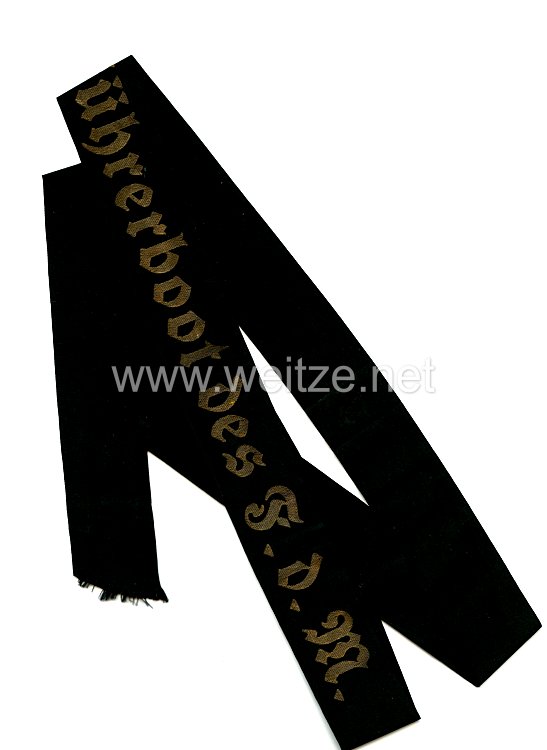
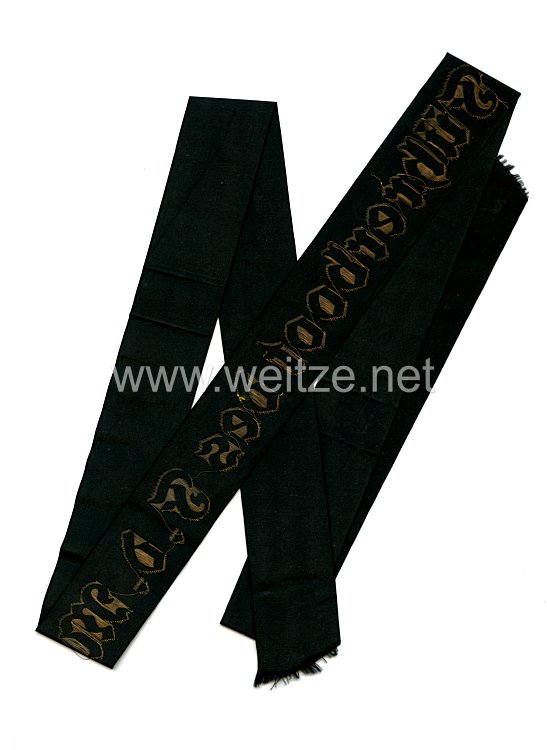
Cap Tally "Führerboot des F. d. M."

Metal thread woven, well preserved, 117 cm long, needle holes with large openings, condition 2
416609
130,00

Cap Tally "Führerboot des F. d. M."

The cap tally “Führerboot des F. d. M.” represents a remarkable testament to the maritime tradition of the German Kriegsmarine. These metal-thread woven ribbons were characteristic components of the uniforms worn by crew members of special units and commands within the Navy.

The abbreviation “F. d. M.” stands for “Führer der Minensuchboote” (Commander of Minesweepers) or alternatively for other fleet command positions. The Führerboot (leader boat) served as the command vessel of such a flotilla, from which tactical and operational orders were issued. The crew of a leader boat enjoyed a special status within fleet formations, which was manifested in the distinctive marking of their headgear.

The tradition of cap tallies in the German Navy dates back to the 19th century. Already in the Imperial Navy, sailors wore cap tallies bearing ship or unit designations. This tradition continued in the Reichsmarine of the Weimar Republic and was eventually carried forward into the Kriegsmarine of the Third Reich. Cap tallies served not only for identification and affiliation but also fostered esprit de corps and connection to the respective unit.

The manufacture of these cap tallies was accomplished through specialized handwork. Metal threads, usually made of gold-plated or silver-plated material, were woven into a black background. The golden or silver letters stood out in sharp contrast against the dark background. This elaborate weaving technique required considerable craftsmanship and made each cap tally a high-quality piece of equipment.

The present specimen with a length of 117 centimeters corresponds to the standardized measurements for Kriegsmarine cap tallies. This length made it possible to wrap the ribbon around the sailor's cap and fasten it at the back of the head with two hanging ends. The characteristic needle marks and attachment holes testify to the actual use of the tally and its mounting on a piece of headgear.

The minesweeper flotillas played an essential, though often underestimated, role during World War II. They were responsible for keeping sea lanes clear, securing ports and coastal waters, and clearing minefields. These tasks were of the highest strategic importance, as mined waters could paralyze all shipping traffic. The crews of minesweepers and their leader boats performed one of the most dangerous duties within the Navy.

The organization of minesweeper flotillas followed a clear hierarchical principle. At the top stood the Führer der Minensuchboote, whose command ship functioned as the leader boat. From here, individual minesweepers were coordinated and their operations directed. The crew of the leader boat consisted of experienced seamen and specialists who possessed both nautical and mine-technical knowledge.

According to the uniform regulations of the Kriegsmarine, cap tallies were an integral part of the service dress for enlisted ranks. While officers and petty officers wore different headgear, the sailor's cap with cap tally was characteristic for sailors and able seamen. The special cap tally of the leader boat identified the wearers as members of a particular unit and distinguished them from other naval units.

The material quality and workmanship of cap tallies varied depending on the time and place of manufacture. While high-quality materials were still used at the beginning of the war, resource scarcity and war economy later led to quality deterioration. The present specimen in good condition with metal thread weaving suggests manufacture during the earlier war years, when sufficient material was still available for high-quality uniform items.

From today's military-historical perspective, such cap tallies are important material witnesses to maritime history. They document not only the organizational structure of the Navy of that time but also craft traditions and the significance of unit symbols for military identity. For collectors and museums, authentic cap tallies therefore represent significant objects that help to understand and document the life and service of naval personnel of that era.

r