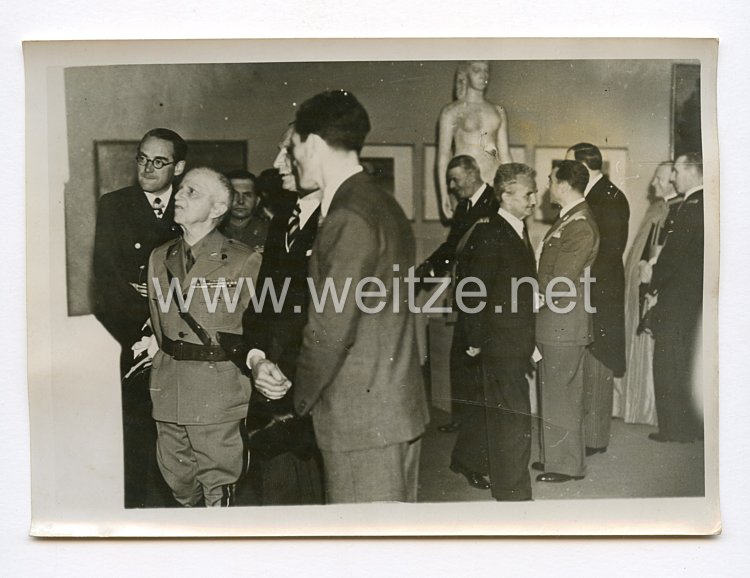
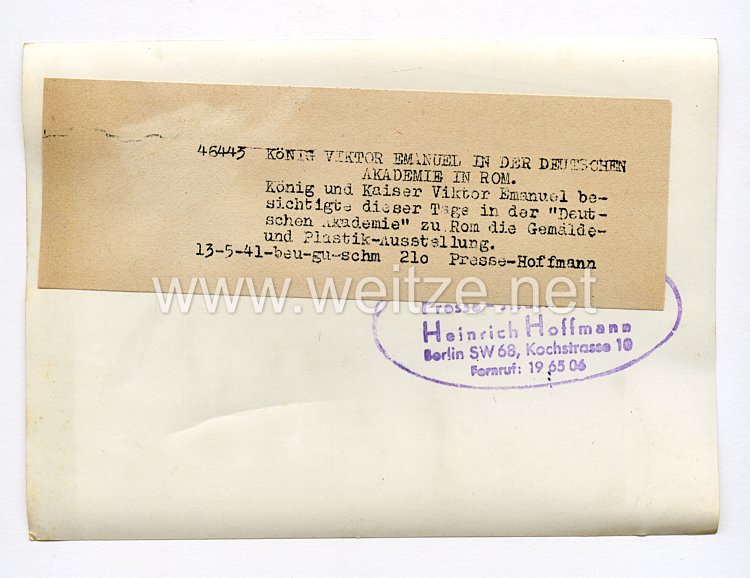
Third Reich Press Photograph. King Victor Emmanuel at the German Academy in Rome. May 13, 1941.

Dimensions approx. 13 x 18 cm, with description on reverse, used condition.
311309
20,00

Third Reich Press Photograph. King Victor Emmanuel at the German Academy in Rome. May 13, 1941.

This press photograph from the Third Reich documents a significant moment in German-Italian relations during World War II. Taken on May 13, 1941, it shows King Victor Emmanuel III of Italy visiting the German Academy in Rome, an institution that played a central role in National Socialist cultural propaganda abroad.

The German Academy (Villa Massimo) in Rome had been an important center for German-Italian cultural exchange since the 19th century. During the Nazi period, however, it was increasingly instrumentalized for propaganda purposes. The Academy served as a meeting place for German and Italian intellectuals, artists, and politicians, intended to demonstrate the cultural solidarity between the two fascist Axis powers.

Victor Emmanuel III (1869-1947) was King of Italy from 1900 to 1946 and played a complex and often contradictory role in Italian history. Although he appointed Benito Mussolini as Prime Minister in 1922, thereby enabling the rise of fascism, his relationship with the Duce remained tense. As monarch, he formally retained supreme command over the Italian armed forces, while Mussolini exercised actual political power.

The timing of the photograph in May 1941 is of particular historical significance. At this point, the Rome-Berlin Axis was at the height of its military successes but also facing decisive challenges. Italy had launched a catastrophic military campaign against Greece in October 1940, which revealed the weakness of the Italian armed forces and necessitated German intervention in the Balkans. In April 1941, German troops had conquered Yugoslavia and Greece, with Italian units playing a subordinate role.

Press photography in the Third Reich was a carefully controlled medium of propaganda. Photographers worked under strict censorship, and all images had to support the official presentation of events. The Reich Ministry of Public Enlightenment and Propaganda under Joseph Goebbels supervised the distribution of all press photos. Such photographs were distributed to newspapers and magazines at home and abroad through official news agencies such as DNB (Deutsches Nachrichtenbüro) and Scherl-Bilderdienst.

The reverse inscriptions on such press photos followed standardized guidelines and typically contained information about the depicted event, date, location, and persons involved. These inscriptions were not only important for editorial use but also served for control and archiving purposes. Many of these photos bear stamps from press agencies, censorship authorities, or editorial offices.

The format of approximately 13 x 18 cm corresponds to a common standard for press photos of this era. This size was practical for shipping, archiving, and reproduction in print media. The photos were usually printed on medium-weight cardboard or photographic paper and were designed for repeated use in editorial offices.

Relations between the Kingdom of Italy and National Socialist Germany were characterized by a mixture of ideological alignment, strategic interests, and mutual distrust. The Pact of Steel of May 1939 bound Italy militarily to Germany, although the country was poorly prepared for war. Cultural and diplomatic events such as the documented visit to the German Academy were intended to demonstrate the unity of the Axis powers and gloss over actual tensions.

For collectors and historians, such press photographs are valuable sources. They document not only historical events but also the way these events were staged and presented for propaganda purposes. The used condition of the photo with its reverse inscription is typical of authentic press photos from this period and actually increases its documentary value.

After World War II, many of these press photos were confiscated by the Allies and transferred to archives. Others remained in private collections or entered circulation through the antiques trade. Today they serve as important historical documents for research into Nazi propaganda and the history of World War II.