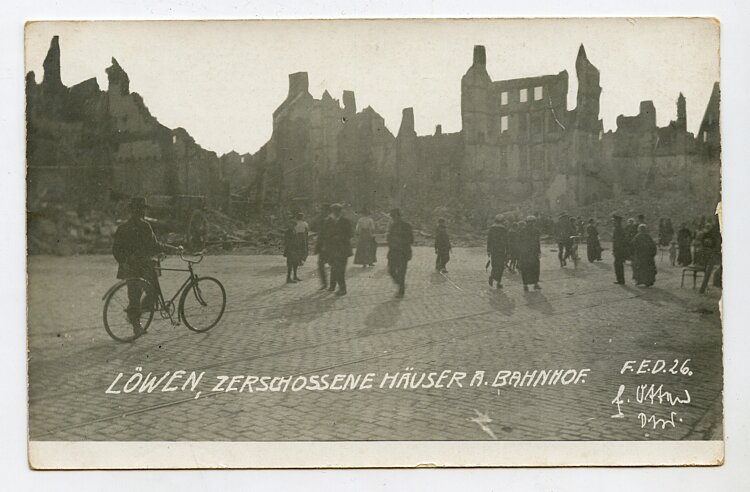
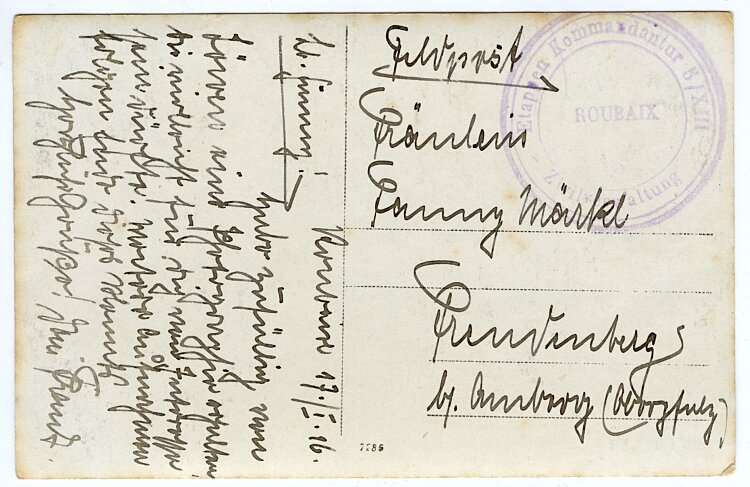
World War I Photograph, Destroyed Houses at Löwen Railway Station
Historical Context: Photographic Documentation of the Destruction of Leuven in World War I
This photograph documents the destruction of houses near the railway station of Leuven (German: Löwen, French: Louvain) during World War I. This postcard-sized document belongs to an important category of visual sources that record the fate of Belgian cities under German occupation between 1914 and 1918.
The Destruction of Leuven in August 1914
Leuven, an important university city in Belgium, experienced one of the most notorious tragedies of the early First World War. Between August 25 and 30, 1914, large parts of the city were burned down by German troops. The German army had invaded Belgium on August 4, 1914, which triggered Britain's entry into the war as Germany had violated Belgian neutrality.
The events in Leuven began when German soldiers allegedly came under fire from Belgian civilians (so-called Francs-tireurs or irregular fighters). Historical research has shown, however, that this was mainly panic among German troops. In retaliation for the supposed attacks, the German military ordered systematic reprisals. Approximately 248 civilians were shot, and the famous University Library with its unique collection of over 300,000 books and medieval manuscripts was set on fire.
The Railway Station as a Strategic Target
The Leuven railway station had particular military significance. Railway stations were central logistical hubs for troop transport and supply during World War I. The destruction of buildings near the station resulted both from targeted military actions and from the uncontrolled fires that spread during the reprisals. The photograph shows the typical ruins left after such destruction: burned-out facades, collapsed roofs, and the characteristic remains of brick architecture.
Photography as Propaganda and Documentation
Photographs like this served multiple functions during World War I. The production and distribution of war photographs in postcard format was widespread. These images served both personal memory and propaganda purposes. From the German side, such photographs were sometimes used as evidence of the “necessity” of military measures, while the Allies used them to denounce German “atrocities.”
The destruction of Leuven became a central theme of Allied propaganda. The Bryce Report of 1915, officially titled “Report of the Committee on Alleged German Outrages,” documented the events in Belgium extensively. The destruction of the University Library was internationally viewed as an attack on civilization and culture and contributed significantly to the deterioration of Germany's reputation, especially in neutral countries like the United States.
Technical Aspects of War Photography
Photographic technology had developed by 1914 to the point where plate cameras and later roll film cameras enabled field deployment. Photographers, often members of specialized propaganda companies or private photojournalists, systematically documented battlefields and destruction. The postcard format (typically 9 × 14 cm) enabled mass reproduction and distribution of such images.
Significance for Historiography
Photographic documents like this are today indispensable sources for historical research. They provide visual evidence of the extent of destruction and complement written reports and archival documents. The destruction of Leuven is an early example of the total warfare that characterized World War I, in which the distinction between military and civilian targets became increasingly blurred.
The city of Leuven was rebuilt after the war, and the University Library was reconstructed with international support, especially from the United States. Ironically, it was destroyed again during World War II in 1940. Today, monuments and museums commemorate the events of 1914, and preserved photographs serve as a sobering testimony to the consequences of war for the civilian population and cultural heritage.