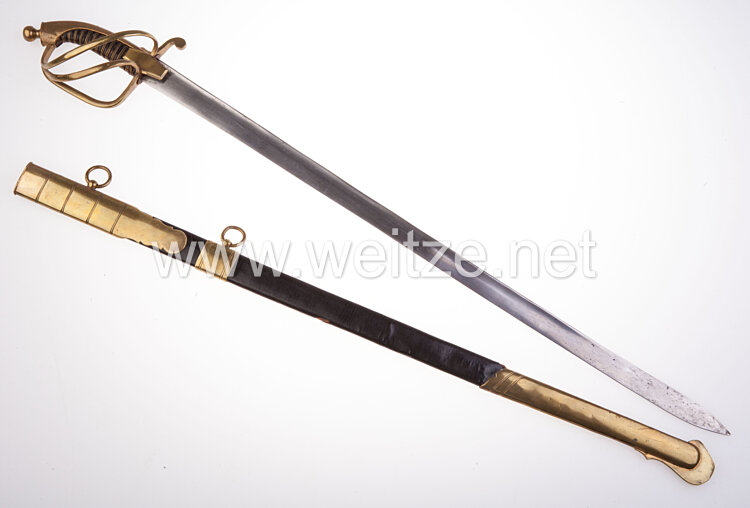
Tsarist Russia Naval Saber or Sword for Officers

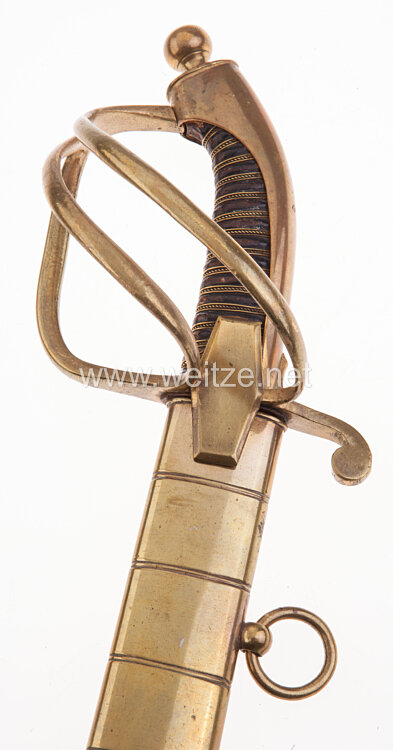
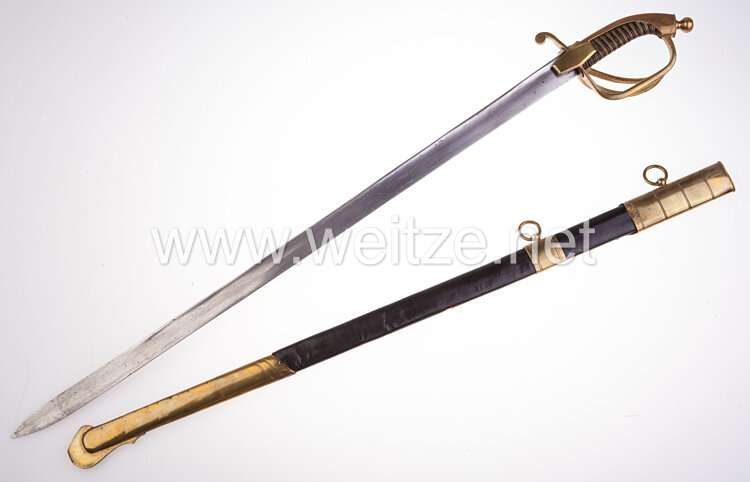
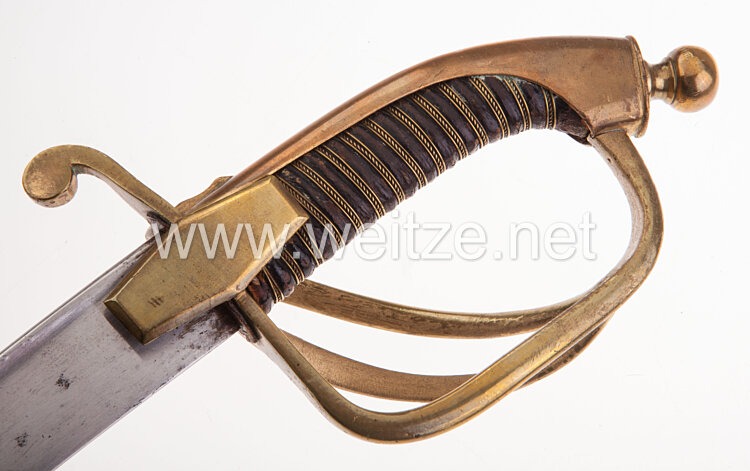
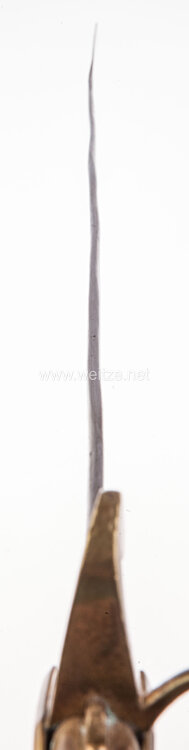
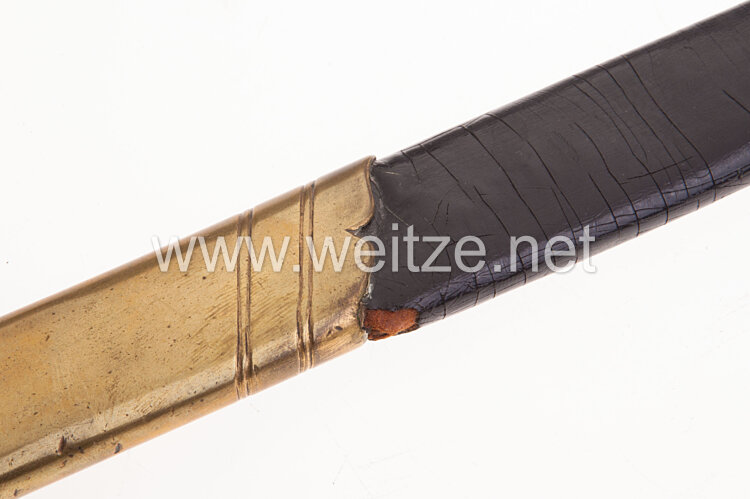
circa 1900. Straight blade without maker's mark. Three-bar hilt of gilt brass, black leather-covered grip with intact wire wrapping. Black lacquered leather scabbard with brass mounts, 2 suspension rings. Overall length 87.5 cm. Worn, condition 2.
245208
5.500,00

Tsarist Russia Naval Saber or Sword for Officers

The sabre or sword described here represents an important component of the officer's equipment of the Imperial Russian Navy from around 1900. These weapons served not only as functional combat tools but were primarily status symbols and an integral part of the military uniform of Russian naval officers during the late Tsarist period.

The Imperial Russian Navy under Tsar Nicholas II (1894-1917) experienced a phase of intensive modernization and expansion. Following the reforms under Tsar Peter the Great, who built the Russian fleet in the early 18th century, the navy developed into one of Europe's most significant naval forces. Around 1900, the Russian fleet was at the height of its power, shortly before the devastating losses in the Russo-Japanese War (1904-1905).

The uniform regulations of the Russian Navy were revised several times during the 19th century. The characteristic form of officer's edged weapons followed both Western European influences and Russia's own traditions. The straight blade, as present in this specimen, was typical for naval officers and differed from the curved sabres of the cavalry.

The gilt brass hilt with its three-bar construction corresponds to the standard designs of the imperial navy. The three guards served to protect the hand and were a characteristic feature of Russian naval officer's swords from this period. The gilding was not merely decorative but also a rank insignia that distinguished officers from non-commissioned officers.

The black leather-wrapped grip with wire binding was a practical solution for use at sea. The leather provided a secure grip even when wet, while the wire binding ensured additional grip. Black was the traditional color for naval edged weapons and differed from the often lighter versions of the land forces.

The black lacquered leather scabbard with brass fittings and two carrying rings enabled the weapon to be worn both ceremonially and practically. The two carrying rings indicated a carrying system in which the sabre could be attached to the uniform. This construction was standard in the Russian Navy and was regulated by specific uniform regulations.

The total length of 87.5 cm corresponds to the typical dimensions for naval officer's swords of this period. This length was a compromise between effectiveness as a weapon and practicality when being worn aboard ships, where longer weapons would have been cumbersome.

The absence of a maker's mark on the blade is not unusual. While many Russian military edged weapons were produced by state armories such as Zlatoust in the Urals or private manufacturers in Tula, there were also numerous imported weapons from Western Europe, particularly from Germany and France. Many officers also privately acquired their weapons from specialized weaponsmiths in St. Petersburg or Kronstadt, the main base of the Baltic Fleet.

The Russian Navy was divided into several fleets: the Baltic Fleet based in Kronstadt, the Black Sea Fleet in Sevastopol, the Pacific Fleet in Vladivostok and Port Arthur, and the Northern Fleet. Officers of all fleets wore similar edged weapons, though there could be slight regional variations.

By the end of the 19th century, the importance of edged weapons in combat had already greatly diminished. Nevertheless, they remained important components of the officer's uniform, especially during parades, official occasions, and as symbols of authority. The sabre symbolized the officer's honor and his loyalty to the Tsar.

The period around 1900 was of great significance for the Russian Navy. The fleet was massively expanding, new battleships and cruisers were being built, and Russia aspired to a dominant position in the Pacific. These ambitions, however, ended catastrophically in the Battle of Tsushima in 1905, when the Russian fleet was devastatingly defeated by Japan.

After the October Revolution of 1917 and the end of Tsarist rule, many of these imperial weapons were withdrawn from circulation, melted down, or sold abroad. Surviving specimens are today sought-after collector's items that represent important testimony to the military culture of Tsarist Russia.

r