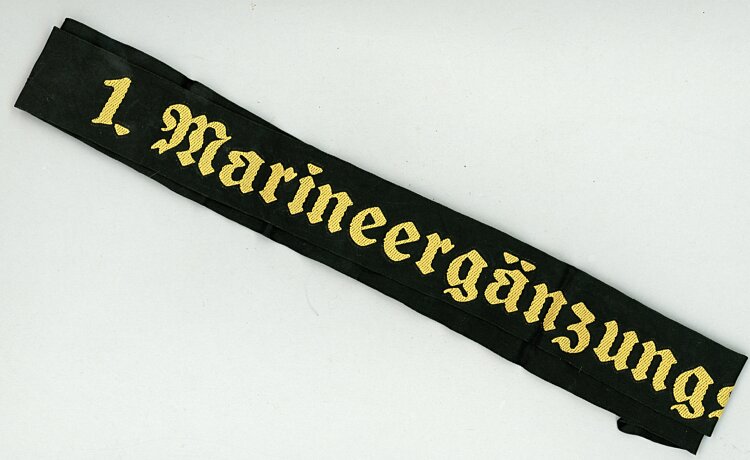
Kriegsmarine Cap Tally "1. Marineergänzungsabteilung 1."

Cotton woven construction, worn condition, well preserved, 104 cm. Condition 2
135408
120,00

Kriegsmarine Cap Tally "1. Marineergänzungsabteilung 1."

The cap tally of the 1st Naval Replacement Division represents a fascinating testimony to the organizational structure of the Kriegsmarine during World War II. This cotton-woven example constitutes an essential component of the German naval uniform and served both for identification purposes and the building of traditions within the maritime forces of the Third Reich.

The Marineergänzungsabteilungen (Naval Replacement Divisions) formed the backbone of the training and replacement system of the Kriegsmarine. These units were responsible for the basic training of recruits as well as for training replacement personnel needed to replenish active fleet formations. The 1st Naval Replacement Division belonged to the first of these formations and played a central role in preparing young men for service at sea.

The cap tally itself was a tradition-rich element of the German naval uniform, whose origins trace back to the Imperial Navy. According to Kriegsmarine regulations, enlisted men and non-commissioned officers without sword knots wore on their sailor cap a black ribbon with golden lettering displaying the designation of their respective unit, ship, or shore establishment. This practice served not only military order but also fostered esprit de corps and identification with one's own unit.

The manufacture of these cap tallies followed strict specifications of the Kriegsmarine clothing regulations. The ribbons were typically made from black cotton fabric, with the inscription machine-woven in golden-yellow color. The standard length was approximately 100-110 centimeters, which corresponds to the present example with its 104 centimeters. The ends of the ribbon were usually provided with two parallel golden stripes and featured a slight V-shaped indentation at the tips.

The organizational structure of the Naval Replacement Divisions evolved continuously throughout the war. At the beginning of World War II in September 1939, several of these training units already existed at various locations throughout the German Reich. The divisions were typically stationed near the coast or at traditional naval bases where the necessary infrastructure for training was available. Recruits underwent their basic training here, which lasted several months and included, in addition to military drill, basic seamanship skills, weapons training, and political indoctrination.

In the context of the Kriegsmarine, the designation on the cap tally held special significance. While soldiers serving on ships wore the name of their warship - such as “Bismarck” or “Tirpitz” - members of shore units and training formations identified their organizational affiliation through designations like “1. Marineergänzungsabteilung 1.” The double numbering indicates the complex organizational structure, whereby possibly several companies or battalions were assigned to a superior division.

The condition of the present example as “worn, well preserved” is remarkable for collectibles of this type. Many cap tallies were heavily used during active service and show corresponding wear. The fact that this ribbon remains in good condition despite its use makes it a valuable historical document. The cotton fibers have apparently survived the decades without significant deterioration or discoloration.

From a historical perspective, such cap tallies document not only military organization but also the industrial manufacturing competence of the era. The weaving technique required for integrating the golden lettering into the black base fabric demanded specialized machinery and expertise. Various supplier companies in the German Reich were commissioned with the production of these uniform components, with quality control conducted by military acceptance commissions.

The Naval Replacement Divisions remained active until the end of the war in May 1945, continuously adapting their training programs to the changing requirements of naval warfare. With increasing Kriegsmarine losses and the growing need for qualified personnel, the work of these units gained ever greater importance. The cap tally of a soldier from these training units thus tells the story of young men who were prepared here for deployment in a devastating world war.

Today, such cap tallies are important collectibles and research objects that provide insight into the everyday reality of the German Kriegsmarine. They complement historical understanding of the lesser-known aspects of naval organization beyond the great naval battles and famous ships.