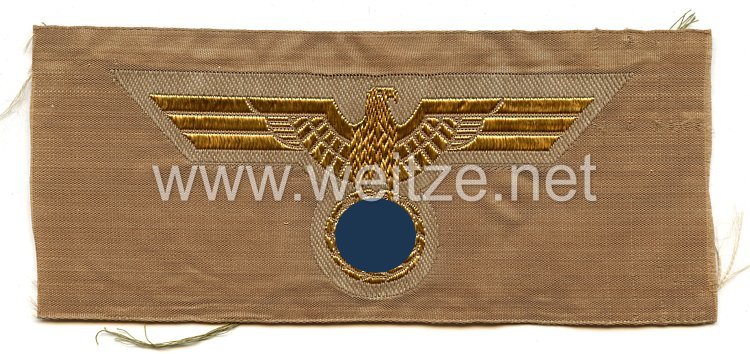
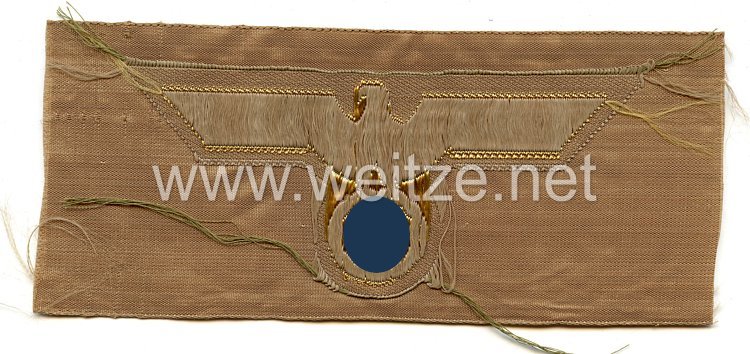
Kriegsmarine Breast Eagle for Tropical Field Blouse
The Kriegsmarine Breast Eagle for Tropical Field Blouse represents a distinctive insignia of the German Navy during World War II. This special badge was worn as part of the tropical uniform and documents the far-reaching operations of the Kriegsmarine in climatically challenging regions.
The Bevo weaving technique, named after the company Bevo (Bandfabrik Ewald Vorsteher) from Wuppertal-Barmen, revolutionized the production of military insignia in the 1930s. This mechanical weaving technique enabled mass production of detailed, colorfast, and durable insignia. Bevo-woven eagles were characterized by their flat structure, precise detail reproduction, and high quality. Unlike hand-embroidered or machine-embroidered variants, Bevo badges were more cost-effective to produce and exhibited consistent quality.
The Kriegsmarine tropical uniform was developed for operations in hot climates, particularly for the Mediterranean region, North Africa, and other subtropical areas. The tropical field blouse consisted of lightweight, sand-colored cotton fabric adapted to the climate. The introduction of this uniform variant occurred in the context of increasing theaters of war in southern regions, especially after the intervention of the German Afrika Korps from 1941 onwards and the intensified Mediterranean operations.
The breast eagle itself followed the National Socialist national emblem, which was systematically introduced in all Wehrmacht branches from 1935. For the Kriegsmarine, the eagle was depicted with lowered wings, holding a wreath with a swastika in its talons. The coloring in yellow on sand color was specifically designed for the tropical uniform and differed significantly from the darker variants for regular naval uniforms. This color choice ensured the visibility of the badge on the light tropical fabric and complied with uniform regulations.
The placement of the breast eagle on the tropical field blouse was precisely regulated. It was attached to the right breast above the breast pocket. This positioning distinguished the Kriegsmarine from other Wehrmacht branches and corresponded to the specific naval dress regulations. Attachment was done by sewing, with unworn specimens showing the original woven edges and no signs of wear.
The Kriegsmarine operated during World War II in diverse geographical regions. Besides the well-known Atlantic operations, U-boats and surface units were also active in the Mediterranean, where they supported the Italian Navy and operated against Allied convoys. Naval units were also deployed for coastal defense and special operations in North Africa. These extensive deployments made the tropical uniform a necessary piece of equipment.
The production of military insignia was subject to strict quality controls and standardizations during the war. Various manufacturers produced according to specified standards, with the Bevo technique being one of the preferred methods. The Bevo company itself was only one of several producers, but the designation “Bevo” was often used generically for woven badges.
From a collector's perspective, unworn specimens are of particular historical value as they document the original condition without signs of wear. The condition 2+ designates in military-historical classification a very well-preserved piece with minimal storage marks. Such specimens offer authentic insights into manufacturing quality and original coloring, which in worn pieces is often faded by sunlight, perspiration, and cleaning.
The historical significance of these badges lies in their function as identification marks and expressions of military hierarchy. They document the organization, equipment, and geographical extent of the German Kriegsmarine during World War II. Today they serve as objects of study for military historians, textile experts, and collectors researching uniform history.
After 1945, the use of National Socialist symbols was prohibited in Germany. However, historical examination and scholarly engagement with such objects is legitimate and important in museum and academic contexts for understanding this era.