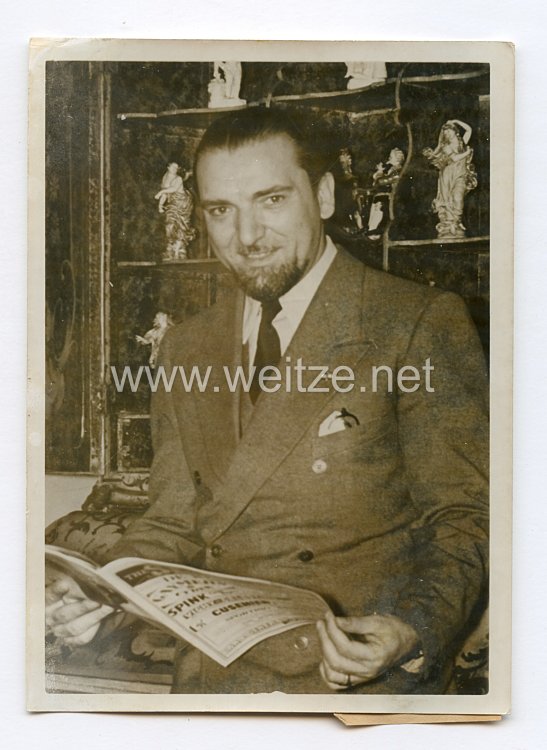
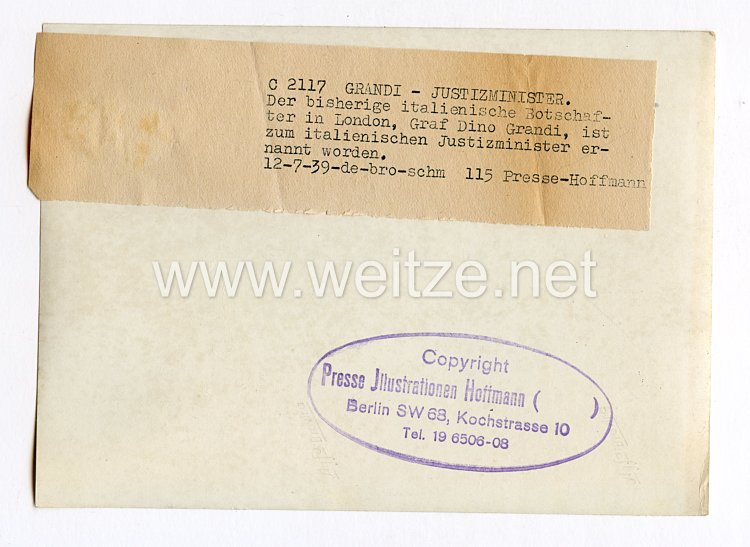
Third Reich Press Photo. Grandi - Minister of Justice. 12.7.1939.
The present object is a press photograph from the Third Reich, dated July 12, 1939, showing Dino Grandi in his capacity as Italian Minister of Justice. Such press photographs were an essential component of the propaganda machinery of Nazi Germany and its Axis partners during the pre-war period.
Dino Grandi (1895-1988) was a key figure in the Italian Fascist movement and a close associate of Benito Mussolini. His political career encompassed various high-ranking positions: he served as Italy's Foreign Minister from 1929 to 1932 and later as Ambassador to London from 1932 to 1939. In July 1939, when this photograph was taken, Grandi was in a transitional phase of his career, shortly after his return from London and just before assuming the position of Minister of Justice (Ministro della Giustizia) in Fascist Italy.
The dating of the photograph to July 12, 1939 is historically significant as it falls within a critical phase of European history. Just weeks before the outbreak of World War II on September 1, 1939, diplomatic tensions in Europe were intensifying. The Pact of Steel (Patto d'Acciaio) between Nazi Germany and Fascist Italy had been signed only in May 1939, formalizing the military and political alliance between the two Axis powers.
Press photographs in the Third Reich were carefully curated propaganda instruments. They were controlled and distributed by official agencies such as the Reich Ministry of Public Enlightenment and Propaganda under Joseph Goebbels. These photographs served multiple purposes: they documented official events, conveyed political messages, and created a specific image of leaders and political developments. The annotation on the reverse of such photos was standard practice and typically contained information about the subject, date, photographer, and sometimes usage instructions for editorial offices.
Relations between Germany and Italy during this period were complex. While Mussolini and Hitler were ideological allies, there were differing opinions within the Italian leadership about the extent of cooperation with Nazi Germany. Grandi himself was among those Fascists who advocated a more cautious foreign policy line and would later play a key role in Mussolini's overthrow in July 1943.
The format of approximately 13 x 18 cm corresponds to a standard size for press photographs of this era. This size was practical for archiving and allowed for easy reproduction in newspapers and magazines. The photographs were frequently taken by press agencies such as the Deutsches Nachrichtenbüro (DNB) or other authorized photographers and distributed through established channels to media organizations.
As a historical document, such a press photograph offers insights into several aspects of Third Reich history: it demonstrates the international dimension of the Fascist movement, the importance of visual propaganda, and the documentary practices of the time. The preservation of the reverse annotation significantly increases its historical value, as it provides context and provenance.
Collectors and historians today value such press photographs as primary sources for studying propaganda methods, the visual culture of Fascism, and international relations in the interwar period. The used condition of the object suggests that it was actually employed in editorial contexts, possibly in German or Italian publications of the time.
The fact that this photograph shows an Italian official but appears in German archives or collections underscores the close cooperation between the Axis powers at all levels, including media and propaganda work. It documents the efforts of both regimes to publicize their alliance and make the leadership figures of their respective partners known to their own audiences.