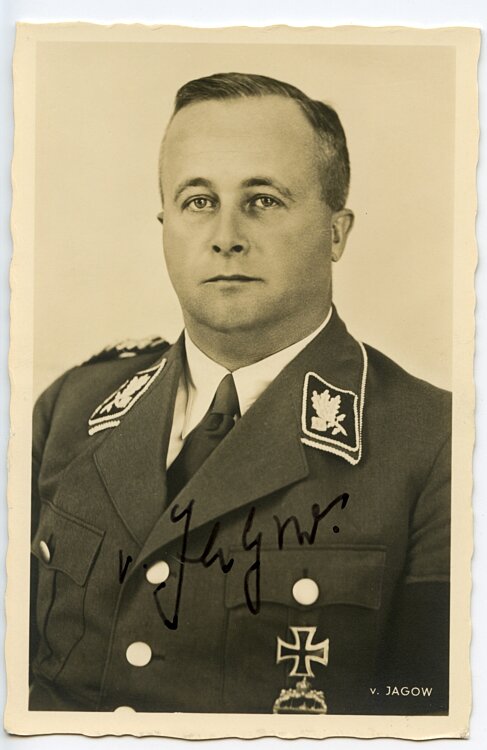
III. Reich - Originalunterschrift von SA-Obergruppenführer Dietrich v. Jagow
auf seiner Hoffmann-Postkarte 616 in SA Uniform, mit sehr schöner Tintensignatur " Jagow ", ungelaufen, Zustand 2.
Von Jagow entstammte einem Adelsgeschlecht der Mark Brandenburg, der nach dem Schulbesuch in die kaiserliche Kriegsmarine eintrat.
Nach dem Ersten Weltkrieg verweigerte er den Eid auf die Weimarer Verfassung, so dass er die Marine verlassen musste. Mit der Brigade Ehrhardt war von Jagow 1919 am Kapp-Putsch beteiligt, zwei Jahre später, 1921, trat er in die NSDAP ein.
Zwischen 1929 und 1930 wurde von Jagow Gaugeschäftsführer der NSDAP in Württemberg, bis er 1931 zum SA-Gruppenführer Südwest ernannt wurde. Von 1932 bis 1945 war er zusätzlich MdR.
1933 erhielt er die Ernennung zum Reichskommissar für Württemberg, und am 1. April 1933 zum Führer der SA-Obergruppe V in Frankfurt am Main.
Ab Juni 1933 im Rang eines SA-Obergruppenführers tätig, Von Juli 1941bis März 1944 war von Jagow deutscher Gesandter in Budapest.
September 1944 wurde er Führer des Volkssturmbataillons 35 (Schlesien) und erlitt am 20. Januar 1945 schwere Verwundungen, er verlor dabei ein Auge. Beim Kriegsende verübte er am 26. April 1945 in Meran Selbstmord.
Von Jagow entstammte einem Adelsgeschlecht der Mark Brandenburg, der nach dem Schulbesuch in die kaiserliche Kriegsmarine eintrat.
Nach dem Ersten Weltkrieg verweigerte er den Eid auf die Weimarer Verfassung, so dass er die Marine verlassen musste. Mit der Brigade Ehrhardt war von Jagow 1919 am Kapp-Putsch beteiligt, zwei Jahre später, 1921, trat er in die NSDAP ein.
Zwischen 1929 und 1930 wurde von Jagow Gaugeschäftsführer der NSDAP in Württemberg, bis er 1931 zum SA-Gruppenführer Südwest ernannt wurde. Von 1932 bis 1945 war er zusätzlich MdR.
1933 erhielt er die Ernennung zum Reichskommissar für Württemberg, und am 1. April 1933 zum Führer der SA-Obergruppe V in Frankfurt am Main.
Ab Juni 1933 im Rang eines SA-Obergruppenführers tätig, Von Juli 1941bis März 1944 war von Jagow deutscher Gesandter in Budapest.
September 1944 wurde er Führer des Volkssturmbataillons 35 (Schlesien) und erlitt am 20. Januar 1945 schwere Verwundungen, er verlor dabei ein Auge. Beim Kriegsende verübte er am 26. April 1945 in Meran Selbstmord.