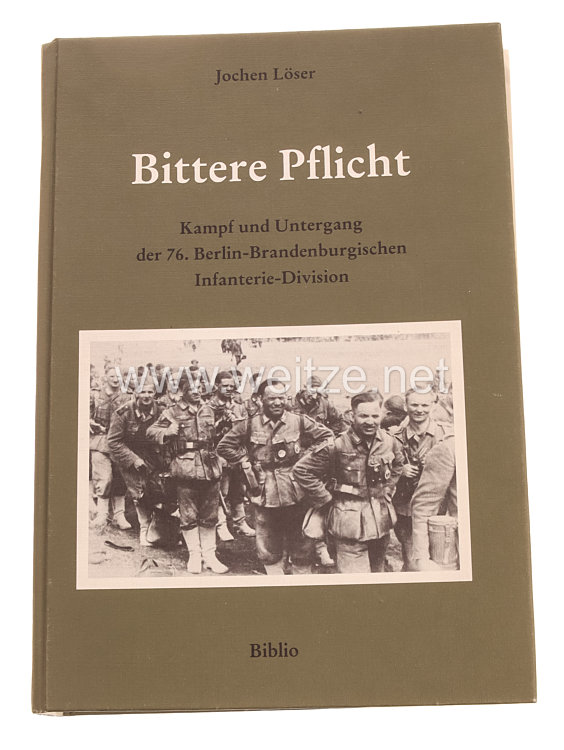
Bitter Duty. Combat and Destruction of the 76th Berlin-Brandenburg Infantry Division
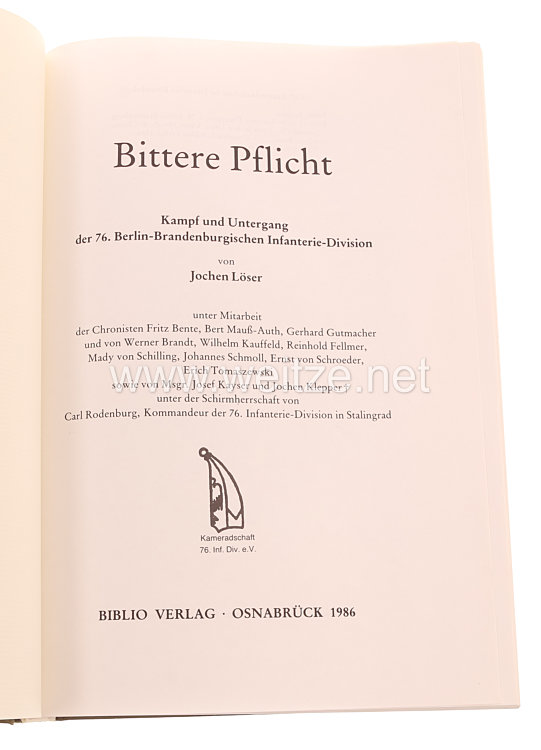
The book “Bittere Pflicht. Kampf und Untergang der 76. Berlin-Brandenburgischen Infanterie-Division” (Bitter Duty: Battle and Destruction of the 76th Berlin-Brandenburg Infantry Division) by Jochen Löser, published in 1986 by Biblio Verlag Osnabrück, represents a significant document of German military history during World War II. With 584 pages and numerous illustrations and maps, this work meticulously documents the history of one of the many Wehrmacht infantry divisions that was raised, deployed, and ultimately destroyed during the war.
The 76th Infantry Division was formed in autumn 1939 as part of the second wave of Wehrmacht formations in Military District III (Berlin-Brandenburg). As a regionally-rooted unit, it recruited its soldiers primarily from Berlin and the Mark Brandenburg region, earning it the unofficial designation “Berlin-Brandenburg Division.” This regional composition was characteristic of many German divisions of that era and was intended to strengthen camaraderie and unit cohesion.
The division was initially deployed in the West and participated in the Western Campaign against France in 1940. After the rapid victory over France, a phase of occupation and reorganization followed. With the beginning of Operation Barbarossa on June 22, 1941, the 76th Infantry Division was transferred to the Eastern Front, where it would spend the majority of its existence. The division fought in various sectors of the Eastern Front and experienced the dramatic turning points of the war in the East.
Particularly noteworthy was the division's deployment during the Battle of Stalingrad and in the subsequent retreat battles. The 76th Infantry Division belonged to the 6th Army under Field Marshal Friedrich Paulus and was encircled in the Stalingrad pocket. The division suffered catastrophic losses and was essentially destroyed. The annihilation at Stalingrad in late January/early February 1943 meant death or Soviet captivity for thousands of soldiers, many of whom never returned.
After the capitulation at Stalingrad, the division was reconstituted using the number 76, which corresponded to the Wehrmacht's common practice of maintaining traditional division designations. The newly formed unit continued fighting on the Eastern Front and participated in the heavy defensive battles of 1943 and 1944. The division's final destruction occurred during the Soviet summer offensive of 1944, Operation Bagration, which led to the complete destruction of German Army Group Center.
Jochen Löser's work is part of an extensive body of German post-war literature dedicated to documenting individual divisional histories. Biblio Verlag in Osnabrück specialized in military-historical publications and released numerous divisional histories, regimental chronicles, and memoir accounts. These books often emerged in collaboration with veterans' associations and were based on personal memories, diaries, official war diaries, and documents from military archives.
The significance of such divisional histories for military historical research is ambivalent. On one hand, they offer detailed insights into operational procedures, soldiers' everyday experiences, and military challenges at various front sectors. They document deployment locations, casualties, decorations, and the fate of individual units. On the other hand, many of these works are characterized by an uncritical, often romanticized view of the Wehrmacht and frequently ignore the complicity of regular armed forces in war crimes.
Modern military historical research has shown since the 1990s, through projects such as the exhibition “Crimes of the Wehrmacht,” that regular infantry divisions were also involved in war crimes, particularly in the context of the war of annihilation in the East. Therefore, critical source analysis is essential when evaluating divisional histories such as the present work.
The hardcover binding and extensive illustration across 584 pages make this book a typical example of military-historical documentation from the 1980s. The maps in the text serve to illustrate march movements, front lines, and combat operations. Such works were and continue to be valued by historians, collectors of military literature, and descendants of soldiers as source material, but must be evaluated in the context of their time of origin and perspective.