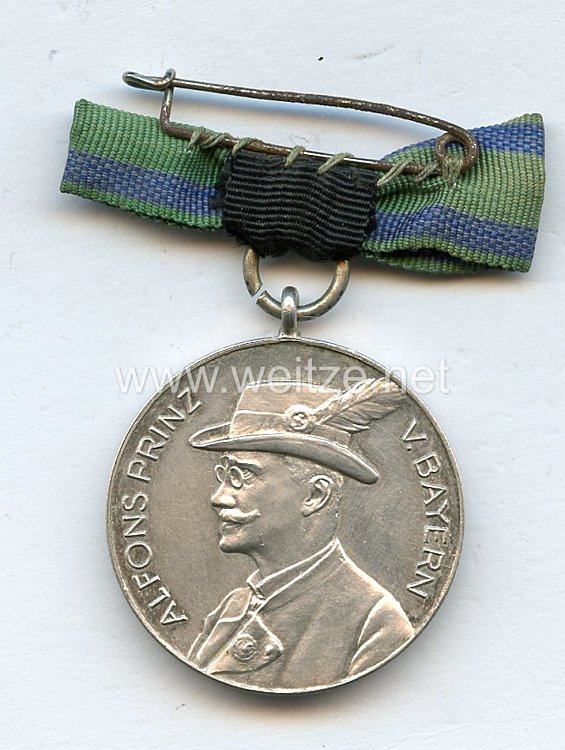
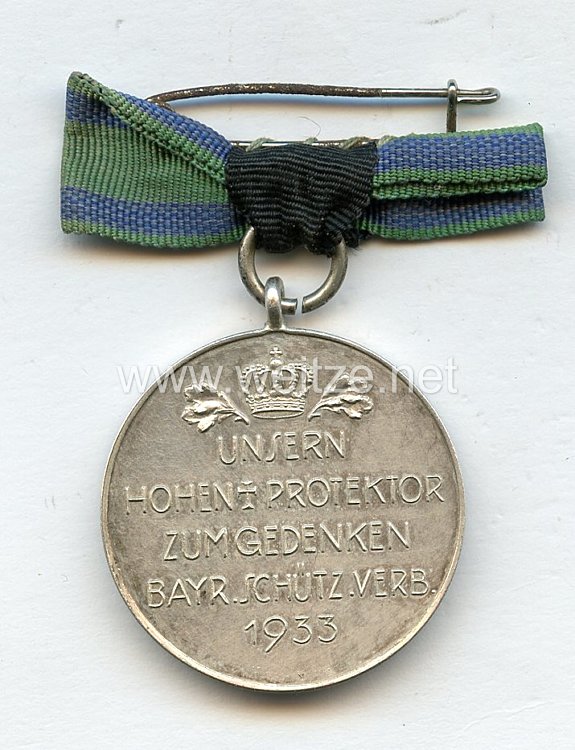
Bavaria Prince Alfons Silver Commemorative Medal 1933 of the Bavarian Rifle Association
The Silver Commemorative Medal of the Bavarian Shooting Association honoring Prince Alfons of Bavaria from 1933 represents a significant testament to Bavarian shooting traditions during the transition period between the Weimar Republic and National Socialist rule. With a diameter of 33 mm, it corresponds to the typical dimensions of Bavarian association medals of this era.
Prince Alfons of Bavaria (1862-1933) was the third son of Prince Regent Luitpold of Bavaria and thus a high-ranking member of the House of Wittelsbach. As a royal prince and General of Infantry, he enjoyed great esteem in Bavaria. His death on January 8, 1933, marked the end of an era, as he belonged to the last prominent representatives of the Bavarian monarchy who were still present in public life. The striking of the medal in 1933 thus most likely occurred as a posthumous honor or on the occasion of his death.
The Bavarian Shooting Association had a long tradition dating back to the 19th century. After the founding of the German Empire in 1871, shooting clubs throughout Germany experienced tremendous growth. In Bavaria, where shooting sports were deeply rooted in popular culture, these associations played an important social role. They combined sporting activity with monarchist sentiment and local identity. The connection between the Bavarian royal house and shooting clubs was traditionally close, with members of the royal family frequently serving as patrons or honorary members.
The silver medal was presumably issued in limited quantities, which was customary for commemorative medals of this type. Such medals did not serve as official state decorations but as association badges of honor. They were awarded to deserving members, functionaries, or to commemorate significant events. The year 1933 was a turning point for Bavaria and Germany: with the National Socialist seizure of power on January 30, 1933, a profound transformation of social life began. Traditional clubs and associations were coordinated or dissolved in the following years. The Bavarian Shooting Association, like many other organizations, had to submit to the new rulers.
The medal thus also serves as testimony to the transition from traditional Bavarian association culture to National Socialist uniformity. The fact that it was dedicated to a prince from the House of Wittelsbach demonstrates the continuing attachment of the Bavarian population to their monarchist past, even though this played no political role anymore. The Wittelsbachs had abdicated in 1918 but remained present and respected in Bavarian social life.
The design of such medals typically followed traditional patterns: they frequently showed the portrait of the honored person or a coat of arms on the obverse, with shooting symbols, inscriptions, or the association's emblem on the reverse. The use of silver indicates a higher-quality execution, which corresponded to the significance of the honored personality. The condition grade 2 (very good) suggests that the specimen was carefully preserved and shows only minimal signs of wear.
In the context of German phaleristies (study of orders and decorations), Bavarian shooting medals occupy a special place. They document the rich association culture of the 19th and early 20th centuries and the close connection between the bourgeoisie, associational life, and monarchy. Today, such medals are important historical documents that provide insight into the social structures and loyalties of their time. They are sought after by collectors of Bavarian militaria and association badges and help reconstruct the history of Bavarian shooting sports.