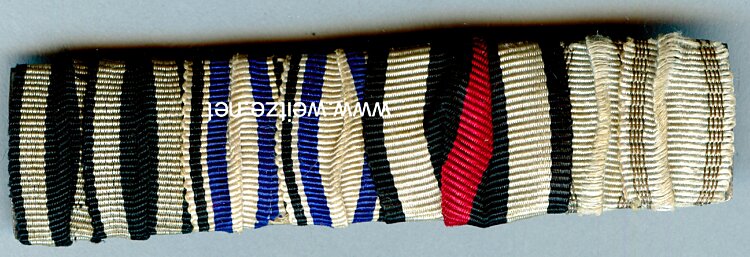
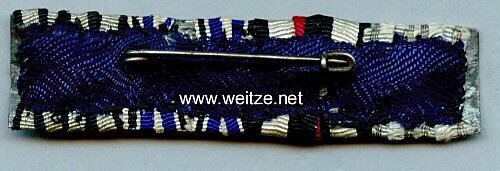
Medal Bar for a Bavarian Veteran of World War I
The ribbon bar or medal bar of a Bavarian veteran of World War I represents a fascinating testament to the military decoration practices in the Kingdom of Bavaria and later in the German Empire. This compact arrangement of four decorations on a common mounting bar documents the service period and merits of a soldier during the Great War from 1914 to 1918.
In the Kingdom of Bavaria, which maintained its own military sovereignty within the German Empire until 1918, there existed a complex system of orders and decorations. The Bavarian Army had its own awards that could be conferred alongside Imperial German orders. The most common Bavarian decorations for soldiers in World War I included the Military Order of Merit, the Military Merit Cross, the Bravery Medal, the Service Decoration Cross, and various war commemoration medals.
The practice of wearing order ribbons on a common bar became established in the late 19th century and became standard practice during World War I. Instead of attaching the complete orders or medals to the uniform, soldiers wore only the characteristic ribbons in their official colors during daily service. This was more practical and preserved the valuable decorations themselves, which were worn in full form on special occasions.
A typical ribbon bar of a Bavarian World War veteran could contain various combinations. The Iron Cross, although a Prussian-German decoration, was also awarded to Bavarian soldiers and was one of the most common decorations for bravery. The characteristic black-and-white ribbon of the Iron Cross 2nd Class is found on countless ribbon bars from this period. The Bavarian War Commemoration Medal 1914/1918 was awarded to all members of the Bavarian armed forces who participated in the war.
The Bavarian Military Merit Cross, established in 1913, was awarded in large numbers during the war and was characterized by its blue-and-white ribbon in the Bavarian national colors. The Bravery Medal, conferred in gold or silver, was another important decoration for personal bravery before the enemy. Its award numbers increased dramatically during the war years, as the enormous losses and intensity of combat created numerous occasions for proven courage.
The arrangement of ribbons on a bar followed strict hierarchical rules. Prussian-German orders generally took precedence over Bavarian decorations, and within each category, the ribbons were arranged according to their importance and date of establishment. The order of precedence was established in official regulations that were binding for uniform wearers.
The manufacture of ribbon bars was carried out both by official military agencies and private manufacturers. Numerous firms in Munich, Nuremberg, and other Bavarian cities specialized in the production of orders, medals, and related accessories. Quality could vary considerably, from simple field-gray versions for front-line use to elaborately crafted parade versions with gilded or silvered metal parts.
After the end of World War I and the abdication of Bavarian King Ludwig III in November 1918, veterans retained the right to wear their acquired decorations. The Weimar Republic generally recognized orders conferred during the Imperial period. Many veterans wore their ribbon bars at comradeship meetings, memorial events, and official occasions as a visible sign of their service period.
Condition 2, as indicated in the object description, suggests in numismatic and militaria collecting terminology a very good to good state of preservation. This means that the ribbon bar shows minimal signs of wear, the colors of the ribbons are still vibrant, and the metal fastening elements are intact. Such well-preserved pieces are sought-after collector's items today, as they represent authentic testimonies of German military history.
The historical significance of such ribbon bars lies not only in their material value but primarily in their function as personal mementos and historical documents. Each decoration on the bar tells a story of duty fulfilled, bravery, or service time. They connect us with the individual fates of the millions of soldiers who fought in World War I and remind us of the enormous human cost of this devastating conflict.