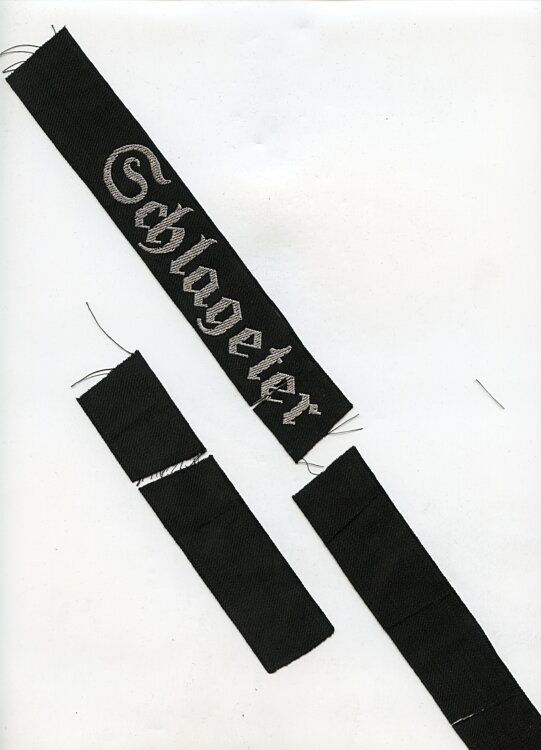
Cuff Title “Schlageter”, of SA-Standarte 39, SA-Gruppe Niederrhein
The SA Cuffband "Schlageter" of Standarte 39
The SA cuffband bearing the inscription "Schlageter" represents a significant award piece of the Sturmabteilung (SA) and references the political mythology of the National Socialist movement during the Weimar Republic. The SA-Standarte 39, which belonged to the SA-Gruppe Niederrhein, wore this cuffband in honor of Albert Leo Schlageter, an early martyr figure of National Socialist propaganda.
Albert Leo Schlageter was born on August 12, 1894, in Schönau in the Black Forest. As a former Freikorps member, he participated in 1923 in the passive resistance against the Franco-Belgian occupation of the Ruhr. Schlageter carried out sabotage acts against railway lines and bridges, was arrested by French authorities, and executed on May 26, 1923, in the Golzheimer Heide near Düsseldorf. His death was instrumentalized for propaganda purposes by various political movements, particularly by the National Socialists. The NSDAP stylized him as the "first soldier of the Third Reich" and as a symbol of the struggle against the provisions of the Treaty of Versailles.
The SA-Gruppe Niederrhein encompassed the geographical area of the Lower Rhine region, including cities such as Düsseldorf, Krefeld, Duisburg, and surrounding areas. The SA was organized hierarchically into Groups, Brigades, Standarten, Sturmbanne, Stürme, and Scharen. A Standarte corresponded approximately to a regiment and comprised several thousand men. Standarte 39 was one of numerous standarten within SA-Gruppe Niederrhein and bore Schlageter's name as an honorary designation due to the regional connection to the Schlageter myth.
The SA cuffband system developed in the early 1930s. Cuffbands served as traditional and honorary designations for specific units that distinguished themselves through special merit or historical references. A fundamental distinction was made between different models: the first model consisted of a black band with silver inscription, while the second model was produced in woven execution. This woven variant typically showed white or silver-colored lettering on a black background and was standardized from approximately 1933/34.
The woven execution of the second model was manufactured mechanically on special ribbon looms. The technique enabled a permanent connection of lettering and base material, with the letters worked directly into the fabric. This differed fundamentally from embroidered or printed variants. The quality of the weaving varied depending on the manufacturer, with various companies in the German Reich holding licenses for the production of SA insignia.
The cuffband was worn on the left upper arm of the SA uniform, usually about 15 centimeters below the shoulder seam. It was attached by sewing it onto the brown uniform tunic. The length of cuffbands varied according to the wearer's arm circumference and had to be individually adjusted. Standard lengths ranged between 35 and 45 centimeters.
The Schlageter cult reached its peak in the 1930s. The National Socialists erected monuments, named streets, schools, and military units after him. A monumental memorial was created in the Golzheimer Heide. May 26 was observed in National Socialist circles as "Schlageter Day." This heroization served to mobilize nationalist resentments and legitimize the political struggle of the NSDAP.
The SA-Gruppe Niederrhein played a significant role in the region during the seizure of power in 1933 and in the subsequent political purges. The SA reached its peak of power in 1933/34 before being disempowered through the "Röhm Affair" in June/July 1934. After the murder of SA Chief of Staff Ernst Röhm and numerous SA leaders, the organization lost its political significance in favor of the SS.
After 1934, the SA continued to exist but functioned mainly as a pre-military training organization. The tradition of cuffbands was continued, but their significance was considerably diminished. During World War II, the SA played only a subordinate role.
From a collecting-historical perspective, unworn cuffbands of the second model are today documentary witnesses to the NS organization and its symbolic world. The state of preservation varies greatly, as the materials and weaving types used had different aging resistance. Brittleness of the fabric is a typical aging characteristic attributable to the use of certain fibers and dyes as well as storage conditions.
Scientific examination of such objects today occurs within the framework of critical historical research on the NS period, with these artifacts serving as sources for uniform studies, organizational history, and political iconography.