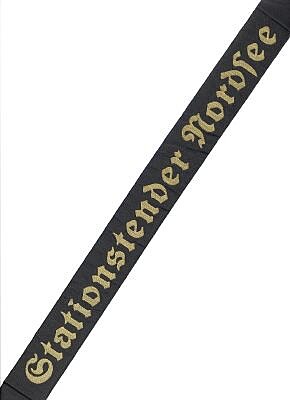
Kriegsmarine Cap Tally “Stationstender Nordsee”

Metal thread woven execution, unworn, still in original packaging. Condition 1
34807
100,00

Kriegsmarine Cap Tally “Stationstender Nordsee”

The cap tally “Stationstender Nordsee” represents a fascinating chapter of German naval history and constitutes a rare example of the Kriegsmarine uniform equipment during World War II. This metal-thread woven version belongs to the standardized uniform components that served to identify crew members of various naval units.

The Kriegsmarine continued a long tradition of the Imperial Navy, whereby each ship and unit was identified by a specific cap tally. This tradition dates back to the 19th century and was detailed in the Kriegsmarine clothing regulations of 1935 and subsequent amendments. The cap tally was worn on the Bordmütze (service cap) by enlisted men and petty officers, displaying the name of the respective ship or unit in gold or silver lettering.

The Stationstender Nordsee was not a warship in the traditional sense, but belonged to the category of auxiliary vessels and supply units of the Kriegsmarine. Tenders were specialized supply ships that provided other units, particularly smaller warships, submarines, or fast attack craft, with supplies, fuel, ammunition, and other necessary goods. The term "Stationstender" indicates that this vessel was assigned to a specific naval station, in this case the North Sea area.

The metal-thread weaving was a high-quality manufacturing technique for cap tallies. Metal threads, usually made of gold or silver-plated artificial silk, were woven into a black base fabric. This technique produced a characteristic luster and high durability. There were basically two quality levels: the simpler printed version for general use and the more elaborate metal-thread weaving for higher quality requirements. The woven version was worn by both officers and enlisted personnel, often being privately procured.

The organization of the Kriegsmarine in the North Sea area was of strategic importance. The North Sea Naval Station with its bases in Wilhelmshaven, Cuxhaven, Emden, and other ports formed an important operational center for the German naval forces. Tenders played a crucial role in the logistical support of the units stationed there, particularly the fast attack craft flotillas and minesweeper units, which conducted intensive operations in the North Sea and English Channel.

The fact that this specimen is unworn and in original packaging makes it an extraordinary collector's item. Most cap tallies were worn in service and show corresponding signs of use. Unworn pieces in original packaging are extremely rare, as the cap tallies were immediately attached to the service cap after assignment to a unit. This may be a piece from an unissued stock or a reserve specimen that was kept for replacement purposes.

The manufacture of cap tallies was carried out by specialized textile manufacturers who were suppliers to the Kriegsmarine. Well-known manufacturers were located in cities with a long tradition in the production of military insignia. Production had to meet strict quality standards specified in the relevant military administration regulations (HV).

After 1945, many of these cap tallies were destroyed or lost. Surviving specimens are now found in museums, private collections, and with specialists in naval history. They serve as important historical documents for reconstructing the organizational structure of the Kriegsmarine and individual units. For maritime historical research, they provide valuable information about the existence and use of various ships and units.

The preservation of such objects in condition 1 (mint) is of particular museum and scientific significance, as they preserve authentic details about materials, manufacturing techniques, and design that are often no longer fully recognizable on worn specimens.