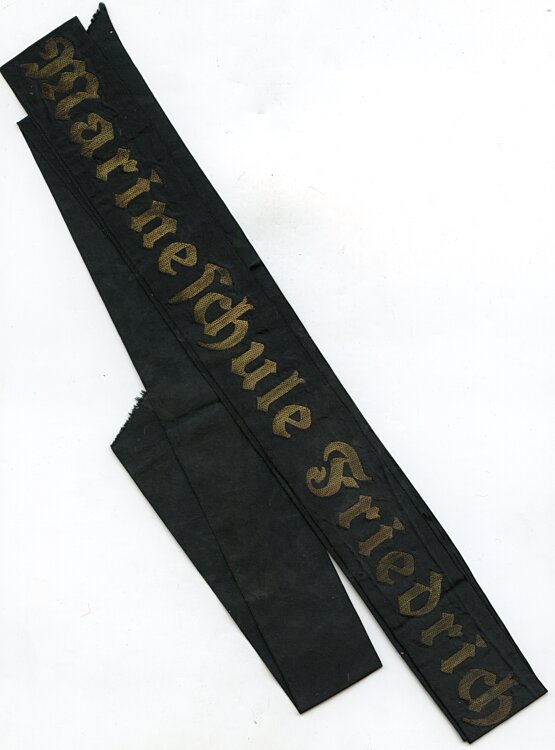
Kriegsmarine Cap Tally "Marineschule Friedrichsort"
The cap tally of the Naval School Friedrichsort represents a significant chapter in German naval history and stands as an example of the training tradition of the Kriegsmarine during the National Socialist era. These cap tallies, worn on peaked caps or sailor caps, served not only as decorative elements but primarily as identification markers for specific units or training establishments.
The Naval School Friedrichsort was located near Kiel on the Baltic Sea coast and was one of the most important training facilities of the Kriegsmarine. The school had its roots in the Imperial Navy and continued operations in modified form after World War I, despite the restrictions of the Treaty of Versailles. With the establishment of the Kriegsmarine from 1935 onwards, the institution gained considerable importance.
The present specimen with a length of 151 cm corresponds to the standardized measurements for Kriegsmarine cap tallies. This length was necessary to wrap the band completely around the cap and tie it into a characteristic bow at the back of the head. The inscription “Marineschule Friedrichsort” was executed in golden-yellow or brass-colored lettering on a black background, which complied with the general regulations for Kriegsmarine cap tallies.
The tradition of cap tallies in the German Navy dates back to the 19th century. Originally, they served to secure peaked caps during heavy seas. Over time, they evolved into an important identifying feature indicating membership in a specific ship or shore establishment. In the Imperial Navy, enlisted men wore cap tallies bearing the name of their ship or training facility, a tradition adopted by the Reichsmarine and later the Kriegsmarine.
Training at the Naval School Friedrichsort encompassed various areas of maritime warfare. Both officer candidates and petty officers and enlisted men were instructed in navigation, seamanship, weapons technology, and tactical leadership. The school possessed modern training facilities, including classrooms, workshops, and training grounds. Its proximity to the Kiel Fjord enabled practical exercises at sea.
The worn appearance of this specimen testifies to its actual use. Cap tallies were worn daily and were exposed to the elements as well as mechanical stress. The stated condition grade 2 indicates a well-preserved piece that nevertheless shows clear signs of use. Such signs may include discoloration, slight wear of the lettering or fabric, and aging characteristics.
The manufacture of cap tallies was carried out by specialized textile companies producing according to Kriegsmarine specifications. The base material consisted of black cotton tape or artificial silk, onto which the inscription was either woven or embroidered. Quality varied depending on the time of manufacture and producer, with early war years generally showing higher manufacturing quality than later productions under wartime conditions.
After the end of World War II in 1945, the Kriegsmarine was dissolved and the Naval School Friedrichsort was closed. The facilities were taken over by the Allies or used for other purposes. Many former Kriegsmarine members kept their cap tallies as personal mementos, while other specimens entered collections as war souvenirs or through estate liquidations.
Today, original Kriegsmarine cap tallies are sought-after collector's items that provide insight into the organizational structure and history of the German Navy. They document the various ships, shore establishments, and training facilities of the Kriegsmarine. For historical research, they are valuable sources for understanding the development and structure of naval organization. Collectors and historians particularly value specimens from training establishments, as these are often rarer than tallies from larger ships.
Authenticating such objects requires expertise, as numerous reproductions and forgeries were made after the war. Experts examine material composition, weaving technique, font type, and aging characteristics. The present specimen, with its documented provenance and typical signs of use, represents an authentic testimony to Kriegsmarine history.