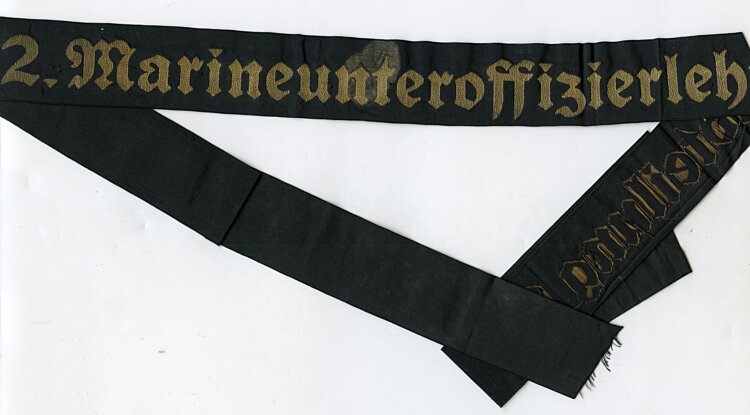
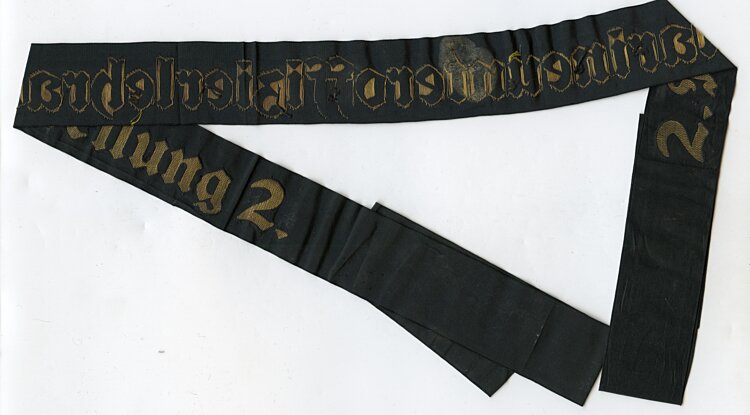
Kriegsmarine Cap Tally "2. Marineunteroffizierlehrabteilung 2."
The cap tally of the 2nd Naval NCO Training Department represents a fascinating testament to the training organization of the Kriegsmarine in the Third Reich. These cap tallies, woven with metal threads, were not merely functional components of the uniform but also important identification markers that denoted affiliation with specific units and training establishments of the German Navy.
The Marine NCO Training Departments (Marineunteroffizierlehrabteilungen) were central training facilities of the Kriegsmarine responsible for the education and further training of non-commissioned officers. These institutions played a crucial role in building and maintaining a professional NCO corps, which functioned as the backbone of the naval forces. The numbering “2” indicates that multiple such training departments existed, conducting education at various locations.
The cap tally itself was a traditional element of naval attire that had been used in the Imperial German Navy and was continued in the Kriegsmarine. These bands were typically made of black fabric and bore the name of the ship, unit, or training establishment in gold or silver letters. The use of metal threads for the lettering was characteristic of this period and testified to the craftsmanship quality of uniform components.
The Kriegsmarine organized its training systematically and thoroughly. According to the Naval Uniform Regulations (Marineuniformvorschrift), cap tallies had to meet certain standards. The bands were worn on the peaked cap or the sailor's cap and were approximately 3 to 4 centimeters wide. The inscription on the band was positioned so it was readable from the front when the band was wrapped around the cap.
Non-commissioned officers in the Kriegsmarine underwent intensive training that included both theoretical and practical elements. The Naval NCO Training Departments offered courses in navigation, weapons technology, leadership, administration, and specialized maritime skills. The duration of training varied depending on specialization but typically lasted several months.
The Kriegsmarine, officially founded in 1935 as the successor to the Reichsmarine, expanded rapidly during the 1930s. This expansion required a massive increase in training capacity. The establishment of multiple Naval NCO Training Departments was part of these efforts to provide qualified personnel for the growing fleet.
The locations of these training departments were usually situated in established naval bases on the Baltic Sea and North Sea. Places such as Kiel, Wilhelmshaven, Stralsund, and Flensburg-Mürwik housed important training facilities of the Kriegsmarine. The precise location of the 2nd Naval NCO Training Department would require detailed archival research.
The condition of this cap tally as “lightly worn” indicates that it was actually used in service. This lends the object historical authenticity and makes it a direct witness to military practice of the time. The preservation of metal thread weaving for over eight decades is remarkable and speaks to the quality of the original manufacture.
For collectors and historians, such cap tallies are important primary sources. They enable the reconstruction of the organizational structure of the Kriegsmarine and help trace the development of individual units. The documentation of these objects contributes to the preservation of historical memory, regardless of the problematic history of the regime that this military organization served.
It is important to emphasize that the Kriegsmarine, like all armed forces of the Third Reich, was part of a criminal system. The scholarly engagement with such objects serves historical education and understanding of this dark period in German history, not its glorification.