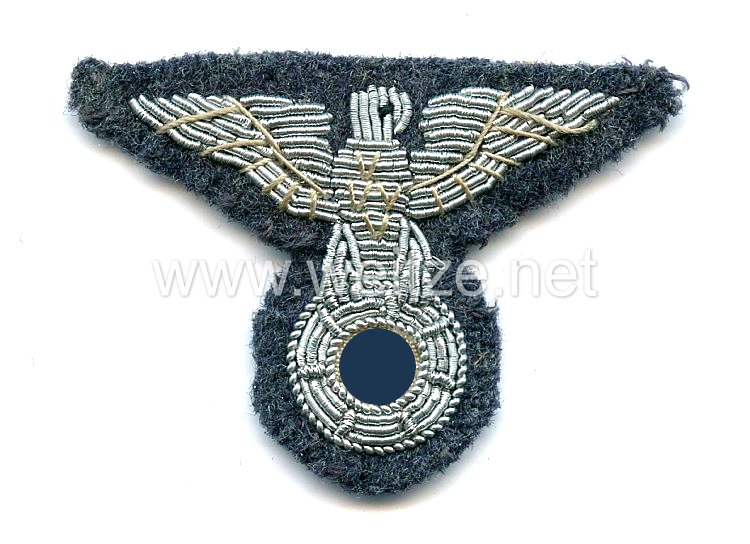
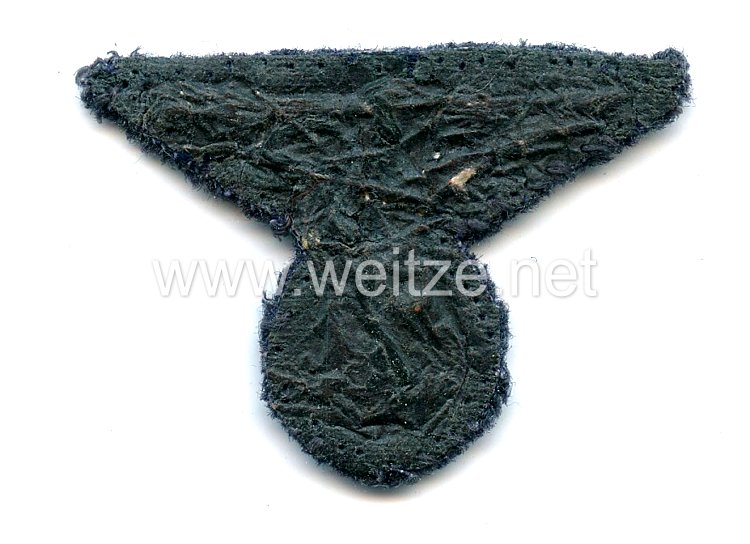
DLV Deutscher Luftsportverband Visor Cap Eagle for Leader
The DLV Deutscher Luftsportverband (German Air Sports Association) Visor Cap Eagle for Leaders represents a significant insignia from the early phase of German aviation history in the 1930s. This hand-embroidered metal thread emblem on Luftwaffe cloth embodies a crucial transitional period in German military and aviation development between the end of the Weimar Republic and the beginning of National Socialist rearmament.
The Deutsche Luftsportverband (DLV) was founded on March 25, 1933, and served as a civilian cover organization for the covert training of air force personnel. Following the Treaty of Versailles in 1919, Germany had been stripped of all military aviation capabilities, and the DLV offered a legal means to preserve and expand aviation personnel and expertise. Under the leadership of Hermann Göring, the association developed into a paramilitary organization with over 300,000 members.
The present execution of the visor cap eagle is particularly noteworthy as it was intended for leadership positions within the DLV. The rank structure of the DLV was already modeled on military precedents and encompassed various leadership levels from group leaders to higher staff positions. The eagle insignia was worn on the visor cap and identified the wearer as a member of this important pre-military organization.
The hand-embroidered metal thread execution was characteristic of higher-quality uniform pieces. This manufacturing technique required considerable craftsmanship and was significantly more elaborate than machine-made or printed variants. The use of metal threads, typically made from aluminum or silvered wire, created a characteristic luster and visually distinguished the wearers. Embroidery on Luftwaffe cloth, a light blue or gray backing material, became the standard for many aviation insignia of this era.
The symbolism of the eagle had a long history in German military tradition. The rightward-facing eagle with spread wings symbolized power, strength, and sovereignty. In the context of the DLV and later the Luftwaffe, the eagle was often combined with the swastika, which clarified the ideological orientation of the organization. The stylistic design of these eagles followed specific guidelines regarding proportions, feather rendering, and overall appearance.
The DLV existed as an independent organization until 1937, when it was dissolved with the founding of the National Socialist Flying Corps (NSFK) on April 17, 1937. Many DLV members were directly absorbed into the now openly existing Luftwaffe, which had already been officially established on February 26, 1935. The uniforms, insignia, and rank structures of the DLV formed important precursors to later Luftwaffe uniforming.
The slight oxidation of the present piece is typical for metal thread embroideries of this period. The materials used reacted over time to moisture and atmospheric oxygen, resulting in characteristic discolorations. This aging process is actually desirable among collectors, as it confirms the authenticity and age of the object.
From a military-historical perspective, such insignia document Germany's systematic preparation for aerial warfare despite international prohibitions. The DLV trained thousands of pilots, navigators, and technical personnel who later formed the core of the Luftwaffe. The organization maintained flight schools, glider groups, and technical training facilities throughout the German Reich.
Collectors and military historians today value DLV insignia as important testimonies of a brief but significant transitional period. The quality of manufacture, state of preservation, and provenance determine the historical and collector value of such objects. Hand-embroidered versions for leadership positions are rarer than simpler enlisted ranks versions.
The present visor cap eagle specimen thus represents not only a military rank insignia but also a piece of German aviation history that documents the development from civilian cover organization to full-fledged air force and provides insight into the uniform technical and craftsmanship standards of the 1930s.