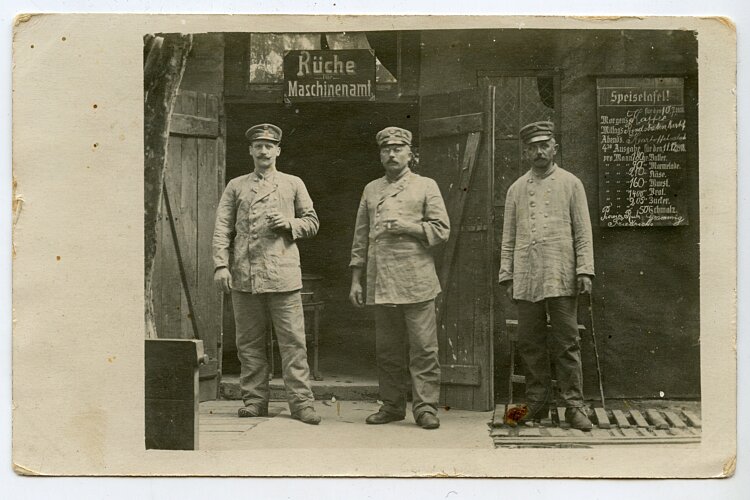
World War I Photograph: Soldiers in the Rear Area Kitchen for Machine Department
This historical photograph from World War I documents a significant yet often overlooked aspect of warfare: the organization of supply services in the rear areas. The image shows soldiers at a kitchen specifically established for a Machine Department, offering valuable insight into the logistical challenges faced by German forces between 1914 and 1918.
The term Etappe (rear area) in German military terminology referred to the zone behind the front lines where supply facilities, hospitals, depots, and administrative units were located. Unlike combat troops at the front, Etappentruppen (rear area troops) were responsible for maintaining supply lines and infrastructure. The organization of the Etappe was regulated by the Etappeninspektion (Rear Area Inspection), which reported directly to army high commands.
Feeding the troops during World War I presented an enormous logistical challenge. Several million soldiers required daily provisioning, with field kitchens and stationary cooking facilities playing a central role. German military authorities developed detailed supply regulations that governed rations, preparation methods, and distribution systems. The Heeresverpflegungsordnung (Army Supply Regulation) stipulated that each soldier was entitled to specific daily quantities of bread, meat, fat, vegetables, and other foodstuffs.
The Maschinenamt (Machine Department) mentioned in this photograph likely refers to a technical unit, possibly connected with aircraft, motor vehicles, or other mechanical equipment. During World War I, the mechanization of warfare became increasingly important. The air forces, motor transport troops, and other technical units required specialized personnel and corresponding support structures. These units were frequently stationed in the rear areas, where maintenance and repair work was conducted.
Kitchens in the Etappe were often permanently installed facilities that, unlike the mobile field kitchens (Gulaschkanonen) at the front, could prepare larger quantities of food for stationed troops. These kitchen facilities had better equipment and could produce more varied meals than field kitchens directly at the front. Soldiers in the rear areas generally enjoyed better provisioning conditions than their comrades in the trenches.
Photographic documentation of daily war life was widespread during World War I. Many soldiers carried their own cameras or used the services of professional war photographers. Photographs were frequently produced in postcard format, like this specimen, as they were easy to send and served as mementos. These field postcards were an important means of communication between front and home and today document valuable details of wartime daily life.
The supply situation deteriorated dramatically as the war progressed. The Allied naval blockade against Germany led to significant supply shortages. The Turnip Winter of 1916/17 marked a low point when food scarcity affected both the civilian population and the armed forces. Daily rations were repeatedly reduced, and substitutes had to be used. Nevertheless, military administration attempted to maintain troop morale through the most reliable provisioning possible.
Historical photographs such as this one are today important sources for military history research. They document not only the material culture of war but also the social aspects of soldier life. The depiction of soldiers engaged in everyday activities such as food distribution conveys a more realistic picture of war than heroic battle scenes. These images show that war largely consisted of routines, waiting, and organizational tasks.
The preservation of such documents in collectible condition is of great importance for historical research. They enable subsequent generations to understand the reality of World War I beyond the great battles and to comprehend the experiences of ordinary soldiers.