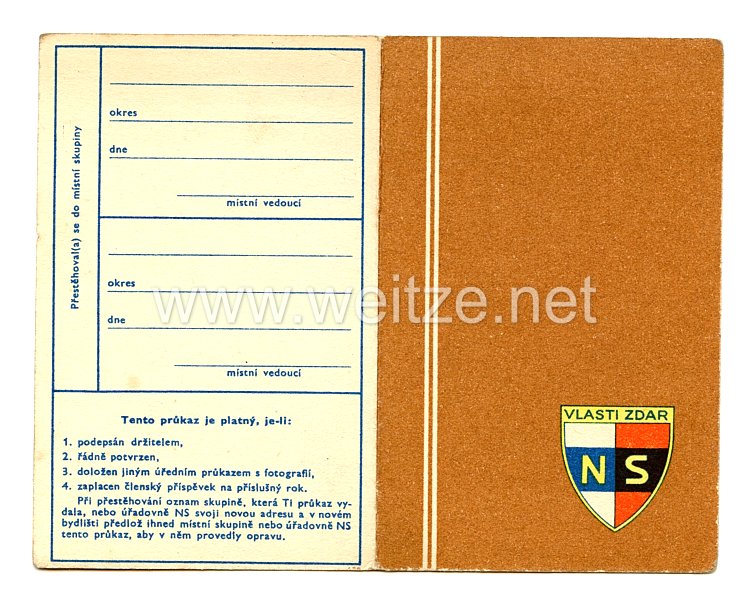
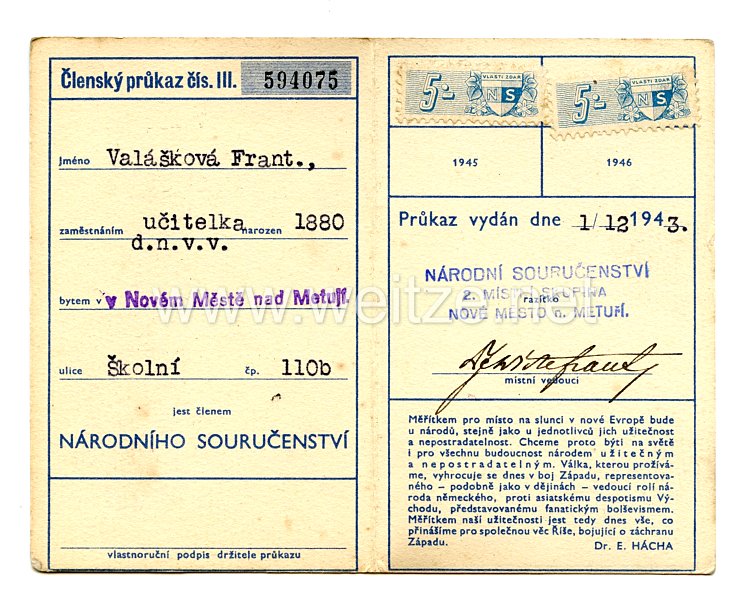
Third Reich - Czechoslovakia - Narodni Sourucenstvi (NS) - Membership Card for a Man Born in 1880

issued on December 1, 1943, with membership dues stamps for 1943 and 1944, used condition.
Vlasti Zdar = Everything for the Fatherland
Národní souručenství (NS), German approximately “National Community,” was during the existence of the Protectorate of Bohemia and Moravia on the partial territory of the former Czechoslovakia the only political party-like organization. (Czech NSDAP)
411206
60,00

Third Reich - Czechoslovakia - Narodni Sourucenstvi (NS) - Membership Card for a Man Born in 1880

Membership Card of the Národní souručenství in the Protectorate of Bohemia and Moravia

This membership card documents a significant chapter in Czech history during the German occupation from 1939 to 1945. The document, issued on December 1, 1943, to a man born in 1880, represents membership in the Národní souručenství (NS), the only permitted political organization in the Protectorate of Bohemia and Moravia.

Following the destruction of the remaining Czech lands on March 15, 1939, Nazi Germany established the Protectorate of Bohemia and Moravia as a subordinate territory of the German Reich. The political landscape was radically transformed, and all existing political parties were dissolved. In their place came the establishment of the Národní souručenství on March 3, 1939, even before the official annexation, through a decree by State President Emil Hácha.

The Národní souručenství, which translates roughly as “National Community” or “National Solidarity,” was conceived as a party-like unified organization following the model of fascist and National Socialist mass organizations. The slogan “Vlasti Zdar” (Everything for the Fatherland) on the card underscores the propagandistic character of the organization. Despite outward similarities to the NSDAP, the NS was a Czech organization that attempted to walk a tightrope between collaboration and national survival under German supervision.

The leadership of the Národní souručenství initially rested with various Protectorate governments. The organization was theoretically meant to unite all Czechs and serve as a link between the Protectorate administration and the population. In practice, it developed into a bureaucratic apparatus that exercised control over social life while attempting to maintain some room for Czech interests.

This card with membership stamps for 1943 and 1944 demonstrates its holder's continuous membership during the final war years. The membership stamps were a common procedure for documenting regular membership dues and simultaneously served to financially support the organization. For a man born in 1880, who was already 63 years old at the time of issuance, membership likely represented a necessity for securing his professional and personal position in the Protectorate.

Membership in the Národní souručenství was formally voluntary, but in practice often necessary for civil servants, teachers, and others employed in public service. The organization controlled various aspects of public life, from labor placement to cultural activities. Those who were not members could suffer considerable disadvantages in their professional and daily lives.

The historical assessment of the Národní souručenství remains complex and controversial. On one hand, it was undoubtedly part of the collaboration apparatus with the German occupation forces. On the other hand, some historians argue that under the given circumstances, it attempted to prevent the total loss of Czech autonomy and offered some protection for the Czech population. This ambivalent position reflects the difficult situation of Czech society under German rule.

After the liberation of Czechoslovakia in May 1945, the Národní souručenství was dissolved, and its leading members had to partially answer before the courts. The organization was viewed as an instrument of the occupation power, although the extent of individual guilt of its members was evaluated differently. Simple memberships, such as documented by this card, were generally understood as forced or pragmatic adaptation to circumstances.

Today, such documents are important historical sources that provide insight into the everyday history of the Protectorate. They document the bureaucratic structures of occupation rule and the difficult decisions facing the Czech population. The used condition of this card underscores its authentic use and makes it a tangible witness to a dark era in Czech history.

r