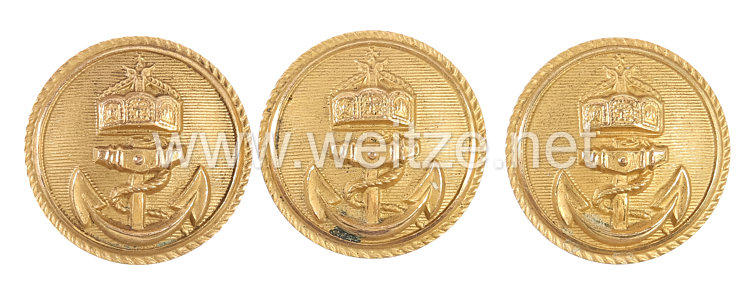
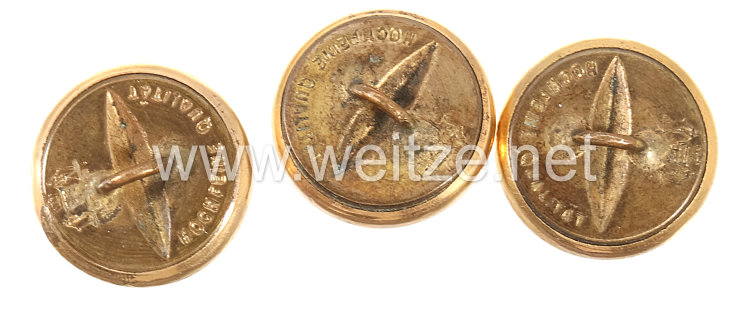
Imperial German Navy Button for Officers

gilt-finished version circa 1910, 20 mm, lightly worn, condition 2.
PRICE PER PIECE:


369205
20,00

Imperial German Navy Button for Officers

This officer's button of the Imperial German Navy from around 1910 represents a significant element of military uniform regulations of the German Empire. With a diameter of 20 mm, this gilded button was part of the standard equipment of officer uniforms and embodied the strict hierarchy and sense of tradition of the imperial naval forces.

Historical Background of the Imperial Navy

The Kaiserliche Marine (Imperial Navy) was established in 1871 with the founding of the German Empire as a unified naval force. Under Kaiser Wilhelm II, who ascended to the throne in 1888, the navy experienced unprecedented expansion. The Kaiser, himself an enthusiastic naval advocate, initiated an ambitious fleet construction program that was legally anchored through the Naval Laws of 1898 and 1900 under State Secretary Alfred von Tirpitz. This policy aimed to make Germany the second-largest naval power after Great Britain.

Uniform Regulations and Rank Insignia

The uniforming of the Imperial Navy was regulated by detailed provisions set forth in the Anzugsordnung für die Kaiserliche Marine (Dress Regulations for the Imperial Navy). These regulations specified precisely which buttons, badges, and decorations were to be worn by different ranks and on different uniform parts. For officers, the use of gilded buttons was mandatory, while enlisted men and non-commissioned officers wore buttons made from other materials.

Manufacturing and Materials

Officers' buttons were manufactured from brass or bronze and subsequently gilded. The gilding process was accomplished either through fire gilding or later through galvanic methods. The production process required high craftsmanship precision, as the naval emblem – typically the Imperial Eagle with anchor or the Imperial Crown with maritime symbols – had to be clearly recognizable. Various manufacturers throughout the German Empire, particularly in Berlin, Hamburg, and Lübeck, specialized in producing military equipment.

Symbolism and Design

The design of naval buttons followed strict iconographic guidelines. The central motif combined monarchical and maritime elements: the eagle as a symbol of the Empire and Kaisertum, combined with anchors, ropes, or other nautical attributes. This symbolism underscored the navy's claim as an instrument of imperial power and German world policy. The 20 mm size was standardized for certain uniform parts, with larger buttons used for coats and smaller ones for vests.

The Navy Around 1910

The year 1910 marks a high point in the development of the Imperial Navy. At this time, the fleet comprised modern Dreadnought battleships, cruisers, and torpedo boats. The officer corps was highly professional and enjoyed considerable social prestige. Naval officers were recruited predominantly from the nobility and upper middle class and underwent demanding training at the Naval Academy Mürwik in Flensburg and on training ships.

Wearing Style and Uniform Variants

Officers of the Imperial Navy wore various uniform variants: the dark blue Waffenrock (dress coat) for formal occasions, the service uniform for daily duty, and the white tropical uniform for overseas stations. Buttons were to be attached to jackets, vests, and coats, with their number and arrangement varying according to uniform part and rank. The gilded buttons had to be maintained in impeccable condition, reflecting the discipline and esprit de corps of the officers.

Preservation and Collector's Value

Today, original buttons from the Imperial Navy are sought-after collector's items. The condition is evaluated on a scale, with “Condition 2” indicating slight signs of wear – typical for worn uniform items. The gilding may show signs of deterioration from decades of storage or wearing time, which however underscores the historical authenticity. Such objects are important testimonies to German naval history and the Wilhelmine era.

Historical Significance

These seemingly insignificant buttons are material witnesses to an era characterized by imperial ambitions, technological progress, and increasing international tensions. They recall the time before World War I, when the Imperial Navy was a central element of German world power policy and simultaneously contributed to the naval arms race that led Europe into war. Each button represents not just a functional uniform component, but a piece of the complex political, social, and military fabric of Imperial Germany.

The officer who wore this button around 1910 would have been part of an elite military establishment that saw itself as the embodiment of German naval prowess and imperial prestige, serving aboard vessels that represented the cutting edge of naval technology and participating in a global strategy that would ultimately help shape the course of twentieth-century history.